
9 Unique Cultural and Natural Experiences
Explore the traditions, landscapes, and hidden treasures that define Puerto Rico
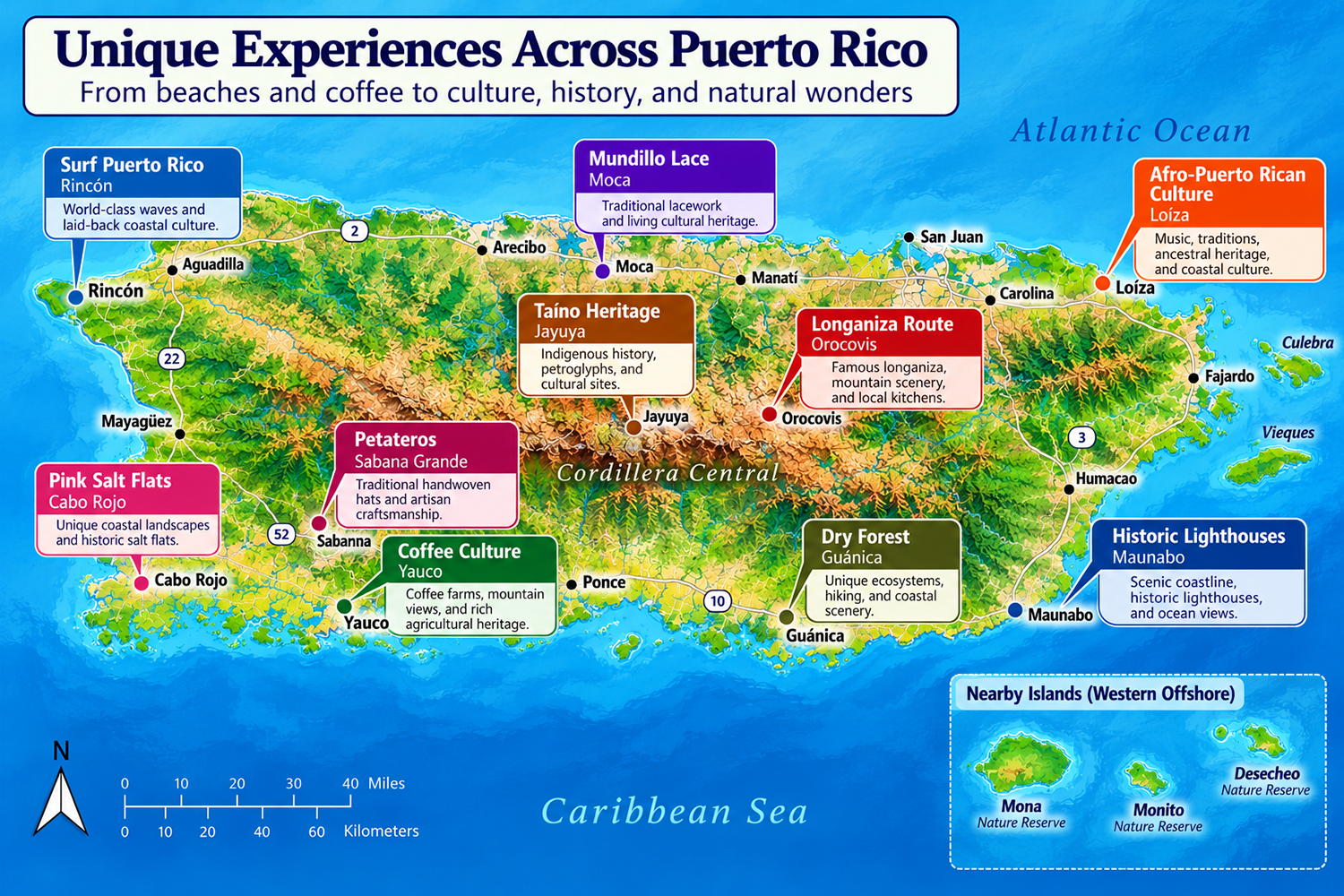
Puerto Rico is much more than beautiful beaches and tropical scenery. Beyond its most famous attractions lies a rich collection of traditions, landscapes, and cultural experiences that tell the story of the island and its people.
From the coffee-growing mountains of Yauco and the Taíno heritage of Jayuya to the traditional lacework of Moca and the Afro-Puerto Rican rhythms of Loíza, every region has something distinctive to discover.
Explore the island's dry forests, historic lighthouses, traditional foods, and centuries-old crafts through nine destinations that celebrate Puerto Rico's identity.
These experiences invite you to explore beyond the usual tourist routes and discover the stories that make each place special.
Explore 9 Unique Experiences
Puerto Rico's Cultural and Natural Treasures at a Glance
From traditional crafts and regional foods to historic landmarks and extraordinary landscapes, these nine destinations showcase the diversity of Puerto Rico's cultural and natural heritage.
| Experience | Municipality | Region | What Makes It Special |
|---|---|---|---|
| Coffee Culture | Yauco | Southwest | Historic coffee-growing traditions and mountain landscapes |
| Dry Forest | Guánica | Southwest | Rare tropical dry forest and distinctive biodiversity |
| Longaniza Route | Orocovis | Central Mountains | Traditional Puerto Rican sausage and mountain cuisine |
| Petateros | Sabana Grande | Southwest | Traditional weaving and handmade petates |
| Mundillo Lace | Moca | Northwest | Intricate handmade bobbin lace |
| Taíno Heritage | Jayuya | Central Mountains | Indigenous history, archaeological sites, and cultural heritage |
| Pink Salt Flats | Cabo Rojo | Southwest | Salt lagoons, coastal wildlife, and dramatic scenery |
| Historic Lighthouses | Maunabo | Southeast | Punta Tuna Lighthouse and Puerto Rico's maritime history |
| Afro-Puerto Rican Culture | Loíza | Northeast | Bomba music, traditional festivals, and African cultural heritage |
Nine Unique Experiences Across Puerto Rico
From mountain coffee plantations and traditional crafts to Indigenous heritage and Afro-Puerto Rican celebrations, these nine destinations reveal the traditions, landscapes, and cultural treasures that make Puerto Rico unique.
1. Coffee Culture — Yauco
Discover Puerto Rico's Coffee-Growing Heritage
Nestled in Puerto Rico's southwestern mountains, Yauco has long been associated with the island's coffee-growing heritage. Its fertile mountain landscapes and agricultural traditions helped establish Puerto Rican coffee as an important export during the nineteenth century.
Coffee cultivation remains an important part of Yauco's cultural identity, connecting generations of farmers, families, and local communities.
Visitors can explore the region's mountain scenery, learn about traditional coffee cultivation, and discover the history behind one of Puerto Rico's most recognizable agricultural products.
What Makes Yauco Special
- Historic coffee-growing traditions and mountain landscapes.
- Connections to Puerto Rico's nineteenth-century coffee industry.
- Coffee-related cultural experiences and local cafés.
- The colorful urban artwork of Yaucromatic in the town center.
Did You Know? Yauco is often called El Pueblo del Café (The Coffee Town), reflecting its long association with Puerto Rico's coffee industry.
Local Tip: Combine a visit to Yauco's historic town center with a drive through the surrounding coffee-growing mountains. Confirm farm-tour availability in advance.
Explore More: Yauco · Puerto Rican Coffee · Puerto Rico's Agriculture
2. Guánica Dry Forest — Guánica
Explore One of the Caribbean's Most Important Dry Forests
The Guánica State Forest, commonly known as Bosque Seco de Guánica, protects one of the Caribbean's most significant subtropical dry forest ecosystems.
Unlike Puerto Rico's lush tropical rainforests, Guánica's landscape is shaped by limited rainfall, rocky terrain, drought-adapted vegetation, and seasonal changes.
The forest contains a remarkable variety of plant communities, including cacti, dry woodland, coastal vegetation, and other species adapted to the region's climate.
Designated a UNESCO Biosphere Reserve in 1981, Guánica Dry Forest is an important destination for understanding Puerto Rico's ecological diversity.
What Makes Guánica Special
- Subtropical dry forest with drought-adapted vegetation.
- Hiking trails through distinctive coastal and inland landscapes.
- Important habitats for native and migratory birds.
- A striking contrast with El Yunque's tropical rainforest.
Did You Know? Puerto Rico contains both tropical rainforest and tropical dry forest ecosystems, despite its relatively small geographic size.
Local Tip: Visit early in the morning, bring plenty of water, and wear sun protection. The forest can become extremely hot, especially during midday.
Explore More: Guánica · Puerto Rico's Forests · Natural Reserves
3. The Longaniza Route — Orocovis
Taste One of Puerto Rico's Favorite Mountain Traditions
Located in Puerto Rico's central mountains, Orocovis is widely recognized for its traditional longaniza, a seasoned sausage that has become an important part of the municipality's culinary identity.
Longaniza is typically prepared using pork and a blend of seasonings, although recipes vary among producers and restaurants.
The region's popular Ruta de la Longaniza (Longaniza Route) highlights local restaurants and food establishments where visitors can enjoy this traditional specialty.
Beyond its food, Orocovis offers scenic mountain roads, rural landscapes, and opportunities to experience Puerto Rico's interior.
What Makes Orocovis Special
- Traditional Puerto Rican longaniza.
- Family-owned restaurants and local culinary traditions.
- Scenic mountain drives through the Cordillera Central.
- Regional food festivals and community celebrations.
Did You Know? Orocovis is often called El Corazón de Puerto Rico (The Heart of Puerto Rico), a reference to its central location.
Local Tip: Try longaniza with traditional sides such as arroz con gandules, tostones, or mofongo. Recipes and seasonings vary by restaurant.
Explore More: Orocovis · Puerto Rican Food · Cordillera Central
4. Petateros — Sabana Grande
Discover the Art of Traditional Mat Weaving
Sabana Grande is associated with the traditional craft of petatería, the weaving of mats known as petates from plant fibers.
Historically, these handmade mats served practical purposes in Puerto Rican households, including sleeping, sitting, and other everyday activities.
The artisans who created them were known as petateros.
Although traditional mat weaving has declined with changing lifestyles and manufacturing methods, the craft remains an important part of Sabana Grande's cultural identity.
What Makes Sabana Grande Special
- Traditional weaving techniques passed through generations.
- Handmade mats produced from natural plant materials.
- Connections to Puerto Rico's rural domestic traditions.
- Preservation of local craftsmanship and cultural heritage.
Did You Know? Sabana Grande is known as El Pueblo de los Petateros, recognizing its historical connection to traditional mat weaving.
Local Tip: Look for local cultural events or artisan demonstrations that feature traditional Puerto Rican crafts. Regular demonstrations may not always be available.
Explore More: Sabana Grande · Puerto Rican Crafts · Traditional Arts
5. Mundillo Lace — Moca
Experience Puerto Rico's Delicate Bobbin Lace Tradition
The northwestern municipality of Moca is famous for mundillo, a traditional form of handmade bobbin lace.
The craft involves carefully crossing and twisting threads wound around small wooden bobbins to create intricate decorative patterns.
Mundillo has been used to embellish clothing, household linens, and ceremonial garments, and it remains one of Puerto Rico's most recognizable textile traditions.
Moca has played an important role in preserving and celebrating this delicate craft.
What Makes Moca Special
- Intricate handmade bobbin lace.
- Traditional textile techniques requiring patience and precision.
- Cultural events celebrating mundillo artisans.
- A craft closely associated with the municipality's identity.
Did You Know? Moca is known as La Capital del Mundillo, reflecting its importance in preserving Puerto Rico's bobbin lace tradition.
Local Tip: Check for local craft festivals, workshops, or artisan demonstrations to see how mundillo lace is made.
Explore More: Moca · Puerto Rican Arts and Crafts
6. Taíno Heritage — Jayuya
Explore Puerto Rico's Indigenous History
Deep in Puerto Rico's central mountains, Jayuya is closely associated with the island's Taíno heritage.
The municipality preserves important connections to the Indigenous peoples who inhabited Puerto Rico before European colonization.
Among its best-known cultural landmarks are the Museo El Cemí, whose architecture resembles a three-pointed Taíno ceremonial object, and Piedra Escrita, a large rock containing Indigenous petroglyphs.
These sites help visitors understand the artistic, spiritual, and cultural traditions of Puerto Rico's Indigenous past.
Taíno heritage also remains present in Puerto Rican language, food, place names, and contemporary cultural identity.
What Makes Jayuya Special
- Indigenous archaeological sites and petroglyphs.
- Museo El Cemí and Taíno cultural interpretation.
- Mountain scenery and rural traditions.
- Connections to Puerto Rico's Indigenous history.
Did You Know? Many familiar Puerto Rican words, including hamaca, huracán, and barbacoa, have Indigenous Caribbean origins.
Local Tip: Visit Piedra Escrita and Museo El Cemí together to experience both archaeological heritage and cultural interpretation. Check museum hours before visiting.
Explore More: Jayuya · Taíno Culture
7. Pink Salt Flats — Cabo Rojo
Discover a Colorful Coastal Landscape
The Cabo Rojo Salt Flats, known as Las Salinas de Cabo Rojo, are among Puerto Rico's most distinctive coastal landscapes.
Located near the southwestern tip of the island, the salt flats are known for their shallow evaporation ponds, which can develop shades of pink and reddish-orange under certain environmental conditions.
The colors are associated with salt-loving microorganisms and other biological processes in highly saline water.
The surrounding area is also important for migratory birds and coastal wildlife.
Nearby, the Los Morrillos Lighthouse stands above dramatic limestone cliffs overlooking the Caribbean Sea.
What Makes Cabo Rojo Special
- Salt ponds that can appear pink or reddish.
- Important coastal habitats for migratory birds.
- Dramatic limestone cliffs and panoramic ocean views.
- The historic Los Morrillos Lighthouse.
Did You Know? The salt flats are part of a landscape shaped by both natural coastal processes and a long history of salt production.
Local Tip: The ponds are not always bright pink. Their appearance changes with salinity, weather, water levels, and lighting conditions.
Explore More: Cabo Rojo · Puerto Rico's Lighthouses · Natural Reserves
8. Historic Lighthouses — Maunabo
Discover Puerto Rico's Maritime Heritage
On Puerto Rico's southeastern coast, Maunabo is home to the historic Punta Tuna Lighthouse, one of the island's notable maritime landmarks.
Constructed during the Spanish colonial period and first illuminated in 1892, the lighthouse helped guide vessels navigating the waters near Puerto Rico's southeastern coastline.
Its distinctive architecture and coastal setting reflect the importance of maritime navigation in the island's history.
The lighthouse stands near a scenic stretch of coastline where visitors can appreciate views of the sea and surrounding landscape.
What Makes Maunabo Special
- Historic Spanish colonial lighthouse architecture.
- Coastal scenery and panoramic ocean views.
- Connections to nineteenth-century maritime navigation.
- A quieter destination along Puerto Rico's southeastern coast.
Did You Know? Puerto Rico's historic lighthouse network was developed primarily during the nineteenth century to improve navigation around the island's coastline.
Local Tip: Check current access and visiting hours before traveling. Even when the lighthouse interior is closed, the surrounding coastal scenery may be worth exploring where public access is permitted.
Explore More: Maunabo · Puerto Rico's Historic Lighthouses · Puerto Rico's History
9. Afro-Puerto Rican Culture — Loíza
Experience the Rhythms and Traditions of Puerto Rico's African Heritage
Located along Puerto Rico's northeastern coast, Loíza is one of the island's most important centers of Afro-Puerto Rican cultural heritage.
The municipality is celebrated for its contributions to bomba, a traditional music and dance form deeply connected to Puerto Rico's African heritage.
Loíza is also known for its colorful vejigante masks, traditional festivals, and community celebrations that reflect centuries of cultural expression.
The Fiestas Tradicionales de Santiago Apóstol are among the municipality's best-known celebrations, featuring music, costumes, processions, and traditional performances.
What Makes Loíza Special
- Bomba music, drumming, and dance.
- Traditional vejigante masks made from coconut shells.
- The Fiestas Tradicionales de Santiago Apóstol.
- A rich Afro-Puerto Rican cultural identity.
Did You Know? In bomba, the lead drum responds to the dancer's movements, creating a dynamic musical conversation between dancer and drummer.
Local Tip: For a meaningful cultural experience, seek out community-led bomba performances, workshops, or cultural events that support local artists.
Explore More: Loíza · >Bomba and Plena · Puerto Rican Festivals
Plan Your Cultural Journey
These nine destinations are spread across Puerto Rico, offering opportunities to discover the island's cultural traditions, natural landscapes, historic landmarks, and regional cuisine.
While visiting all nine destinations is possible during a multi-day trip, grouping nearby attractions into regional excursions can help reduce travel time and create a more enjoyable experience.
Explore Puerto Rico by Region
| Region | Suggested Destinations | Experience |
|---|---|---|
| Southwest | Yauco, Guánica, Cabo Rojo, Sabana Grande | Discover coffee-growing traditions, explore tropical dry forests, visit colorful salt flats, and learn about traditional mat weaving. |
| Central Mountains | Orocovis, Jayuya | Enjoy traditional mountain cuisine, explore Taíno heritage, and experience the scenic landscapes of the Cordillera Central. |
| Northwest | Moca | Discover the traditional art of mundillo lace and Puerto Rico's artisan heritage. |
| Southeast | Maunabo | Explore the historic Punta Tuna Lighthouse and enjoy Puerto Rico's southeastern coastal scenery. |
| Northeast | Loíza | Experience Afro-Puerto Rican cultural traditions, bomba music, vejigante masks, and local festivals. |
Travel Tips for Exploring Puerto Rico
Allow Time for Mountain Roads: Puerto Rico's interior routes can be winding and slower than coastal highways. Plan additional travel time when visiting Orocovis, Jayuya, and Yauco's mountain communities.
Check Visiting Hours: Museums, historic sites, artisan workshops, and cultural attractions may have limited operating schedules. Confirm hours and availability before traveling.
Respect Cultural Traditions: When attending community celebrations, cultural performances, or artisan demonstrations, follow local guidance and support local artists.
Prepare for Different Climates: Puerto Rico's landscapes vary considerably. Mountain destinations may experience cooler temperatures and rain, while coastal areas such as Cabo Rojo and Guánica can be particularly hot and dry.
Explore Beyond the Attractions: Take time to visit local cafés, restaurants, markets, and historic town centers. These experiences offer additional opportunities to discover the character and traditions of each municipality.
Local Tip
Don't try to see everything in one day. Puerto Rico may be relatively small, but its mountain roads, coastal routes, and diverse attractions deserve time to explore.
Consider planning separate regional day trips or an extended road trip that allows you to experience local food, cultural landmarks, and natural scenery without rushing.
Frequently Asked Questions
What are some unique cultural experiences in Puerto Rico?
Puerto Rico offers distinctive cultural experiences such as exploring coffee traditions in Yauco, tasting longaniza in Orocovis, discovering mundillo lace in Moca, learning about Taíno heritage in Jayuya, and experiencing bomba music in Loíza.
Where can I learn about Puerto Rico's coffee culture?
Yauco is one of Puerto Rico's historic coffee-growing municipalities. Visitors can explore its mountain landscapes, coffee heritage, and local establishments associated with the region's agricultural traditions.
What is the Longaniza Route in Puerto Rico?
The Longaniza Route is a culinary experience associated with Orocovis, where local restaurants specialize in traditional Puerto Rican longaniza and other mountain-style dishes.
Where can I see traditional Puerto Rican crafts?
Moca is known for handmade mundillo lace, while Sabana Grande is historically associated with petateros, artisans who weave traditional mats from natural plant materials.
Where can I learn about Taíno heritage in Puerto Rico?
Jayuya is an important destination for exploring Puerto Rico's Indigenous heritage. Notable sites include Museo El Cemí and Piedra Escrita, which contains Indigenous petroglyphs.
Where are Puerto Rico's pink salt flats?
The Cabo Rojo Salt Flats are located in southwestern Puerto Rico. Their shallow salt ponds can appear pink or reddish under certain environmental conditions.
What is Loíza known for?
Loíza is known for its Afro-Puerto Rican cultural heritage, particularly bomba music and dance, traditional vejigante masks, and the Fiestas Tradicionales de Santiago Apóstol.
Can I visit all nine destinations in one trip?
Yes, but visiting all nine destinations is best planned as a multi-day road trip. Grouping destinations by region helps reduce travel time and allows more opportunities to experience local culture and attractions.
Did You Know?
Loíza's Fiestas de Santiago Apóstol is Puerto Rico's oldest African heritage celebration, dating to the 18th century.
Get Our Newsletter
Discover new places, local flavors, upcoming events, cultural stories, and some of our favorite finds from around the island.Read the Latest ¡La Isla! Newsletter
Follow Along


