Parks & Scenic Spots
Old San Juan offers several peaceful spaces to relax and take in the views
Parque de las Palomas (Pigeon Park)
Located near the Paseo de la Princesa,
next to Capilla del Cristo at the end of Cristo Street.
This park overlooks the restored La Princesa Jail, now a
government office with an attractive art gallery. It is the perfect spot
from which to enjoy a magnificent view of the harbor, city and mountains. It is also a great choice for families
with small children; kids will enjoy interacting with the local pigeons.
Luis Muñoz Rivera Park
This park is an spacious ocean side park with
large trees, landscape gardens and wide walks, located on Jesús T.
Piñero Avenue. Open Tues-Sun 9:00am - 5:00pm.
Other parks include: Martí Coll Linera Park, and Central Park
(with facilities for jogging, baseball, calisthenics and tennis).
Forts
Old San Juan's fortifications are among the most impressive in the Americas.
El Morro
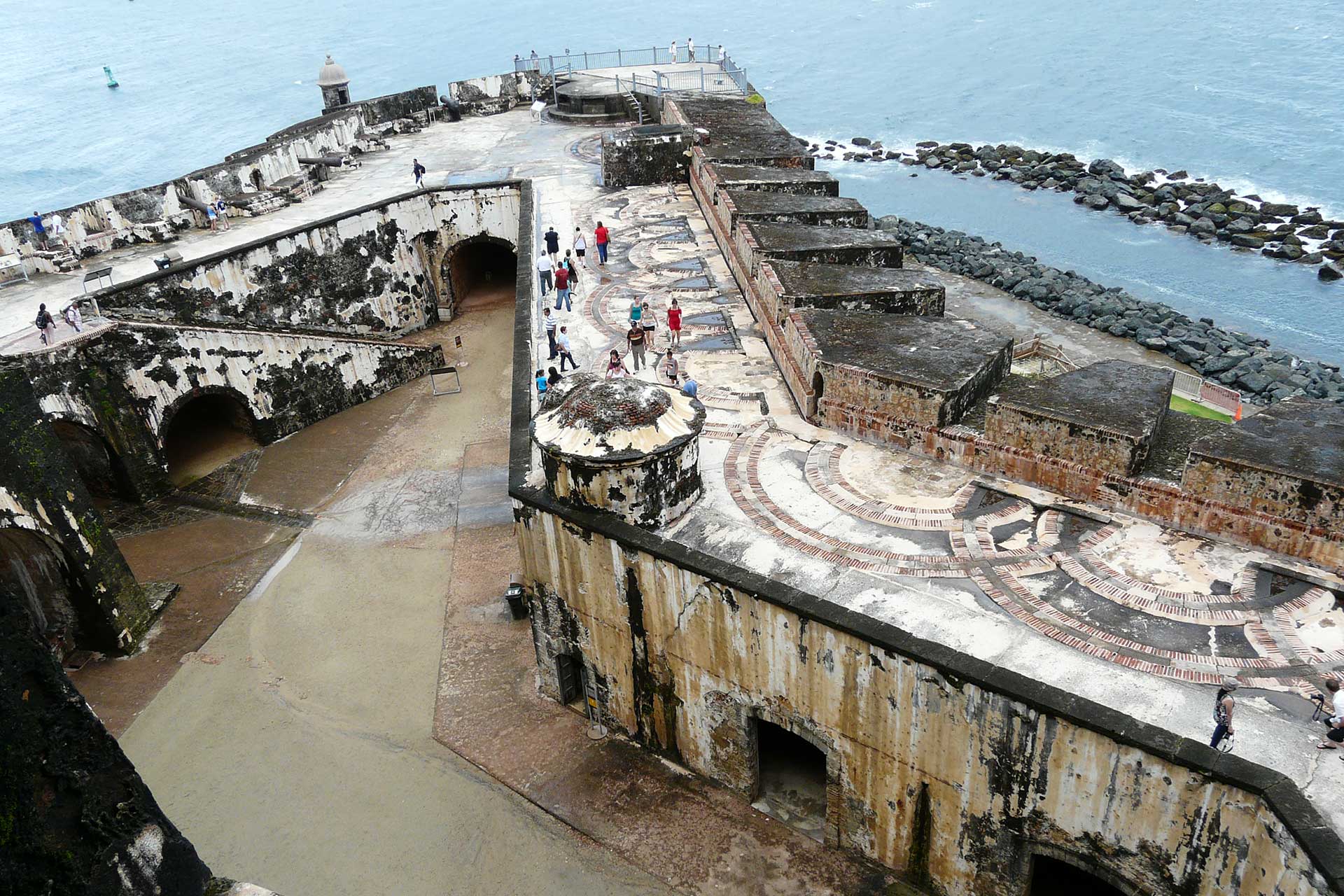
El Morro
San Felipe del Morro was named in honor of King Phillip II, commonly known as
El Morro, is a 16th-century citadel.
The word itself sounds powerful and this six-level fortress certainly is. The construction
of the Castillo San Felipe del Morro began in 1540 when King Charles V of Spain
authorized its construction, including the surrounding walls and completed in 1589.
Most of the walls in the fort today were added later, in a period of
tremendous construction from the 1760's-1780's. Rising 140 feet above the
sea, its 18-foot-thick wall proved a formidable defense. It fell only
once, in 1598, to a land assault by the Earl of Cumberland's forces. The
fort is a maze of tunnels, dungeons, barracks, outposts and ramps. El
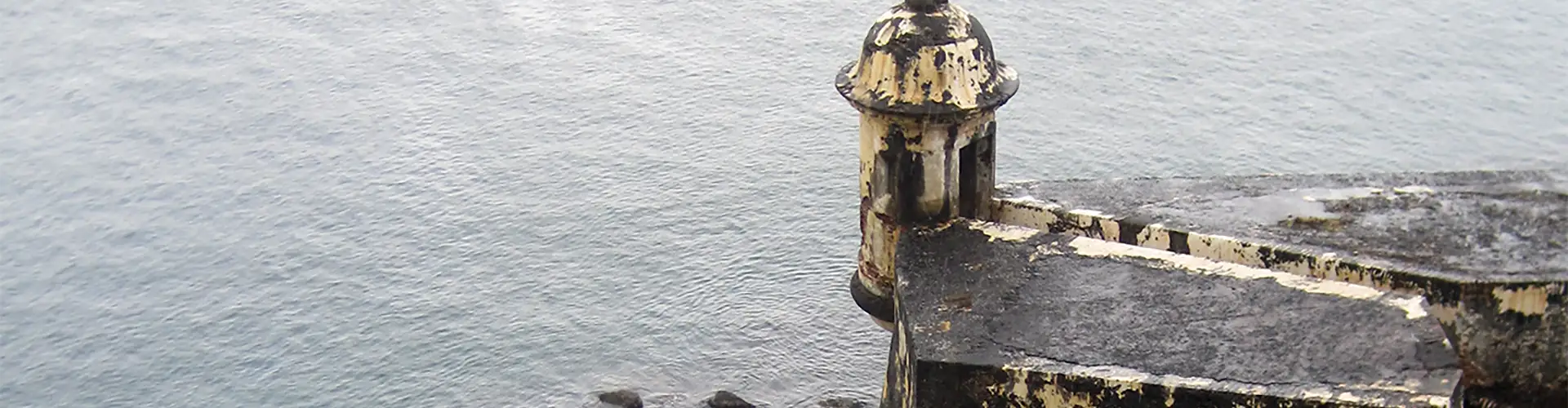
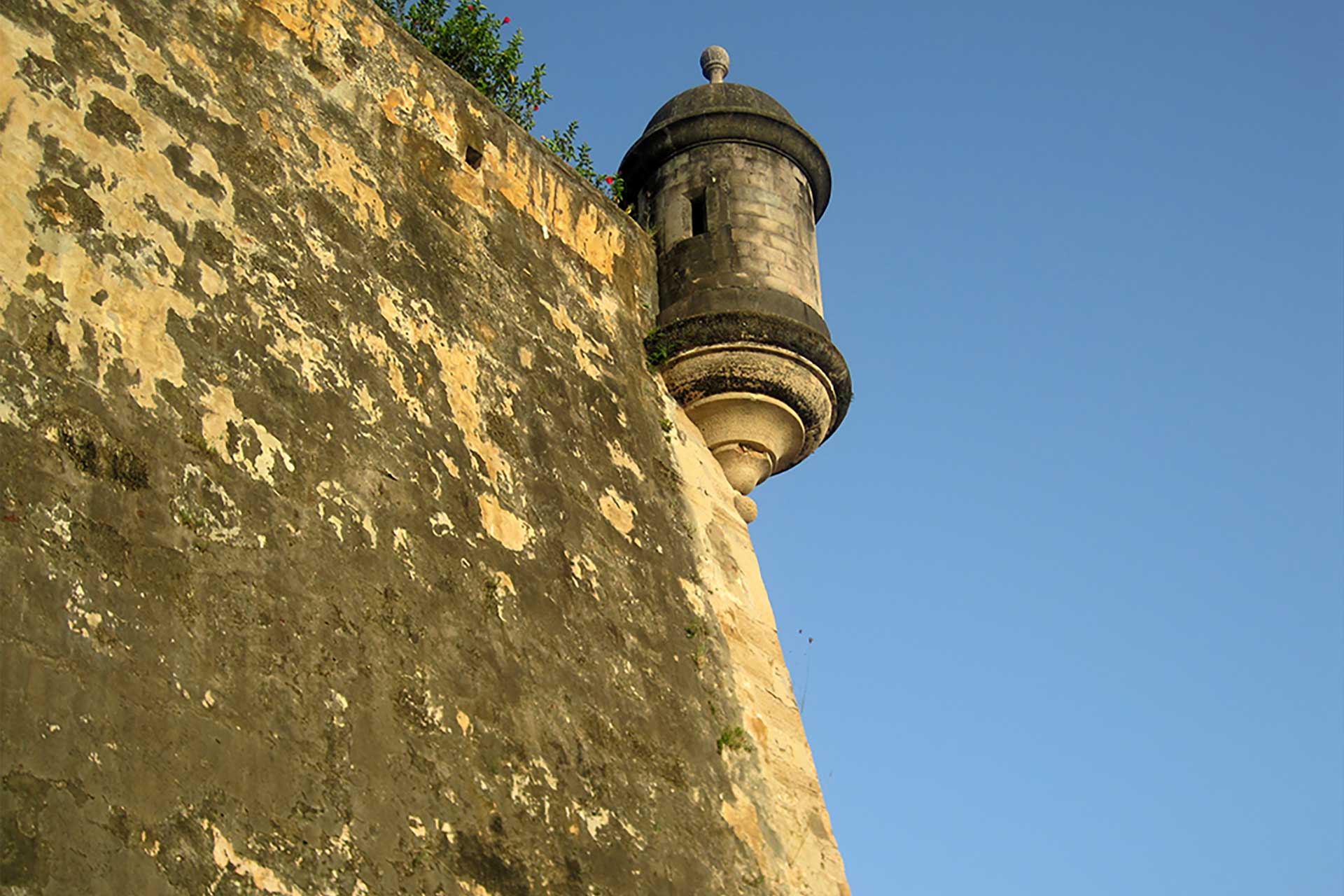
Morro is studded with small, circular sentry boxes called garitas
that have become a national symbol. The views of San Juan Bay from El Morro are
spectacular. The area was designated a National Historic Site in February, 1949 with 74 total acres.
It has the distinction of being the largest fortification in the
Caribbean. In 1992, in honor of the 500th anniversary of the discovery of Puerto Rico by
Christopher Columbus, the fortress was restored to its historical architectural grace and beauty.
El Morro Fortress is a National Historic Site administered by the National Park Service. The fort
is open to the public everyday from 9am to 6pm except on Thanksgiving Day, Christmas Day and
New Year's Day. Admissions US$5 adults, children under 15 free, 1-787-729-6960.
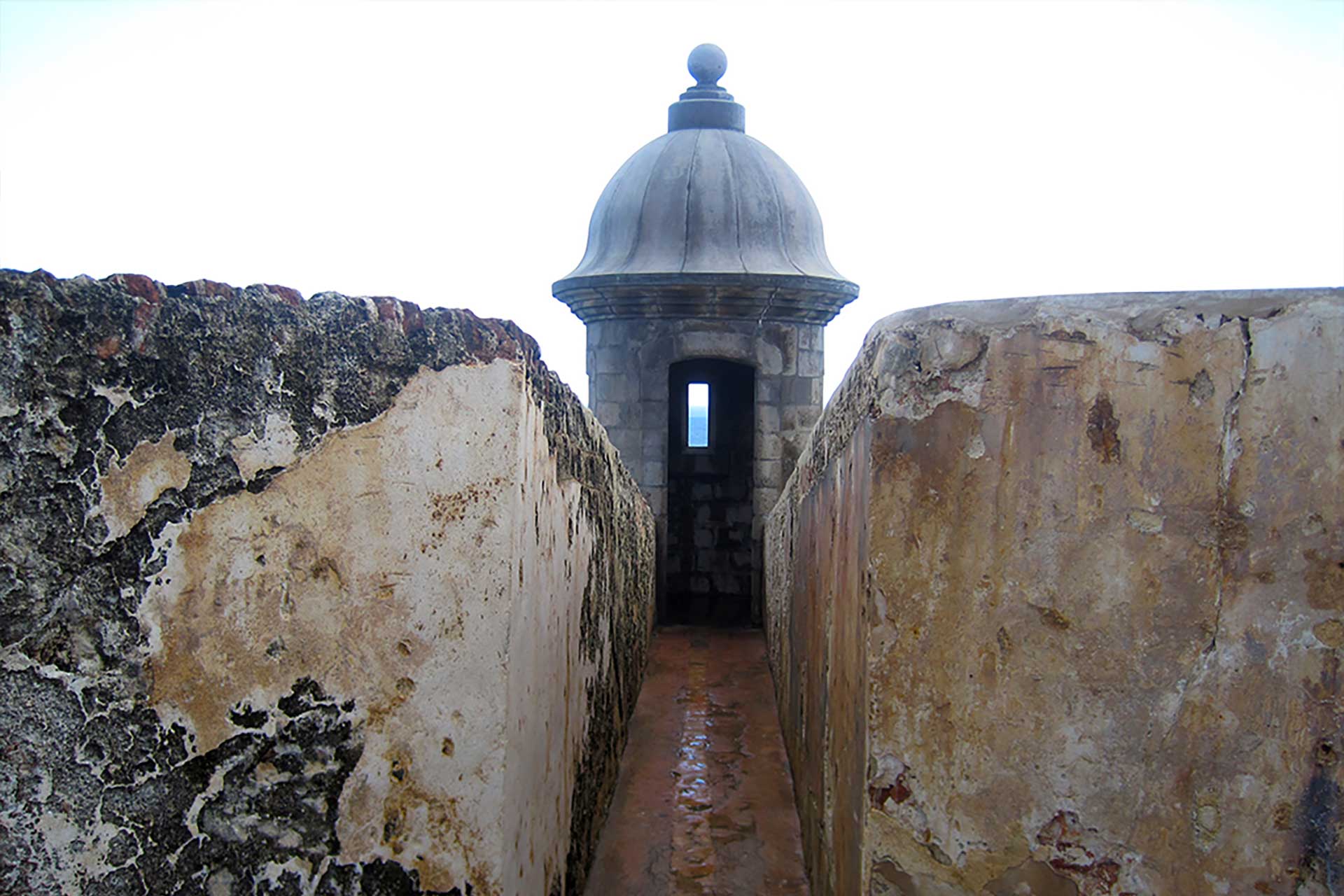
El Morro
Castillo de San Cristóbal (San Cristóbal Fort)
San Cristobal is
El Morro's partner in the city's defense. Built in 1634
(completed in 1771), was considered the Gibraltar of the West Indies. San
Cristóbal was supported by a massive system of outworks which provided
defense in depth and is is one of the largest defenses ever built in the
Americas. It rose 150 feet, covering 27 acres of land. As if its size and
height weren't sufficient to intimidate enemies, its intricate modular
design was sure to foil them. A strategic masterpiece, it features five
independent units, each connected by moat and tunnel; each fully
self-sufficient should the others fall. It's a World Heritage
and National Historic Site, administered by the U.S. National Park
Service. Open daily from 9am to 6pm; 1-787-729-6960.
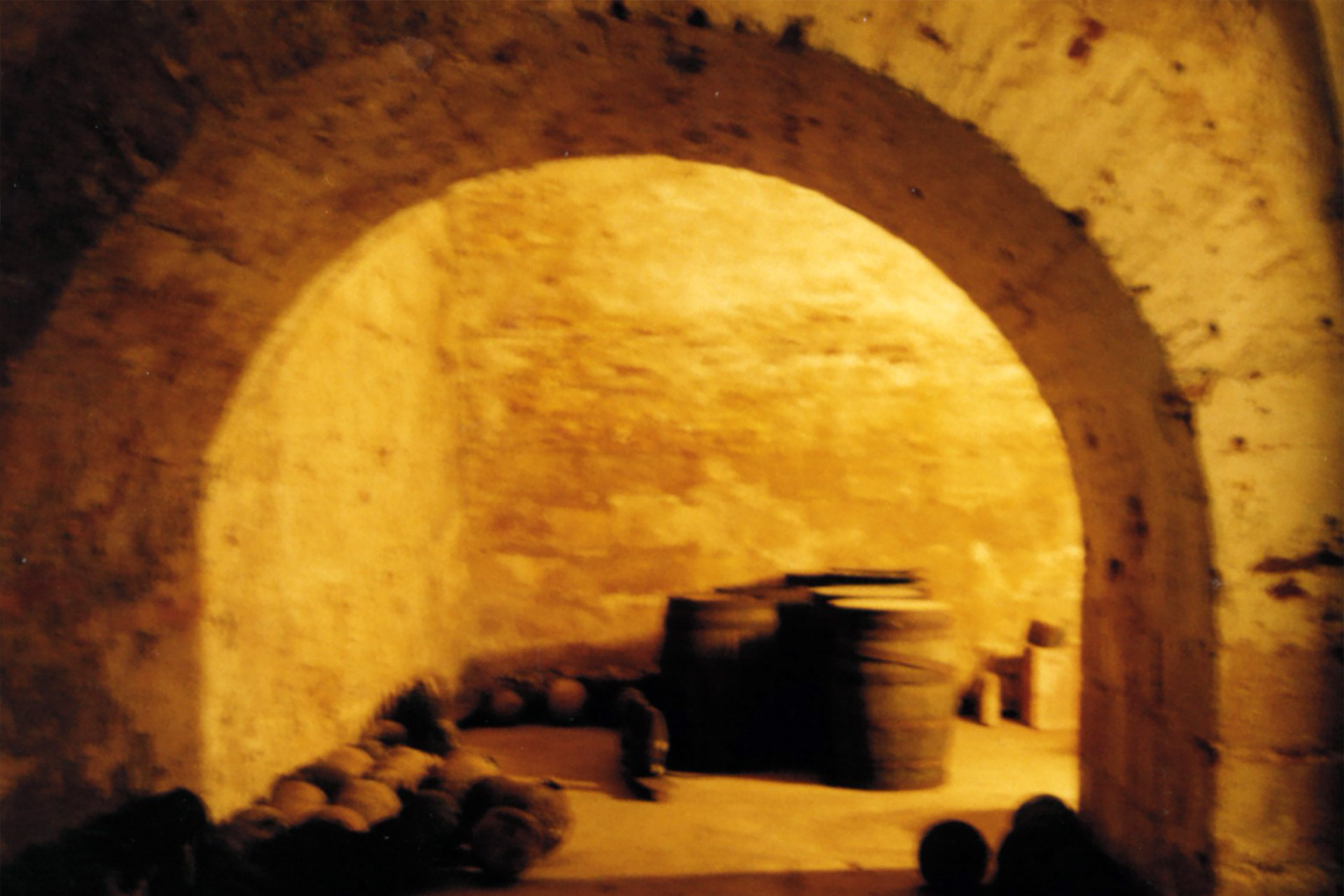
Barracks in El Morro
San Gerónimo Fort
The Fuerte San Gerónimo (San Gerónimo Fort) was built
on the opposite end of San Juan to strengthen the city's defenses. The fort is
located behind the Caribe Hilton Hotel, with small military museum in Puerta de
Tierra.
Landmarks & Historic Buildings
Old San Juan is home to some of the most significant historic structures in Puerto Rico.
La Fortaleza
Also known as the Palacio de Santa
Catalina began construction in 1533 and finalized the 25 of May
of 1540, as a fortress. It was authorized to be built by Charles V as a defense
against Carib Indian attacks. The building was the first of a series of military
facilities constructed in the Bay of San Juan, but soon later proved inadequate
to guard the entrance to the harbor, and became the official Governor's
Residence. The oldest governor's mansion still used as such in Western Hemisphere
and part of the old city's World Heritage Site. It has been occupied twice by
invaders; by the Earl of Cumberland in 1598 and by the Dutch General Bowdoin
Hendrick in 1625 when the building was damaged by fire. A major reconstruction was
undertaken in 1640. In 1846,
the building was remodeled and given a palatial aspect, uniting
harmoniously 16th century military architecture with the refinements of
the 19th century. It has been the home of 170 governors of Puerto Rico
and is the official residence of the current governor. Although the
original structure (Palatial Building surrounded by gardens) was very
primitive, La Fortaleza has undergone numerous changes over its 400 years
of history. Free tours are available daily. Open Mon-Fri
9:00am-4:00pm; guided tours in English on the hour, in Spanish every 30
minutes, 1-787-721-7000 ext. 2358. Tours last about 40 minutes. Access to
the official areas is not permitted.
City Hall
The Alcaldia (San Juan's City Hall), started
construction in 1602, completed in 1789. In the
1840's the building was heavily remodeled providing its present day facade
intended by its builders to be an exact replica of Madrid's. The building has a
tourism information center and a small gallery for periodic exhibitions.
Open Mon-Fri 8am - 4pm, except holidays. Free admissions. 1-787-724-7171 ext.
2391.
El Capitolio (Capitol Building of Puerto Rico)
The building hold the offices of senators on one wing and
those of representatives on the other, with galleries, friezes, mosaics and an
impressive rotunda in which Puerto Rico's constitution is exhibited.
Construction began in 1919 and the building was inaugurated on February 11, 1929.
Guided tours by appointment only, Mon-Fri 9am-5pm, 1-787-721-5200 ext. 301.
Catedral de San Juan (San Juan Cathedral)
This is the second oldest cathedral in the Western Hemisphere;
construction began in 1521. The original church on these grounds had wooden walls and a thatched
roof. It was destroyed by hurricane in 1526 (October 4th), rebuilt in in 1540,
looted in 1598, and damaged by another hurricane in 1615. The Cathedral as seen
today is the result of work done in 1917, when major restorations were
performed. This Cathedral is an authentic and rare New World example of
medieval architecture. The cathedral contains the marble tomb of the island's
first governor Juan Ponce de León and the relic of San Pio, a Roman
martyr. San Juan Cathedral still holds religious services on a regular
schedule. Visitors can explore the cathedral from 8:30am to 4pm daily.
Iglesia de San José (San José Church)
This church began
construction in 1523. Juan Ponce de León gave the land where the Church
now stands. Originally called the Church and Monastery of Saint Thomas Aquinas,
it was built by Dominican friars to serve as the monastery's church and chapel dedicated to Saint Thomas Aquinas. The section
erected in 1532, the Main Chapel or Sanctuary,
is an excellent example of 16th century Spanish Gothic architecture.
Ponce de León, was buried here for 300 years until his
body was moved to the San Juan Cathedral in 1913. This was the family church of
Ponce de León's descendants. Puerto Rican painter José Campeche, who
contributed a great deal to the beautiful churches of his island, is buried
here. Open Mon-Sat 8:30am - 4pm, Sun mass at 12:00pm; 1-787-725-7501.
Capilla del Cristo (Cristo Chapel)
Built in the 18th century (1753). The stories surrounding the history of this small chapel
conflict wildly except on one point: someone on horseback took a terrible
spill off the cliffs at the end of Calle Cristo. Whether he lived, and
the chapel was built to commemorate the miracle, or whether he died, and
the chapel was to block off the street and prevent such an accident from
happening again, is the part of the story that is in dispute. The
beautiful Campeche paintings and altar inside can be seen through the
church's glass doors. Open Tues. 10am - 4pm.
Casino of Puerto Rico
Built just before World War I. The
exterior - in the style of French mansions of the Louis XVI era, a copper
copula, a large ballroom with elaborate plaster-work and a 12-foot
chandelier distinguish this building.
Teatro Tapia (Tapia Theater)
Built in 1832 (financed by
subscriptions and by taxes on bread and imported liquor) and remodeled in
1949 and 1987 is one of the oldest theaters in the Western Hemisphere,
was named for Alejandro Tapia y Rivera, the famous Puerto Rican
playwright. Still hosts a variety of entertainment in the fine arts,
plays, ballets and concerts. 1-787-721-0169 or 1-787-721-0180.
Centro de Bellas Artes (Fine Arts Center)
The theather opened its doors
in 1981. The modern facilities offer concerts, plays, and opera. It is
the largest fine arts center in the Caribbean. Located on Ponce de
León Avenue, Santurce. Ticket windows are open daily from 10am to
6pm. and remain open until 8:00 p.m. on performance nights. 1-787-725-7353, 1-787-725-7354 or
1-787-725-7358.
Escuela de Artes Plásticas (School of Fine Arts)
Built by the Spanish colonial government in the 1800s. Previously the facilities
served as an asylum for mental patients.
La Intendencia
Formerly the Spanish colonial exchequer, a fine
example of 19th century Puerto Rican architecture, now houses Puerto
Rico's State Department. Open Mon-Fri 8am - 12pm, 1pm - 4:30pm, 1-787-722-2121.
Museums & Culture
The district offers a rich cultural experience through its museums and institutions.
San Juan Museum of Art and History
Built in 1855 as a market and restored in 1979 as a cultural center, showcases Puerto Rico
art and music, including concerts and festivals. Open Tuesday-Sunday,
10am - 4pm, 1-787-724-1875.
Pablo Casals Museum
This museum is the Spanish master's legacy to
the people of Puerto Rico. The museum collection includes manuscripts,
memorabilia, photographs and a library of videotapes of Festival Casals
concerts. Casals moved to Puerto Rico with his wife in the 1950s. He
became the conductor of the Puerto Rico Symphony Orchestra and the
president of the Conservatory of Music in Puerto Rico. The museum is open
Tuesdays through Saturdays, 9:30am to 5:30pm. Admissions US$1 adults,
US$0.50 children, 1-787-723-9185.
Casa de los Dos Zaguanes (House of the Two Foyers)
Home of the Museo del Indio (Museum of the Indian) and features exhibits on
the indigenous peoples of the Caribbean region, with exhibits, ceramics and
archaeological digs. Located on San José Street, Old San Juan. Open
Tues-Sat 9am - 4pm. Admission free, 1-787-724-5477 or
1-787-722-1709.
Asilo de Beneficencia (Home for the Poor)
Built 1840s for the indigent people. Today houses the Instituto de Cultura
Puertorriqueña (Institute of Puerto Rican Culture)
offering exhibits galleries every day, features an impressive collection
of artifacts from pre-European Puerto Rico, including pottery, stone tools
and relics, and a recreation of a Taíno village. Open Wed-Sun: 9am -
4:30pm. Admission: US $1. 9 Calle Santana Elena Norzagarais, 1-787-724-5949 or 1-787-724-5477.
Convento de los Dominicos (Dominican Convent)
Built by Dominican friars in 1523, this building has served alternately as a
convent, as a shelter against Carib Indian raids, and as the Caribbean
headquarters of the U.S. Army. The convent contains a small chapel
museum. Open Wed-Sun, 9am - 12pm, 1pm - 4:30pm; cultural events are
sometimes held in the patio, art exhibitions
in the galleries, 1-787-721-6866.
Casa Blanca (White House)
Built in 1521 and lived in by Ponce de León descendants for over 250 years. In 1779 it was taken over
by the Spanish military, then used later by the United States as a residence
for military commanders (1898-1966). Today the mansion serves as National
Historic Monument, housing a museum of 16th, 17th and 18th century
history. Each room is decorated in a style associated with a period of the
house's history. Casa Blanca is the oldest continuously occupied
residence in the Western Hemisphere. Located on San Sebastián Street,
Old San Juan, it houses a ethnographic museum and Taino (native
Indian) artifacts. Open to the public Tuesday through Sunday, 9am to
noon, 1pm to 4:30pm. Guided tours Tuesday-Friday by
appointment. Admission US$2 adults, US$1 children, 1-787-724-4102.
Casa Rosada (Pink House)
Built in 1812 for the Spanish army. Today houses a government tourism office where you can pick up
brochures, maps and a complimentary welcome cocktail made with Puerto Rican
rum.
La Casita (Little House)
Home of the Puerto Rico Tourism Co. Information Center. Open Mon-Wed from 8:30am to 8pm;
Thu-Fri until 5:30pm; and Sat-Sun, 9am to 8pm. 1-787-722-1709.
Casa de Ramón Power y Girault
This building is the headquarters for the
Conservation Trust of Puerto Rico, it also serves as a conservation resource
center, in which critical environmental issues can be explored through an
interactive multimedia exhibition entitled OJO-ISLA. Located at 155 Tetuán
Street. Open Tuesday through Saturday, from 10am to 4:00pm, 1-787-722-5834.
Ruinas de Caparra (Caparra Ruins)
This is ancient fort where Ponce de León founded the first settlement on the island in 1508.
The Museum of the Conquest and Colonization of Puerto Rico at the ruins
offers historical documents, exhibits and artifacts. Open daily 9am - 4pm, 1-787-781-4795.
Cuartel de Ballajá (Ballajá Barracks or
Ballajá Quarters)
These quarters housed Spanish soldiers and their families in the late
1800s, the building could accommodate up to 1,000 people. The construction
began in 1854, the main building was completed in 1863 and the chapel was
added in 1881. Originally conceived as a solution to the lodging needs of
military personnel stationed in San Juan. The Cuartel de Ballajá is a
three-story square building with large gates on two ends, ample balconies,
designed with a series of arches and a protected central courtyard that served
as a plaza and covers a reservoir. The Cuartel de Ballajá was the last
and largest building constructed by the Spaniards in the New World. Facilities
included officer quarters, warehouses, kitchens, dining rooms, prison cells and
stables. After the Spanish American War, the U.S. Army used Ballajá to
house its Infantry division. In 1943, it was converted into a military medical
facility, known as the Rodriguez Hospital and it was part of the Fort Brooke
structure. Today it houses the Museum of the Americas (inaugurated
October 12, 1992), located on its second floor. The museum features changing
exhibitions, craft exhibits and an impressive collection of Caribbean and
European American art and artifacts, most notably a diverse collection of
carved santos (saints). Open Monday-Friday 10am - 4pm, Sat-Sun 11am - 5pm,
guided tours available weekdays 10:30am, 11:30am, 12:30pm and 2pm. Admission free,
1-787-724-5052.
Museo de Doña Fela (Felisa Rincón de Gautier
Museum)
This is a colonial building that was once the home of Felisa Rincón
de Gautier, the dynamic mayor of San Juan from 1946 to 1968. Memorabilia from
the mayor's life, such as plaques, correspondence and furniture, are on
display. Open Mon-Fri: 9am - 4pm; 1-787-723-1897.
Casa de los Contrafuertes (House of Buttresses)
This is a traditional Spanish-style home, which holds the Museum of Colonial
Architecture and the Museum of the Puerto Rican Family. This is
believed to be the oldest residence left in Old San Juan, dating back to the
early 18th century. Open Wed-Sun, 9am - 4:30pm, 1-787-724-5949.
Also within Casa de los Contrafuertes you will find the Museo de
Nuestra Raíz Africana (African Heritage Museum), features African
artifacts, including masks, maps, musical instruments, and paintings. Open
Mon-Fri from 9:30am to 5pm, and Sat from 10am to 5pm. Admission free,
1-787-724-4294 or 1-787-724-4184.
Casa del Libro (House of the Book)
This is an 18th-century house that is now a book museum holding a rare collection of early manuscripts
and books (nearly 5,000 works), some dating back to the 15th century.
Among the museum's most precious possessions are two royal mandates signed by
Ferdinand and Isabella in 1493 concerning provisioning Columbus' fleet for his
second voyage.
Open Tues-Sat, except holidays, 11am - 4:30pm, 1-787-723-0354.
La Princesa (the princess)
Formerly the local San Juan
penitentiary was built in 1837. It is elegantly landscaped with trees, a
fountain, and a bronze sculpture. The building houses the Puerto Rico Tourism
Company headquarters and rotating art exhibits. Open Mon-Fri from 9am to 4pm.
1787-721-2400.
Explore San Juan Adventures
Waterfront & Scenic Walks
Puerta de San Juan (San Juan Gate)
Built in the late 1700s, is one of six heavy wooden doors in the wall which for centuries were
closed at sundown to cut off access to the city and protect the city from
invaders. The wall is up to 20 feet thick and up to 40 feet tall.
Paseo de la Princesa (promenade of the princess)
This is an elegantly landscaped walkway with trees, statues, benches, street lamps and
kiosks. The promenade faces the bay.
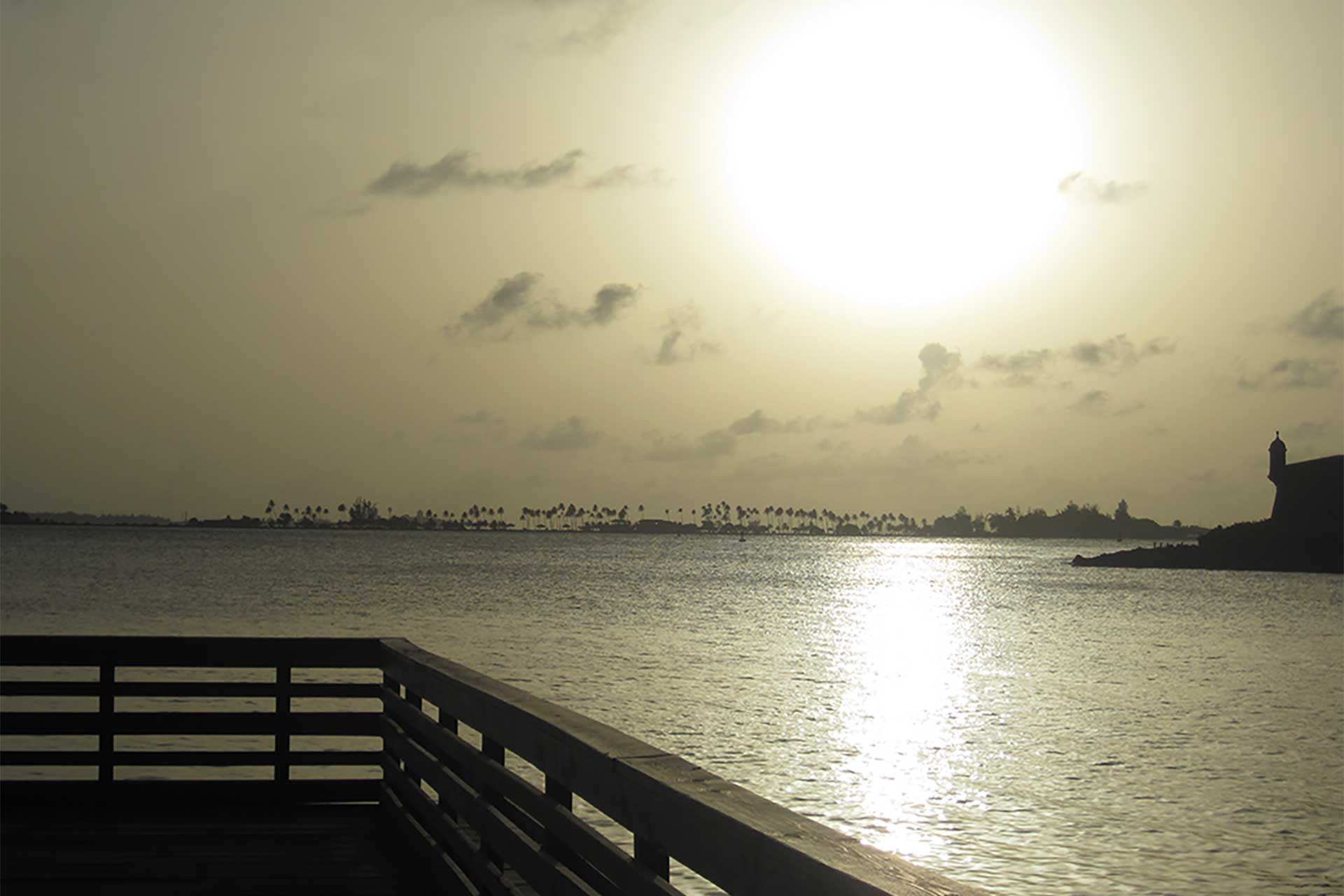
Sunset in Paseo La Princesa
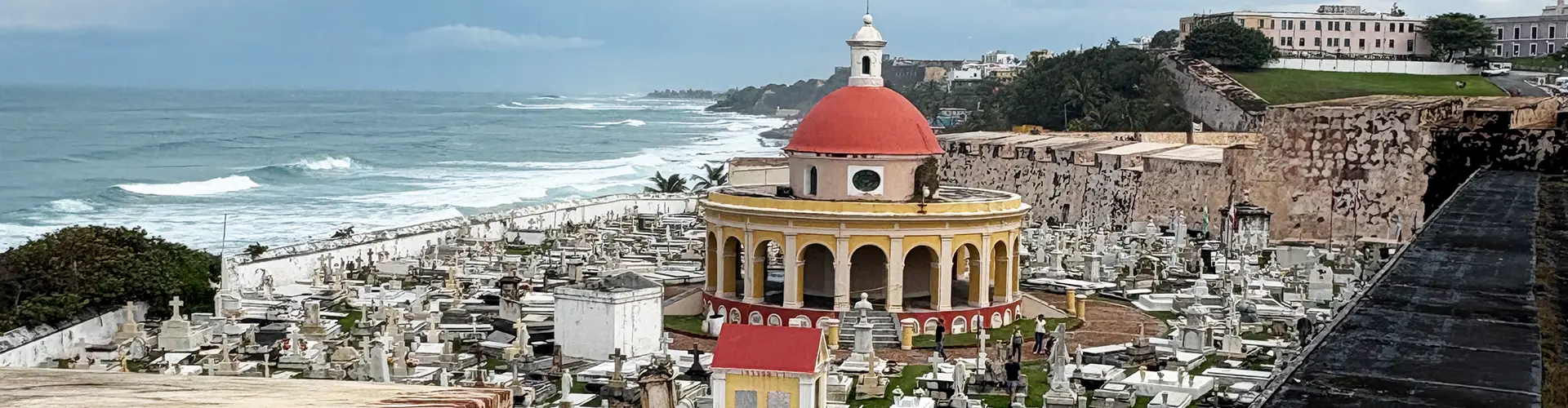
Cementerio de San Juan (San Juan Cemetery)
Located between
El Morro and the rocky cliffs above the Atlantic is considered one of the most
picturesque of burial grounds anywhere. The cemetery is particularly noteworthy
for its elaborate tombstones and the circular neoclassical chapel dedicated to
Mary Magdalen. The most notable piece is a circular, red-domed chapel,
which dates back to the late 19th century.
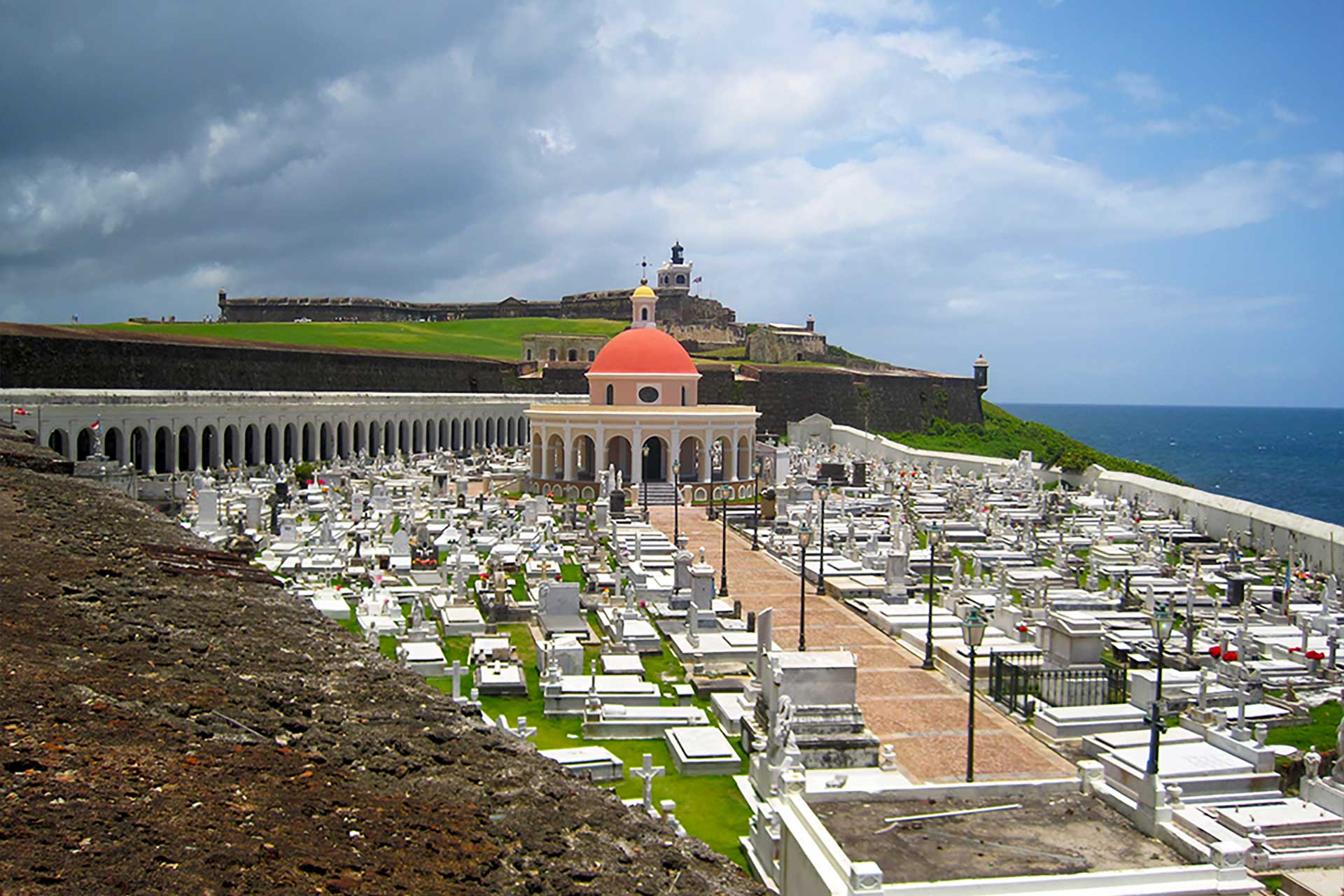
Cementerio Santa Maria Magdalena de Pazzis
Other Sights
Centro Nacional de Artes Populares y Artesanias (Popular Arts and
Crafts Center) is part of the Puerto Rico Institute of Culture,
displays and offers for sale a verity of island crafts.
University of Puerto Rico which include campus, University Museum and
the Jardin Botánico (Botanical Garden) is located in the
Río Piedras. The University Museum has archaeological and historical
exhibitions, and also monthly art exhibitions. Open Monday-Friday, 9am - 11pm,
weekends 9am - 3pm, 1-787-764-0000, ext 2452. The Botanical Garden
is a living laboratory of the native flora of Puerto Rico, with over 200
species of tropical and sub-tropical plants. There are many exotic
plants, including Egyptian papyrus, red palm, rain tree, candle tree,
cantaloupe tree, the shapely Puerto Rican palm, and much more. Open daily
9am - 4:30pm, 1-787-250-0000 ext 6580 or 1-787-763-4408.
The YMCA was built in 1914 and today shares the building with the
Olympic Committee. Its facilities include a patio and the Salón de
los Presidentes, (a meeting room).
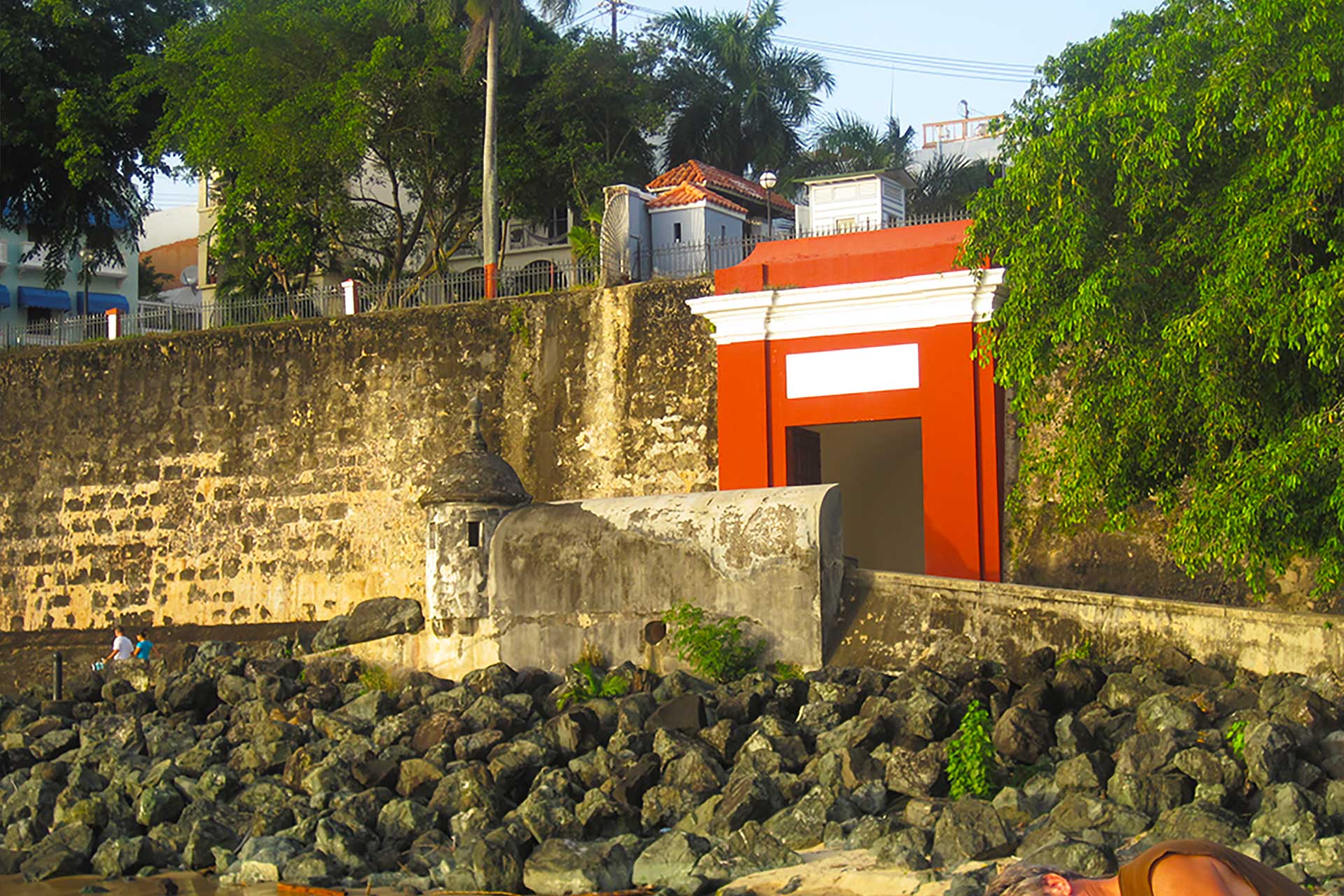
La Puerta dee San Juan
Piñones Reserve
A sub-tropical moist forest, includes mangroves, sea turtle nesting sites and beautiful beaches. No camping
allowed.
Colonial Adventures offers organized historical and art walking tours of
Old San Juan, 1-787-729-0114.
Ferry services are offered from San Juan to Cataño, across the San
Juan Bay. Departs daily from Pier 2 in Old San Juan every half-hour between
6am and 10pm. For information call 1-787-788-1155.
Roberto Clemente Coliseum
This sports and concert arena, with a capacity of 10,000 spectators, is named in honor of baseball legend Roberto Clemente. Completed in 1973, it was Puerto Rico's leading venue for major events for over 30 years, until the José Miguel Agrelot Coliseum opened in 2004. The coliseum is located on Franklin Delano Roosevelt Avenue.
3-day Puerto Rico itinerary
San Juan blends history, beaches, and nightlife into one vibrant destination.
Explore how to spend the perfect day in San Juan or follow our 3-day Puerto Rico itinerary to experience the highlights.
Book a Walking Tour
Beyond Old San Juan
San Juan Beach & Resort area. This area starts just outside of Old
San Juan and includes the areas of Condado, Miramar, Ocean Park and Isla
Verde. This is a area of fancy hotels, casinos, nightclubs, restaurants
and chic boutiques.
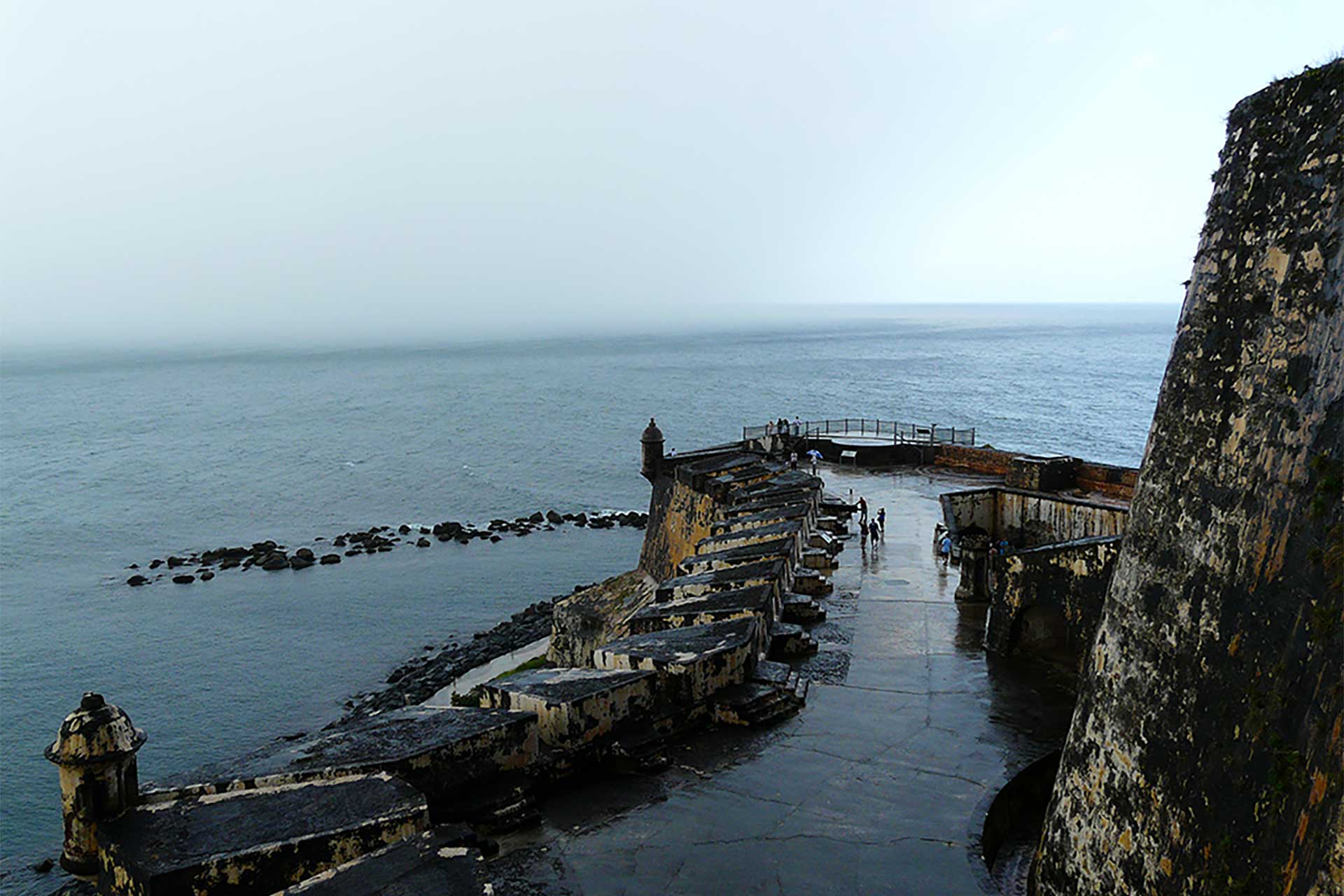
El Morro
Beaches
San Juan's beaches offer a mix of convenience, energy, and ocean views—from lively Condado to calmer spots like Isla Verde and Escambrón.
Explore San Juan beaches
Plan your Visit
Whether you are arriving by air at Luis Muñoz Marín International Airport (SJU) or docking at the bustling cruise port, the city serves as the ultimate gateway to the Puerto Rican experience.
Getting There
By Air
Luis Muñoz Marín International Airport (SJU) is the main hub for the Caribbean, with direct flights from most major U.S. cities, Canada, and Europe. The airport is about 20 minutes from Old San Juan by taxi.
Airport to City
Taxis from SJU to Old San Juan cost around $20–25 fixed rate. Uber is also available and often cheaper. The Tren Urbano metro connects the airport area to Santurce and Hato Rey.
By Sea
San Juan is the busiest cruise port in the Caribbean. The cruise pier in Old San Juan puts passengers steps from El Morro and the historic district. Ferry service also connects to Culebra and Vieques.
Entry Requirements
As a U.S. territory, Puerto Rico requires no passport for U.S. citizens — a government-issued ID suffices. International visitors follow standard U.S. entry requirements.
Getting Around
Rental Car
Essential for exploring beyond San Juan — El Yunque, Ponce, and the island's beaches all require one. Pick up at the airport. Parking in Old San Juan can be challenging; use the La Puntilla garage.
Tren Urbano
Puerto Rico's metro system connects Santurce, Hato Rey, Bayamón, and the university area. Useful for commuting between districts but doesn't reach Old San Juan or the beach areas.
Uber & Taxis
Uber works throughout San Juan and is generally reliable and affordable. Traditional taxis charge fixed rates between zones. For late-night travel between Condado and Old San Juan, both are easy to find.
Walking Old San Juan
Old San Juan is best explored on foot — the entire historic district is just 7 blocks wide. Be prepared for steep cobblestone streets and bring comfortable shoes. Many visitors use the free trolley.
Old San Juan Trolley Service
The easiest way to navigate the historic district is via the free trolley service.
The trolley runs every day Monday-Friday from 7am - 6pm, and Saturday-Sunday from 9am - 7pm every 15 minutes.
Most of the trolleys are accessible for wheelchairs and mobility devices and identified with the blue
International Symbol of Accessibility.
Nature & Resources
Geography
San Juan is located along the northeastern coast of Puerto Rico, bordering the Atlantic Ocean. As the island's capital and most populous municipality, it encompasses approximately 76 square miles (197 km²) of land and water, including the historic islet of Old San Juan, the neighborhoods of Santurce, Río Piedras, Hato Rey, Condado, Ocean Park, Isla Verde, and several smaller islands such as Isla de Cabras and portions of the San Juan Bay Estuary.
The municipality features a diverse landscape of natural harbors, beaches, lagoons, mangrove forests, rivers, and urban parks. San Juan Bay, one of the Caribbean's finest natural harbors, has played a crucial role in the city's history since its founding in 1521. To the north, miles of Atlantic coastline include popular beaches such as Condado Beach, Ocean Park, and Isla Verde, while inland areas are crossed by the Río Piedras and Puerto Nuevo rivers.
San Juan enjoys a tropical marine climate with warm temperatures year-round, averaging between 75°F and 89°F (24°C to 32°C). Its coastal location provides refreshing trade winds that help moderate the heat, while the surrounding estuaries, wetlands, and protected natural areas support a rich variety of birds, marine life, and native vegetation.
As Puerto Rico's political, economic, and cultural capital, San Juan combines centuries of history with a modern skyline, making it one of the Caribbean's most dynamic and geographically diverse cities.
Neighborhoods & Barrios
San Juan is made up of 11 barrios (PDF) (wards/districts):
- Caimito
- Cupey
- Hato Rey
- Monacillos
- Old San Juan
- Puerto Nuevo
- Quebrada Arenas
- Río Piedras
- Santurce
- Sabana Llana
- Tortugo
Climate
San Juan enjoys year round summer temperatures, an average annual temperature of 79.9°F
(26.6°C). On average, the warmest month is June and the coolest month is February.
San Juan averages 50.75 inches (1,289 mm) of rain per year. November is the average wettest month.
SAN JUAN WEATHER
10 Day Forecast from weather.com
Where to Stay
Luxury
- El Convento (Old San Juan)
- Condado Vanderbilt Hotel
- La Concha Renaissance
- Caribe Hilton
El Convento is a 16th-century convent turned boutique hotel — the most atmospheric choice.
Mid-Range
- Olive Boutique Hotel (Condado)
- Hotel Miramar
- InterContinental San Juan
- Courtyard Isla Verde
Miramar and Condado offer great value and easy access to both Old San Juan and beaches.
Budget
- Airbnb in Santurce
- Hostels in Old San Juan
- Guest houses in Ocean Park
- Apartments near UPR
Ocean Park sits between Condado and Isla Verde — quieter, cheaper, with its own beach.
Restaurants
San Juan is full of countless dining options with unique themes, locations, and cuisine.
Restaurants in San Juan
Festivals and Events
From world-famous festivals and live music to food fairs, cultural celebrations, and monthly art walks, San Juan hosts exciting events throughout the year. Plan your visit around the city's vibrant calendar and experience Puerto Rican culture at its best.
Explore San Juan Festivals & Events
History
With more than 500 years of history, San Juan has evolved from a fortified Spanish colonial city into a dynamic hub of culture, architecture, and heritage.
Read the full history of San Juan
Notable People
San Juan has shaped artists, athletes, politicians, and visionaries whose influence extends far beyond the island.
Famous Sanjuaneros
Rita Moreno
b. 1931
Entertainment
EGOT winner (Emmy, Grammy, Oscar, Tony) — the first Latina to win an Academy Award. Born in Humacao, she grew up in New York but has been Puerto Rico's most globally recognized cultural ambassador for decades.
Luis Muñoz Marín
1898–1980
Politics
Puerto Rico's first democratically elected governor (1948–1964). Architect of Operation Bootstrap, which transformed Puerto Rico from an agrarian economy into an industrialized society.
Felisa Rincón de Gautier
1897–1994
Politics
Mayor of San Juan for 22 years (1946–1968), one of the longest-serving and most beloved mayors in the city's history. A pioneering figure for women in Puerto Rican public life.
José Campeche
1751–1809
Fine Arts
Puerto Rico's first great painter and one of the finest portrait and religious artists in the Americas during the colonial period. Son of a freed slave, he became the island's most celebrated 18th-century artist.
Read more about famous Sanjuaneros
City Symbols
San Juan's flag, coat of arms, anthem, and other municipal symbols reflect more than five centuries of history. Their imagery draws heavily from the city's patron saint, Saint John the Baptist (San Juan Bautista), Spanish heraldic traditions, Christianity, and San Juan's historic relationship with the sea.
Flag
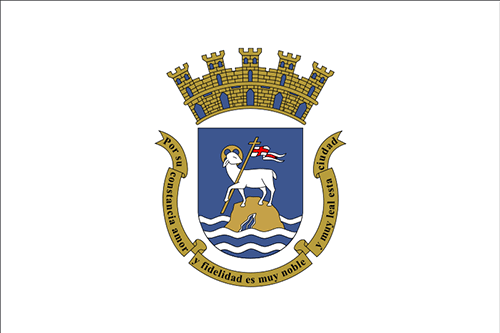
The municipal flag of San Juan features the city's historic coat of arms centered on a white field. The simple white background places emphasis on the elaborate heraldic emblem and is commonly associated with peace and unity.
At the center is the Lamb of God, or Agnus Dei, one of the most recognizable symbols associated with Saint John the Baptist. According to the Gospel of John, John refers to Jesus as the "Lamb of God," making the lamb a traditional emblem of the saint for whom San Juan is named.
The flag therefore connects the modern municipality directly with the religious and historical origins of its name, while the coat of arms recalls San Juan's centuries-old role as a fortified Spanish colonial city and one of the most historically important cities in the Caribbean.
Coat of Arms
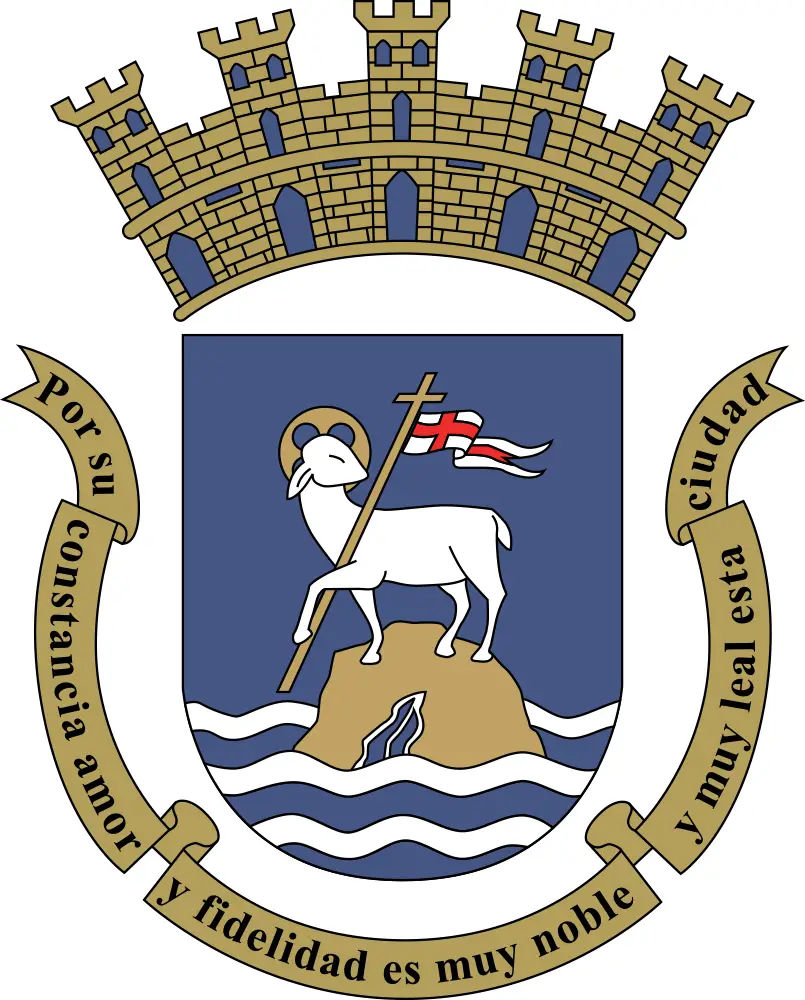
San Juan's coat of arms is one of the city's most distinctive historical symbols. Its central figure is the Agnus Dei — the Lamb of God — shown carrying a cross and banner. The image represents Saint John the Baptist, the patron saint from whom San Juan Bautista received its name.
The lamb stands upon a rocky island rising from stylized waves. The maritime imagery is particularly appropriate for San Juan, whose history has always been closely connected with its harbor and strategic position along the Atlantic approaches to the Caribbean.
The waves beneath the lamb recall the sea surrounding the capital and the importance of San Juan Bay, which helped transform the settlement into a major Spanish military, commercial, and maritime center.
The Lamb of God
The Agnus Dei is an ancient Christian symbol representing Jesus Christ as the Lamb of God. Its appearance on San Juan's coat of arms is directly associated with Saint John the Baptist, who proclaimed Christ as the Lamb of God in the New Testament.
The religious symbolism also preserves the city's original colonial identity. Puerto Rico's capital was historically known as Ciudad de Puerto Rico, while the island itself was called San Juan Bautista. Over time, popular usage effectively reversed the names: the island became Puerto Rico and the city became San Juan.
The Banner
The lamb carries a cross from which flies a small banner, another traditional element of Agnus Dei imagery. In Christian heraldry, the banner represents Christ's victory and resurrection and commonly accompanies representations of the Lamb of God.
The Sea and Rocky Island
The blue-and-white waves at the bottom of the shield emphasize San Juan's maritime character. From the earliest years of Spanish settlement, San Juan Bay provided one of the Caribbean's most valuable natural harbors and helped make the city a strategic gateway to the Spanish Americas.
The rocky formation rising from the water further reinforces the image of San Juan as an island city protected by the sea — an identity still visible today in Old San Juan's massive coastal fortifications.
The Mural Crown
Above the shield is a mural crown designed to resemble fortified city walls and towers. Mural crowns are a traditional feature of European civic heraldry and signify municipal or city status.
For San Juan, the crown is especially fitting. For centuries the city was enclosed by defensive walls and protected by an extraordinary network of fortifications, including Castillo San Felipe del Morro, Castillo San Cristóbal, city gates, bastions, and defensive walls overlooking San Juan Bay and the Atlantic Ocean.
The Motto
The ribbons surrounding the shield bear the historic motto:
"Por su constancia, amor y fidelidad es muy noble y muy leal esta ciudad."
The phrase can be translated approximately as:
"For its steadfastness, love, and loyalty, this city is very noble and very loyal."
The motto reflects the language and traditions of Spanish civic heraldry, in which cities could be recognized with honorific titles celebrating loyalty and service to the Crown.
Anthem
San Juan's municipal anthem, like the flag and coat of arms, the anthem celebrates the city's identity, history, and importance as Puerto Rico's capital.
"En Mi Viejo San Juan," is one of Puerto Rico's most beloved and recognizable songs. Written and composed by Noel Estrada in 1943, the song expresses a deep sense of nostalgia and affection for Puerto Rico's historic capital. Over the decades, it has been performed by countless artists and has become an enduring symbol of San Juan's rich history, culture, and emotional connection for both residents and the Puerto Rican diaspora.
Beyond being the official anthem of the capital city, it is widely considered an unofficial second national anthem for the entire island and the Puerto Rican diaspora worldwide due to its poignant themes of nostalgia, exile, and longing for home.
En Mi Viejo San Juan
Why This Song Means So Much to Me
Every time I hear En Mi Viejo San Juan, I almost tear up. Although I grew up in Coamo rather than San Juan, the song perfectly captures how I felt when I boarded a plane to move to the United States in 1994. Like so many Puerto Ricans who have left the island, I wasn't just saying goodbye to a city—I was saying goodbye to family, familiar places, and the life I had always known. Decades later, whenever I return to Puerto Rico, those emotions come rushing back. To me, En Mi Viejo San Juan isn't just San Juan's anthem; it's the soundtrack of the Puerto Rican diaspora.
Human & Capital Resources
Economy
As Puerto Rico's capital and largest metropolitan area, San Juan is the island's economic, financial, and tourism center. The city is home to Puerto Rico's principal seaport, the headquarters of major banks, government agencies, convention facilities, cruise terminals, and many of the island's largest businesses. Tourism, hospitality, finance, healthcare, education, professional services, and retail are among San Juan's leading industries, while nearby metropolitan municipalities support pharmaceutical, biotechnology, and advanced manufacturing sectors.
Historically, San Juan's economy was built around shipping, rum production, tobacco processing, and sugar exports. Today, visitors experience a city driven by culture, commerce, international tourism, world-class dining, conventions, and one of the busiest cruise ports in the Caribbean.
Education
As Puerto Rico's capital and largest city, San Juan is the island's premier center for higher education, research, and professional training. The city offers an extensive network of public and private schools, as well as many of Puerto Rico's most prestigious universities, attracting students from across the Caribbean and beyond.
San Juan is home to the University of Puerto Rico, Río Piedras Campus (UPR-RP), the flagship campus of the University of Puerto Rico system. Founded in 1903, it is the island's oldest and largest public university, offering more than 150 undergraduate and graduate programs in business, law, architecture, engineering, education, communications, the humanities, social sciences, and the natural sciences. The campus is internationally recognized for its research, academic excellence, and cultural significance.
The city also hosts several leading private institutions, including the Universidad Ana G. Méndez, Carlos Albizu University, and Universidad del Sagrado Corazón, each offering specialized programs in healthcare, psychology, communications, business, education, and the arts. In nearby Santurce, the Conservatory of Music of Puerto Rico provides world-class education in classical and contemporary music, while the Escuela de Artes Plásticas y Diseño de Puerto Rico is renowned for its programs in fine arts, graphic design, architecture, and visual communications.
With its concentration of universities, research centers, libraries, museums, and cultural institutions, San Juan has established itself as the educational and intellectual capital of Puerto Rico, preparing generations of leaders, entrepreneurs, artists, scientists, and professionals while fostering innovation and lifelong learning.
Efforts have been made to ensure the accuracy of the information on this site, help me keep this site up to date.
Send me a note
to correct or update information.
Demographics *
Population
342,259
Puerto Rico: 3,285,874
Land Area: 47.85 sq mi
Density: 7,043.50 per sq mi
Median Age: 45.3
Sex: 54% female
Economics **
Per capita income
$20,027Puerto Rico: $21,058
Median household income: $23,642
Puerto Rico: $21,058
Persons below poverty line: 40.1%
Housing, families and educational attainment *
Number of households
145,066
Housing units density:
4,178 (2013)
Persons per household: 2.2
High school grad or higher: 82.9%
Marital status: 28% married
* U.S. Census Bureau 2020 data, unless otherwise noted - Source: Quick Facts Puerto Rico.
** U.S. Census Bureau 2016-2020
Map References
Coordinates: 18.4500° N, 66.0667° W
ZIP Code: 00901, 00902, 00906, 00907, 00908, 00909, 00910-00917, 00919, 00920-00929, 00930, 00931, 00933, 00934, 00936, 00940
Interesting Facts
- When the United Nations designated world-class historic sites such as
the Taj Mahal, it named six monuments in Old San Juan.
- San Juan is one of the largest home-based cruise port in the world.
Twenty-eight vessels use San Juan as their home port, and each year new
cruise ships either originate or call at the port.
Frequently Asked Questions
Is San Juan the capital of Puerto Rico?
Yes. San Juan has served as Puerto Rico's capital since the early 1500s and is the center of the island's government, finance, culture, tourism, and transportation.
What is the largest city in Puerto Rico?
San Juan is Puerto Rico's capital and largest city by population, while the greater San Juan metropolitan area is home to nearly half of the island's residents.
Where is San Juan located?
San Juan is located on the northeastern coast of Puerto Rico and serves as the island's capital and largest metropolitan area.
What is San Juan known for?
San Juan is famous for Old San Juan, El Morro and San Cristóbal forts, colorful colonial architecture, beautiful beaches, world-class dining, shopping, nightlife, museums, and its rich 500-year history.
Is Old San Juan worth visiting?
Absolutely. Old San Juan is one of the oldest European settlements in the Americas and is home to centuries-old forts, blue cobblestone streets, colorful buildings, museums, churches, plazas, restaurants, and boutique shops.
How many days should I spend in San Juan?
Most visitors spend two to four days exploring San Juan. This allows enough time to visit Old San Juan, the historic forts, Condado, Isla Verde, Santurce, museums, beaches, and experience the city's food and nightlife.
Do cruise ships dock in San Juan?
Yes. San Juan is one of the Caribbean's busiest cruise ports. Many cruises begin or end here, while others stop in Old San Juan within walking distance of historic attractions, restaurants, and shops.
Does San Juan have beaches?
Yes. Popular beaches include Condado Beach, Ocean Park Beach, Escambrón Beach, Isla Verde Beach, and Balneario El Escambrón, offering swimming, surfing, snorkeling, and sunbathing close to the city.
Is San Juan a good destination for families?
Yes. Families can enjoy museums, historic forts, beaches, parks, boat tours, interactive attractions, and family-friendly restaurants throughout the city.
Is English spoken in San Juan?
Yes. Spanish is the primary language, but English is widely spoken in hotels, restaurants, tourist attractions, and most businesses frequented by visitors.
Which airport serves San Juan?
Luis Muñoz Marín International Airport (SJU) is Puerto Rico's primary international airport and serves millions of passengers each year with direct flights from dozens of cities throughout North America, Europe, Latin America, and the Caribbean.
Do I need a car in San Juan?
Not necessarily. Old San Juan, Condado, Miramar, and parts of Santurce are easily explored on foot or by rideshare. A rental car is recommended only if you plan to explore other parts of Puerto Rico beyond the metropolitan area.
What are the top attractions in San Juan?
Top attractions include Old San Juan, Castillo San Felipe del Morro, Castillo San Cristóbal, La Fortaleza, Paseo de la Princesa, Condado Beach, Escambrón Beach, the Puerto Rico Museum of Art, Distrito T-Mobile, and the Convention Center District.
Is Old San Juan a UNESCO World Heritage Site?
The historic fortifications of San Juan—including Castillo San Felipe del Morro, Castillo San Cristóbal, and the city walls—are part of the UNESCO World Heritage Site known as "La Fortaleza and San Juan National Historic Site."
Is San Juan safe for tourists?
San Juan is generally considered a safe destination for visitors. As with any major city, use common sense, remain aware of your surroundings, avoid isolated areas late at night, and keep valuables secure.
What is the best time to visit San Juan?
San Juan is a year-round destination. December through April offers the driest weather and many festivals, while summer brings warmer temperatures, lively beaches, and cultural events.
What festivals take place in San Juan?
Major annual events include the San Sebastián Street Festival (Fiestas de la Calle San Sebastián), Puerto Rico Heineken JazzFest, San Juan Bautista Patron Saint Festival, Pride Puerto Rico, and numerous music, culinary, and cultural festivals throughout the year.
Why is San Juan historically important?
Founded in 1521, San Juan is the oldest city under U.S. jurisdiction and one of the oldest European-founded cities in the Americas. For centuries it served as one of Spain's most important military and commercial ports in the Caribbean.
Maps
Books
Other Resources
Did You Know?
Puerto Ricans have voted in five referendums on the issue of statehood, in 1967, 1993, 1998, 2012 and 2017.
Get Our Newsletter
Discover new places, local flavors, upcoming events, cultural stories, and some of our favorite finds from around the island.
Read the Latest ¡La Isla! Newsletter
Follow Along