
Western Offshore Islands of Puerto Rico
Mona, Monito, and Desecheo
Far beyond Puerto Rico's western coastline lie three of the archipelago's most remote islands: Mona, Monito, and Desecheo. Surrounded by the waters of the Mona Passage, these isolated landforms are known for their dramatic limestone landscapes, rare wildlife, and ecological importance.
Unlike the populated islands of Vieques and Culebra or the recreational cays near Fajardo, Puerto Rico's western offshore islands have no permanent civilian communities. Their isolation has helped preserve distinctive natural environments, making them valuable sites for conservation and scientific research.
Mona is the largest of the three and is famous for its towering limestone cliffs, extensive cave systems, and endemic wildlife. Nearby Monito is a much smaller, steep-sided island that provides habitat for rare species. Farther north, Desecheo rises from the sea west of Puerto Rico, supporting seabird habitats and surrounding marine ecosystems.
Together, these islands represent a remarkable part of Puerto Rico's natural heritage, where geology, biodiversity, and maritime history intersect.
Western Offshore Islands at a Glance
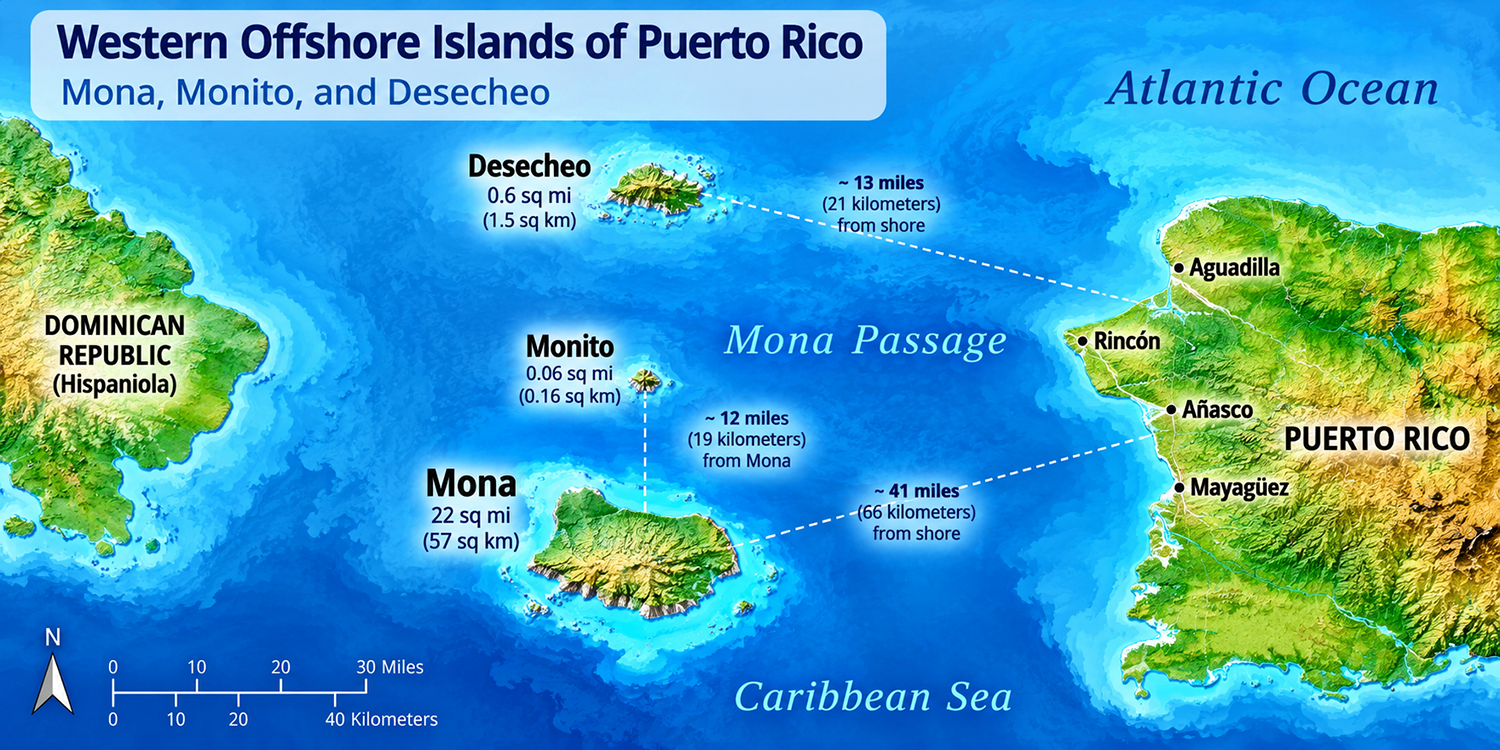
Puerto Rico's western offshore islands consist primarily of Mona, Monito, and Desecheo, three isolated islands located west of mainland Puerto Rico in the waters of the Mona Passage.
| Feature | Description |
|---|---|
| Location | West of mainland Puerto Rico |
| Principal islands | Mona, Monito, Desecheo |
| Surrounding waters | Mona Passage, between Puerto Rico and Hispaniola |
| Municipal affiliation | Mona and Monito: Mayagüez; Desecheo: Añasco |
| Largest island | Mona, approximately 22 square miles (57 sq km) |
| Permanent population | No permanent civilian communities |
| Geographic features | Limestone cliffs, caves, rocky shorelines, and offshore reefs |
| Protected areas | Mona and Monito Natural Reserve; Desecheo National Wildlife Refuge |
| Notable wildlife | Mona ground iguana, Mona gecko, seabirds, sea turtles |
| Access | Restricted or regulated; permits may be required |
Where Are Puerto Rico's Western Offshore Islands?
The western offshore islands lie in the Mona Passage, the body of water separating Puerto Rico from the Dominican Republic on the island of Hispaniola.
Mona is situated approximately 41 miles (66 kilometers) west of Puerto Rico. Monito lies several miles northwest of Mona, while Desecheo is farther north, approximately 13 miles (21 kilometers) west of Puerto Rico's northwestern coast.
Although these islands share a western offshore location, they are separated by substantial stretches of open water.
The Mona Passage is an important maritime corridor connecting the Atlantic Ocean and the Caribbean Sea. Its currents, waves, and underwater topography can create challenging navigation conditions.
The Three Major Western Offshore Islands
Puerto Rico's western offshore islands consist of three remote and ecologically significant islands: Mona, Monito, and Desecheo. Although all three lie west of mainland Puerto Rico, they differ in size, geology, wildlife, and accessibility.
Mona Island (Isla de Mona)
Mona Island is the largest of Puerto Rico's western offshore islands, covering approximately 22 square miles (57 sq km). Located in the Mona Passage between Puerto Rico and the Dominican Republic, it is known for its dramatic limestone cliffs, extensive cave systems, and relatively undisturbed natural landscapes.
The island consists primarily of an elevated limestone plateau surrounded by steep coastal cliffs. Its interior supports dry forest and shrubland habitats, while its coastline includes rocky shores, beaches, and marine ecosystems.
Mona is particularly important for its endemic wildlife, including the Mona ground iguana (Cyclura stejnegeri), a large reptile found naturally only on the island.
The island's caves also preserve evidence of Indigenous history, including archaeological remains and rock art associated with its early inhabitants.
Today, Mona forms part of the Reserva Natural de las Islas de Mona y Monito, managed by Puerto Rico's Department of Natural and Environmental Resources (DRNA). Access is regulated, and visitors must follow applicable permit and conservation requirements.
Monito Island (Isla Monito)
Monito Island is a small, steep-sided island located northwest of Mona. Despite its limited size, it is one of Puerto Rico's most ecologically significant offshore formations.
Monito is characterized by rugged limestone terrain, steep cliffs, and limited accessible shoreline. Its isolation has helped preserve specialized habitats for rare wildlife.
The island is especially known for the Monito gecko (Sphaerodactylus micropithecus), a tiny reptile found naturally only on Monito.
Because of its sensitive ecosystems and difficult terrain, public access is highly restricted. Monito is protected as part of the Mona and Monito Natural Reserve.
Desecheo Island (Isla Desecheo)
Desecheo Island lies approximately 13 miles (21 kilometers) west of Puerto Rico's northwestern coast, surrounded by the waters of the Mona Passage.
Unlike the limestone-dominated landscapes of Mona and Monito, Desecheo consists largely of volcanic rock. Its rugged hills, steep slopes, and rocky shorelines reflect a different geological history.
The island provides important habitats for seabirds and other coastal wildlife, while its surrounding waters support coral reefs, tropical fish, and diverse marine organisms.
Desecheo is protected as the Desecheo National Wildlife Refuge, administered by the U.S. Fish and Wildlife Service.
The island was historically used for military training, and unexploded ordnance remains a safety concern. Public landing is prohibited without authorization.
Did You Know?
Mona Island is sometimes called the Galápagos of the Caribbean because of its isolation, endemic wildlife, and ecological importance.
Comparing Mona, Monito, and Desecheo
Although Mona, Monito, and Desecheo are all remote islands west of Puerto Rico, they differ considerably in size, geography, ecological importance, and accessibility.
| Feature | Mona | Monito | Desecheo |
|---|---|---|---|
| Location | Central Mona Passage | Northwest of Mona | West of northwestern Puerto Rico |
| Approximate size | 22 sq mi (57 sq km) | 0.06 sq mi (0.16 sq km) | 0.6 sq mi (1.5 sq km) |
| Landscape | Limestone plateau, cliffs, caves | Steep rocky terrain | Rocky hills and coastal cliffs |
| Notable wildlife | Mona ground iguana | Monito gecko | Seabirds and coastal wildlife |
| Protected status | Natural reserve | Natural reserve | National Wildlife Refuge |
| Permanent population | None | None | None |
| Public access | Regulated; permits required | Highly restricted | Landing prohibited without authorization |
Geological History of the Western Offshore Islands
Puerto Rico's western offshore islands have distinctive geological characteristics shaped by their origins, isolation, and surrounding marine environments.
Although Mona, Monito, and Desecheo are geographically close, their landscapes reveal different aspects of the Caribbean's geological history.
Mona's Limestone Plateau
Mona Island is primarily composed of limestone and features an elevated plateau surrounded by steep coastal cliffs.
Over thousands of years, water gradually dissolved portions of the limestone, creating an extensive network of caves, underground passages, and other karst formations.
These caves are important for geological research and archaeological preservation. Some contain Indigenous rock art and evidence of human activity dating to the pre-Columbian period.
Monito's Rocky Landscape
Monito rises steeply from the surrounding waters, forming a rugged limestone island with limited accessible terrain.
Its steep cliffs and rocky surfaces create specialized habitats for wildlife adapted to the island's isolated environment.
The island's small size and difficult access have helped limit human disturbance.
Desecheo's Volcanic Origins
Unlike the limestone-dominated landscapes of Mona and Monito, Desecheo consists largely of volcanic rocks.
Its rugged terrain, steep hills, and rocky coastline reflect a geological history distinct from the carbonate formations of the other two islands.
These differences contribute to the geological diversity of Puerto Rico's western archipelago.
The Mona Passage
The Mona Passage separates Puerto Rico from Hispaniola and forms an important maritime connection between the Atlantic Ocean and the Caribbean Sea.
Its complex underwater topography, strong currents, and exposure to ocean swells influence navigation, marine ecosystems, and coastal conditions surrounding the islands.
Did You Know?
Mona and Desecheo illustrate two different geological landscapes within Puerto Rico's archipelago: Mona is dominated by limestone and extensive caves, while Desecheo is largely volcanic in origin.
Wildlife and Conservation
Puerto Rico's western offshore islands are among the archipelago's most important areas for protecting rare and endemic wildlife.
Their geographic isolation has allowed distinctive species and ecosystems to persist, while conservation programs help address threats from invasive species, habitat disturbance, and environmental change.
Mona Ground Iguana
The Mona ground iguana (Cyclura stejnegeri) is one of Puerto Rico's most distinctive reptiles.
Found naturally only on Mona Island, this large iguana inhabits the island's dry forest, shrubland, and limestone environments.
Conservation efforts have focused on protecting nesting areas, controlling invasive species, and supporting population recovery.
Monito Gecko
The Monito gecko (Sphaerodactylus micropithecus) is a tiny reptile endemic to Monito Island.
Its extremely limited natural range makes the species particularly important for biodiversity conservation.
Protecting Monito's habitat is essential because the species occurs naturally nowhere else in the world.
Seabirds and Marine Wildlife
Mona, Monito, and Desecheo provide habitats for seabirds and other coastal wildlife.
Their surrounding waters support coral communities, reef fish, sea turtles, and numerous marine organisms.
The islands' relatively isolated locations also make them valuable for scientific research and environmental monitoring.
Conservation Challenges
Despite their protected status, the western offshore islands face several environmental challenges.
Invasive Species: Introduced animals and plants can threaten native wildlife, compete for resources, and disrupt sensitive habitats.
Habitat Disturbance: Unauthorized access and human activity can damage nesting areas and other ecologically important environments.
Climate Change: Rising sea temperatures, coral bleaching, coastal erosion, and stronger storm impacts may affect terrestrial and marine habitats.
Historical Military Activity: Desecheo's former use for military training has left safety concerns that continue to influence conservation management and public access.
Conservation programs, scientific research, and protected-area management are essential for preserving these unique ecosystems.
Visiting Puerto Rico's Western Offshore Islands
Visiting Mona, Monito, and Desecheo requires considerably more planning than a typical day trip to Puerto Rico's coastal cays.
Their remote locations, challenging marine conditions, and conservation regulations make access difficult or restricted.
Visiting Mona Island
Mona Island may be visited under regulated conditions, generally requiring advance permits and transportation arrangements.
The island has limited infrastructure, and visitors must be prepared for a remote natural environment.
Depending on current regulations and authorized access, activities may include wildlife observation, hiking, camping, and exploring designated areas.
Visitors should contact Puerto Rico's Department of Natural and Environmental Resources (DRNA) to confirm current permit requirements, authorized activities, and seasonal restrictions.
Visiting Monito Island
Monito is not a conventional tourist destination.
Its steep terrain, sensitive habitats, and protected status make public access highly restricted.
Visitors should not attempt to land without explicit authorization.
Visiting Desecheo Island
Public landing on Desecheo is prohibited without authorization because of its protected status and the potential presence of unexploded military ordnance.
The surrounding waters are known for marine biodiversity, and recreational diving may take place offshore, subject to applicable regulations and marine conditions.
Safety and Conservation
The Mona Passage can experience strong currents, rough seas, and rapidly changing weather conditions.
Visitors should never attempt unauthorized landings or enter restricted areas.
- Confirm current permit requirements before planning a visit.
- Arrange transportation with experienced marine operators.
- Check weather forecasts and marine conditions.
- Respect protected habitats and wildlife.
- Do not enter restricted or unauthorized areas.
- Carry appropriate supplies for remote travel.
- Follow all conservation and safety regulations.
Local Tip
Plan well in advance. If you are interested in visiting Mona Island, contact Puerto Rico's Department of Natural and Environmental Resources to confirm current permit requirements and access restrictions.
Arrange transportation with an experienced operator familiar with the Mona Passage, where marine conditions can make travel challenging.
Western Offshore Islands vs. Other Puerto Rican Islands
Puerto Rico's western offshore islands differ significantly from the Spanish Virgin Islands and the eastern coastal cays.
While Vieques and Culebra support established communities and the eastern cays attract recreational visitors, Mona, Monito, and Desecheo are primarily protected natural areas with limited or restricted access.
Comparing Puerto Rico's Island Groups
| Feature | Western Offshore Islands | Spanish Virgin Islands | Eastern Coastal Islands |
|---|---|---|---|
| Principal islands | Mona, Monito, Desecheo | Vieques, Culebra | Icacos, Palomino, Palominito |
| Location | West of mainland Puerto Rico | East of mainland Puerto Rico | Northeastern coast near Fajardo |
| Permanent population | No permanent civilian communities | Inhabited municipalities | Generally uninhabited offshore islands |
| Landscape | Limestone cliffs, caves, rugged volcanic terrain | Beaches, hills, reefs, coastal forests | Sandy cays, coral reefs, small islands |
| Accessibility | Restricted or regulated | Public ferries and air connections | Primarily boat excursions |
| Popular activities | Authorized nature visits, research, wildlife observation | Beaches, snorkeling, cultural tourism | Snorkeling, sailing, boating, day trips |
| Conservation areas | Mona and Monito Natural Reserve; Desecheo National Wildlife Refuge | Vieques and Culebra National Wildlife Refuges | Reserva Natural Arrecifes de la Cordillera |
| Main significance | Endemic wildlife, geology, conservation | Culture, tourism, biodiversity | Marine recreation, coral reefs, conservation |
Important Geographic Distinction
Mona, Monito, and Desecheo are remote western offshore islands located in the Mona Passage. Unlike Vieques and Culebra, they have no permanent civilian communities.
Their protected status, ecological importance, and restricted accessibility distinguish them from Puerto Rico's more frequently visited eastern islands and coastal cays.
Continue Exploring Puerto Rico
North Coast
Explore Puerto Rico's North Coast, home to Atlantic beaches, dramatic karst landscapes, caves, and communities stretching west from San Juan.
East Coast
Discover Puerto Rico's East Coast, where El Yunque, Luquillo's beaches, Fajardo, and coastal nature reserves create endless opportunities for outdoor adventure.
Central Mountains
Journey into Puerto Rico's Central Mountains for coffee country, cooler temperatures, scenic roads, forests, and traditional mountain towns.
Metro Area
Experience Puerto Rico's Metro Area, home to San Juan, historic Old San Juan, beaches, museums, restaurants, nightlife, shopping, and the island's largest urban center.
West Coast
Head to Puerto Rico's West Coast for legendary surfing, beautiful sunsets, beaches, and lively coastal towns such as Rincón and Mayagüez.
South Coast
Explore Puerto Rico's South Coast for historic Ponce, Caribbean beaches, dry forests, coastal communities, and a slower pace.
Did You Know?
Puerto Rico has three bioluminescent bays, more than any other place in the world.
Get Our Newsletter
Discover new places, local flavors, upcoming events, cultural stories, and some of our favorite finds from around the island.Read the Latest ¡La Isla! Newsletter
Follow Along


