
Spanish Virgin Islands
The Spanish Virgin Islands, also known as the Puerto Rican Virgin Islands (Islas Vírgenes Españolas or Islas Vírgenes Puertorriqueñas), are a group of Caribbean islands located east of mainland Puerto Rico. They consist primarily of Vieques and Culebra, along with numerous smaller islands, islets, and cays.
Known for their turquoise waters, white-sand beaches, coral reefs, and protected natural habitats, these islands form an important part of Puerto Rico's archipelago. Their landscapes range from the rolling hills and bioluminescent waters of Vieques to the secluded beaches and marine ecosystems surrounding Culebra.
Although geographically associated with the Virgin Islands, the Spanish Virgin Islands are politically and administratively part of Puerto Rico, a U.S. territory. Vieques and Culebra are two of Puerto Rico's 78 municipalities.
Unlike the neighboring U.S. Virgin Islands and British Virgin Islands, the Spanish Virgin Islands do not constitute a separate political territory.
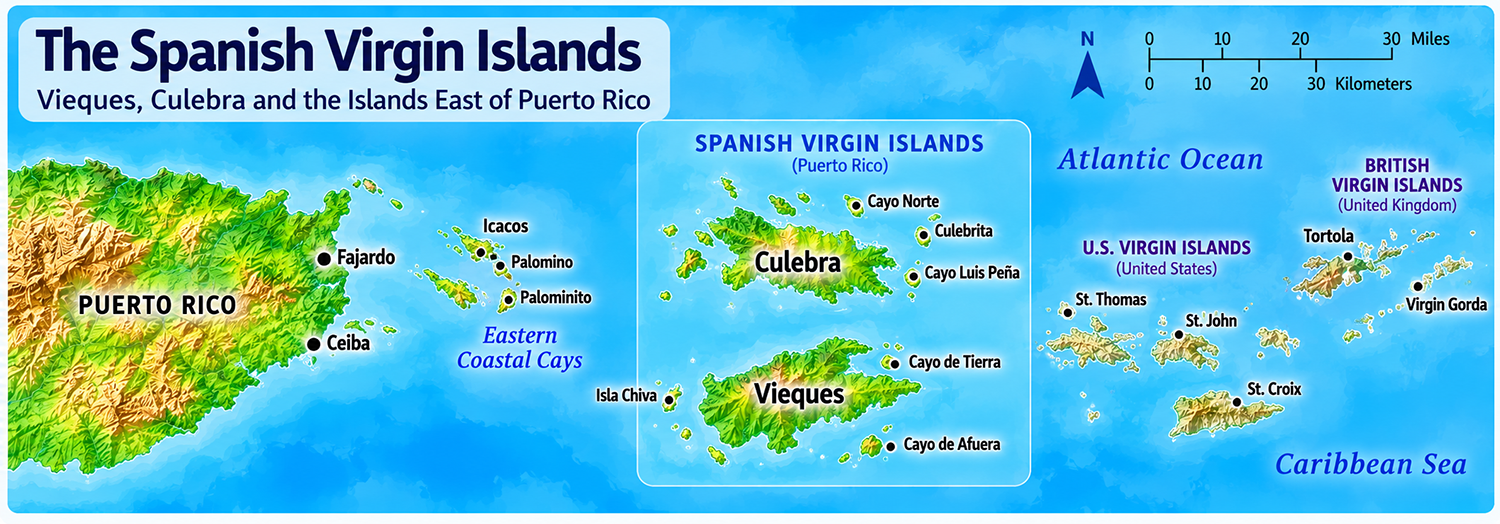
Spanish Virgin Islands at a Glance
The Spanish Virgin Islands form the westernmost portion of the Virgin Islands archipelago and include Puerto Rico's two island municipalities, Vieques and Culebra, along with their surrounding smaller islands and cays.
| Feature | Description |
|---|---|
| Official affiliation | Puerto Rico, United States |
| Also known as | Puerto Rican Virgin Islands |
| Spanish names | Islas Vírgenes Españolas; Islas Vírgenes Puertorriqueñas |
| Location | East of mainland Puerto Rico |
| Main islands | Vieques and Culebra |
| Municipalities | Vieques and Culebra |
| Surrounding waters | Caribbean Sea and Atlantic Ocean |
| Notable smaller islands | Culebrita, Cayo Luis Peña, Cayo Norte, Cayo de Tierra |
| Known for | Beaches, coral reefs, wildlife refuges, bioluminescence |
Where are the Spanish Virgin Islands?
The Spanish Virgin Islands lie immediately east of mainland Puerto Rico, between the Caribbean Sea and the Atlantic Ocean.
Vieques is situated southeast of Puerto Rico, while Culebra lies northeast of Vieques. Together, these islands form the western portion of the broader Virgin Islands island chain, which extends eastward toward St. Thomas, St. John, and the British Virgin Islands.
Although separated from mainland Puerto Rico by water, Vieques and Culebra share close geographic, historical, cultural, and administrative ties with the rest of Puerto Rico.
The Main Islands
Vieques
Located southeast of mainland Puerto Rico, Vieques is the larger of the two principal Spanish Virgin Islands.
The island is known for its beaches, rolling hills, dry forests, coastal lagoons, and extensive protected natural areas. Much of its landscape is preserved within the Vieques National Wildlife Refuge.
One of its most extraordinary natural features is Mosquito Bay (Bahía Mosquito), internationally recognized for its remarkable bioluminescence. Microscopic organisms called dinoflagellates produce a blue-green glow when the water is disturbed.
Vieques also has a distinctive history shaped by Indigenous settlement, Spanish colonial rule, agriculture, and decades of U.S. Navy activity.
Today, its communities, historic landmarks, beaches, and protected landscapes make it one of Puerto Rico's most distinctive island destinations.
Culebra
Located northeast of Vieques, Culebra is a smaller island municipality known for its clear waters, white-sand beaches, and surrounding marine habitats.
Its most famous destination is Flamenco Beach, a broad crescent-shaped beach recognized for its turquoise waters and scenic shoreline.
Culebra's coastal ecosystems include coral reefs, seagrass beds, and habitats that support sea turtles, seabirds, and other marine wildlife.
The municipality also encompasses numerous smaller islands and cays, including Culebrita, Cayo Luis Peña, and Cayo Norte.
Portions of these islands form part of the Culebra National Wildlife Refuge, one of the oldest wildlife refuges in the Caribbean.
Smaller Islands and Cays
Beyond Vieques and Culebra, the Spanish Virgin Islands include numerous smaller islands, rocky islets, and cays.
The following list the smaller islands, cays, and rocks associated with the municipalities of Vieques and Culebra. Many are uninhabited and provide important nesting habitats for seabirds, refuge for coastal wildlife, and protection for surrounding marine ecosystems.
Islands and Cays of Vieques
| Name | Type or Description |
|---|---|
| Cayo Chiva | Cay |
| Cayo de Tierra | Coastal cay |
| Pleasure Island | Small island |
| Cayo Jalova | Cay |
| Cayo Jalovita | Cay |
| Cayo Real | Cay |
| Isla Chiva | Small island |
| Isla Yallis | Small island |
| Roca Alcatraz | Rocky formation |
| Roca Cucaracha | Rocky formation |
Islands, Cays and Rocks of Culebra
| Name | Type or Description |
|---|---|
| Alcarraza | Rocky islet |
| Cayo Ballena | Cay |
| Cayo Botella | Cay |
| Cayo de Luis Peña | Cay |
| Cayo del Agua | Cay |
| Cayo Lobito | Cay |
| Cayo Lobo | Cay |
| Cayo Matojo | Cay |
| Cayo Norte | Small island |
| Cayo Pirata | Cay |
| Cayo Raton | Cay |
| Cayo Sombrerito | Cay |
| Cayo Tiburon | Cay |
| Cayo Verde | Cay |
| Cayo Yerba | Cay |
| Cayos Geniqui | Group of cays |
| El Ancon | Rocky formation |
| El Mono | Rocky formation |
| Isla Culebrita | Small island |
| Las Hermanas | Group of small cays or rocks |
| Los Gemelos | Group of rocky formations |
| Pela | Small offshore formation |
| Pelaita | Small offshore formation |
| Piedra del Norte | Rock formation associated with Culebrita |
| Piedra Stevens | Rock formation |
| Roca Culumna | Rock formation associated with Cayo Lobito |
| Roca Speck | Rock formation |
| Cayo Tuna | Cay |
| Roca Lavador | Rock formation (awash) |
| Cayo Botijuela | Cay |
Note: This directory includes named islands, cays, and offshore rocks associated with Vieques and Culebra. Some features may be known by alternate names, and certain rocks form part of larger islands or cays. The list is intended as a geographic reference, not a list of publicly accessible destinations.
What makes the Spanish Virgin Islands different from the U.S. and British Virgin Islands?
Although the Spanish, U.S., and British Virgin Islands belong to the same broader Caribbean island chain, they have different political affiliations, histories, and administrative systems.
The Spanish Virgin Islands belong to Puerto Rico, while the U.S. Virgin Islands form a separate U.S. territory and the British Virgin Islands are a British Overseas Territory.
Comparing the Virgin Islands
| Feature | Spanish Virgin Islands | U.S. Virgin Islands | British Virgin Islands |
|---|---|---|---|
| Political affiliation | Puerto Rico, U.S. territory | Separate U.S. territory | British Overseas Territory |
| Principal islands | Vieques, Culebra | St. Thomas, St. John, St. Croix | Tortola, Virgin Gorda, Anegada, Jost Van Dyke |
| Government | Municipalities of Puerto Rico | Territorial government | Local government under British sovereignty |
| Primary language | Spanish | English | English |
| Currency | U.S. dollar (USD) | U.S. dollar (USD) | U.S. dollar (USD) |
| Cultural influences | Puerto Rican and broader Caribbean | Caribbean, African, European, and American | Caribbean, African, and British |
| U.S. citizenship | U.S. citizenship applies under Puerto Rico's laws | People born there generally acquire U.S. citizenship | British nationality rules apply |
| Location | East of mainland Puerto Rico | East of the Spanish Virgin Islands | East and northeast of the U.S. Virgin Islands |
Why are they called the Spanish Virgin Islands?
The name reflects their historical association with Puerto Rico, which remained under Spanish colonial rule until 1898.
The neighboring islands developed under different European colonial administrations, resulting in the modern geographic distinctions between the Spanish, U.S., and British Virgin Islands.
Today, the term Spanish Virgin Islands is primarily a geographic and historical designation rather than an official political classification.
The Spanish Virgin Islands are not a separate U.S. territory. Vieques and Culebra are municipalities of Puerto Rico. By contrast, the U.S. Virgin Islands have their own territorial government, while the British Virgin Islands are a British Overseas Territory.
A Brief History of the Spanish Virgin Islands
Indigenous Heritage
Long before European arrival, Vieques and Culebra were part of the Indigenous Caribbean world.
Archaeological evidence from Vieques reveals thousands of years of human occupation, including communities connected through maritime travel, trade, and cultural exchange.
Indigenous peoples navigated between the islands using watercraft and maintained relationships with communities throughout the eastern Caribbean.
Spanish Colonial Period
Following European arrival in the late 15th century, the islands became associated with Spanish-controlled Puerto Rico.
Vieques experienced periods of settlement, agricultural development, and economic activity tied to the broader colonial Caribbean.
Culebra's permanent colonial settlement developed later, particularly during the 19th century.
Transition to U.S. Administration
In 1898, following the Spanish-American War, Puerto Rico and its associated islands came under United States sovereignty.
Vieques and Culebra remained administratively connected to Puerto Rico.
U.S. Navy Presence
During the 20th century, the U.S. Navy used substantial portions of Vieques and areas of Culebra for military training.
Military activities on Culebra ended in the 1970s, while bombing exercises on Vieques ended in 2003.
These activities profoundly affected the islands' landscapes, communities, and environmental histories.
Conservation and the Present Day
Today, significant areas of Vieques and Culebra are protected for their ecological importance.
Wildlife refuges, marine conservation areas, and community-based environmental initiatives contribute to the protection of coastal ecosystems.
However, some former military areas remain subject to environmental cleanup and access restrictions.
Natural Environment and Wildlife
The Spanish Virgin Islands support a diverse range of terrestrial and marine ecosystems.
Their landscapes include dry forests, mangroves, coastal lagoons, sandy beaches, rocky shorelines, and coral reefs.
Coral Reefs and Marine Life
The waters surrounding Vieques and Culebra contain coral reef and seagrass habitats that support tropical fish, sea turtles, rays, and numerous other marine organisms.
Seabirds and Coastal Wildlife
Smaller offshore islands provide important nesting and resting areas for seabirds.
Some islands are protected specifically because of their value to migratory and resident bird populations.
Bioluminescent Waters
Vieques is home to Mosquito Bay, one of Puerto Rico's best-known bioluminescent bays.
The bay's natural glow is produced by microscopic dinoflagellates, whose concentrations and visibility vary with environmental conditions.
Conservation Challenges
The islands face environmental pressures including coral bleaching, coastal erosion, storm damage, invasive species, and the impacts of historical military activities.
Conservation programs and protected areas play an important role in preserving their natural heritage.
Visiting the Spanish Virgin Islands
Although Vieques and Culebra are geographically close to mainland Puerto Rico, visiting them requires planning.
Getting There
By Air
Small aircraft provide connections between Vieques, Culebra, and airports in Puerto Rico.
Flight routes and schedules vary by operator.
By Ferry
Passenger ferry service connects Ceiba on Puerto Rico's eastern coast with Vieques and Culebra. Schedules and availability vary, especially during holidays and busy travel periods.
Getting Around
Transportation options differ between the two islands.
Vieques is larger, and visitors generally benefit from arranging ground transportation.
Culebra is smaller, but transportation is still necessary to reach many beaches and coastal destinations.
Visiting Smaller Cays
Some smaller islands are accessible through licensed boat excursions, while others have restricted or prohibited access because of wildlife protection, private ownership, or safety concerns.
Visitors should verify current regulations before traveling.
Frequently Asked Questions
Find answers to common questions about the Spanish Virgin Islands, including their geography, political status, history, and the islands that belong to this eastern Caribbean group.
What are the Spanish Virgin Islands?
The Spanish Virgin Islands, also known as the Puerto Rican Virgin Islands, are a group of Caribbean islands east of mainland Puerto Rico. They consist primarily of Vieques, Culebra, and their surrounding smaller islands and cays.
Are the Spanish Virgin Islands part of Puerto Rico?
Yes. Vieques and Culebra are two of Puerto Rico's 78 municipalities. They are governed under Puerto Rico's administrative and political system and are not a separate territory.
Are the Spanish Virgin Islands part of the U.S. Virgin Islands?
No. The Spanish Virgin Islands belong to Puerto Rico, while the U.S. Virgin Islands form a separate United States territory that includes St. Thomas, St. John, and St. Croix.
Why are they called the Spanish Virgin Islands?
The name reflects their historical connection to Puerto Rico during the Spanish colonial period. It distinguishes Vieques, Culebra, and their surrounding islands from neighboring Virgin Islands that developed under different colonial administrations.
Which islands make up the Spanish Virgin Islands?
The principal islands are Vieques and Culebra. The group also includes smaller islands and cays such as Culebrita, Cayo Luis Peña, Cayo Norte, Cayo Pirata, Cayo de Tierra, and Cayo de Afuera.
Are Icacos, Palomino, and Palominito part of the Spanish Virgin Islands?
Icacos, Palomino, and Palominito are located off Puerto Rico's eastern coast near Fajardo. Although some broader geographic descriptions associate nearby eastern islands with the Spanish Virgin Islands, these cays are generally treated separately from the core group centered on Vieques and Culebra.
Can you travel between Vieques and Culebra?
Travel between Vieques and Culebra is possible, but direct scheduled transportation options are limited. Visitors commonly travel through mainland Puerto Rico or arrange private transportation between the islands.
Do you need a passport to visit the Spanish Virgin Islands?
U.S. citizens traveling directly between mainland Puerto Rico, Vieques, and Culebra do not need a passport because these destinations are within U.S. jurisdiction. Travelers should carry appropriate identification, and international visitors should verify their entry requirements.
Which islands and cays can you visit?
Vieques and Culebra are accessible by ferry or air from mainland Puerto Rico. Some smaller islands, including Culebrita and Cayo Luis Peña, may be visited by boat, subject to weather conditions and applicable regulations. Other islands are protected or privately owned, and access may be restricted.
Why are the Spanish Virgin Islands important to Puerto Rico?
The Spanish Virgin Islands are important for their cultural heritage, coastal ecosystems, wildlife refuges, and maritime history. Their beaches, coral reefs, seagrass habitats, and protected landscapes also contribute to Puerto Rico's biodiversity and tourism economy.
Continue Exploring Puerto Rico
North Coast
Explore Puerto Rico's North Coast, home to Atlantic beaches, dramatic karst landscapes, caves, and communities stretching west from San Juan.
East Coast
Discover Puerto Rico's East Coast, where El Yunque, Luquillo's beaches, Fajardo, and coastal nature reserves create endless opportunities for outdoor adventure.
Central Mountains
Journey into Puerto Rico's Central Mountains for coffee country, cooler temperatures, scenic roads, forests, and traditional mountain towns.
Metro Area
Experience Puerto Rico's Metro Area, home to San Juan, historic Old San Juan, beaches, museums, restaurants, nightlife, shopping, and the island's largest urban center.
West Coast
Head to Puerto Rico's West Coast for legendary surfing, beautiful sunsets, beaches, and lively coastal towns such as Rincón and Mayagüez.
South Coast
Explore Puerto Rico's South Coast for historic Ponce, Caribbean beaches, dry forests, coastal communities, and a slower pace.
Did You Know?
El Yunque is the only tropical rainforest in the U.S. National Forest System.
Get Our Newsletter
Discover new places, local flavors, upcoming events, cultural stories, and some of our favorite finds from around the island.Read the Latest ¡La Isla! Newsletter
Follow Along


