
Jones-Shafroth Act of 1917
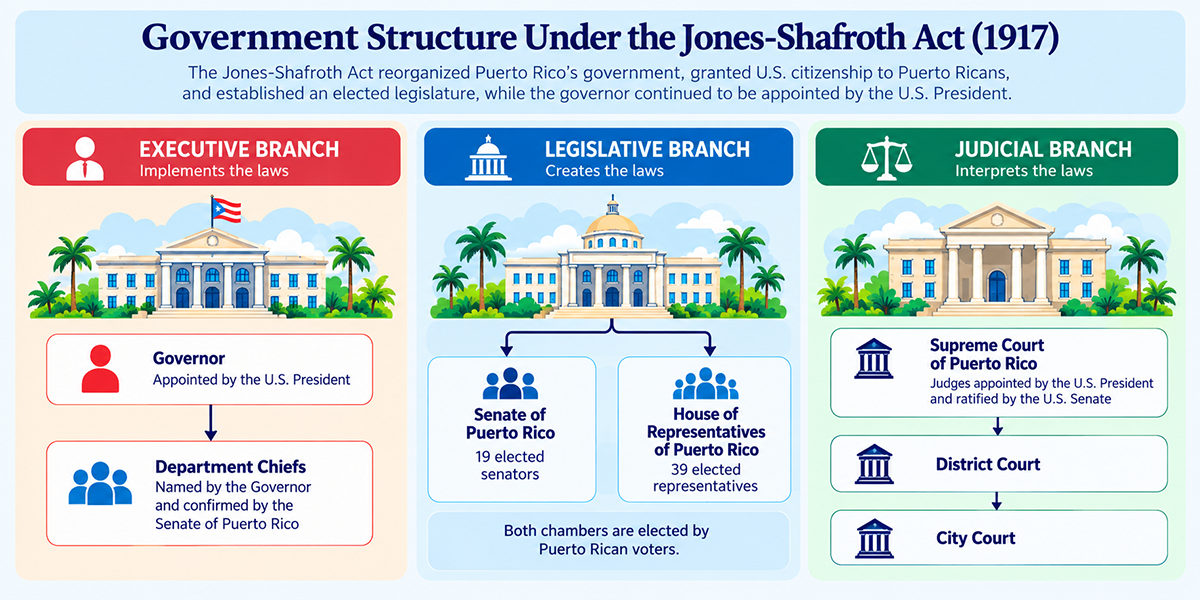
The Jones-Shafroth Act of 1917, commonly called the Jones Act of Puerto Rico, significantly reorganized Puerto Rico's government under U.S. rule. Signed by President Woodrow Wilson on March 2, 1917, the law replaced much of the governmental structure created by the Foraker Act of 1900.
Most notably, the Jones Act granted U.S. statutory citizenship to Puerto Ricans, established a bill of rights, and created a fully elected bicameral legislature. Puerto Rican voters could elect members of both the new Senate and House of Representatives, although the governor continued to be appointed by the President of the United States.
What Did the Jones Act Change?
The Jones Act expanded Puerto Rican participation in the island's government while maintaining significant federal authority. Among its major provisions:
- U.S. citizenship was granted to Puerto Ricans.
- A bill of rights was established for Puerto Rico.
- The government was divided into executive, legislative, and judicial branches.
- A 19-member Senate was created and elected by Puerto Rican voters.
- The former House of Delegates became a 39-member House of Representatives, also elected by voters.
- The governor remained appointed by the U.S. President, rather than elected by Puerto Ricans.
- Congress retained authority over Puerto Rico, and both the governor and federal government retained important powers over legislation.
A Legislature Elected by Puerto Ricans
One of the most important governmental changes was the replacement of the Foraker Act's Executive Council as the upper legislative chamber.
Under the Foraker Act, the Executive Council consisted of presidential appointees and served both executive and legislative functions. The Jones Act replaced that arrangement with a Senate elected by Puerto Rican voters, creating a legislature in which both chambers were elected locally.
The first Senate consisted of 19 senators: two elected from each of seven senatorial districts and five elected at large. The House of Representatives consisted of 39 members.
Why Was U.S. Citizenship Significant?
The Jones Act made people born in Puerto Rico U.S. citizens by statute, a major change in the political relationship established after the United States acquired Puerto Rico from Spain in 1898.
Citizenship, however, did not make Puerto Rico a state or give residents of the island the same federal political participation as residents of a state. Puerto Rico remained a U.S. territory, and Congress continued to exercise authority over the island.
What Powers Did the United States Retain?
Despite the increased role of Puerto Rican voters, the Jones Act did not establish complete local self-government. The U.S. President continued to appoint Puerto Rico's governor, and the federal government retained substantial authority over the territory.
The governor could veto legislation passed by Puerto Rico's legislature, while Congress retained authority to intervene in territorial legislation. The federal government also maintained control over areas including defense, immigration, postal services, and other federal matters.
The Evolution of Puerto Rico's Goverment
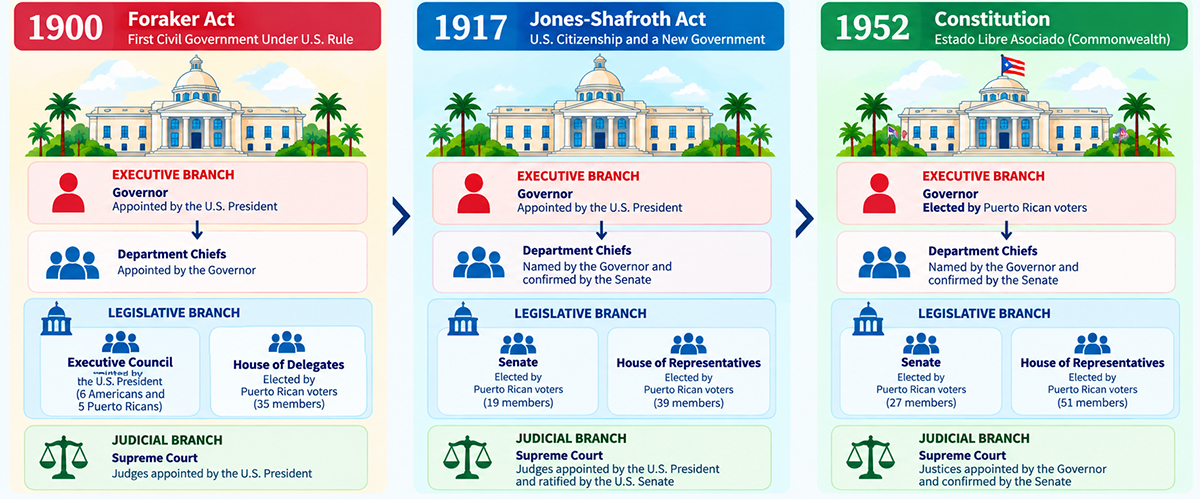
From U.S. territorial rule to the present, Puerto Rico's government has undergone significant changes in how its leaders are selected and how much authority Puerto Ricans have over their affairs.
Explore Puerto Rico's Political Evolution
Foraker Act (1900)
From military rule to civilian government.
Constitution of 1952
The foundation of Puerto Rico's modern government.


