
Puerto Rico's Commonwealth Status
What Is the Estado Libre Asociado?
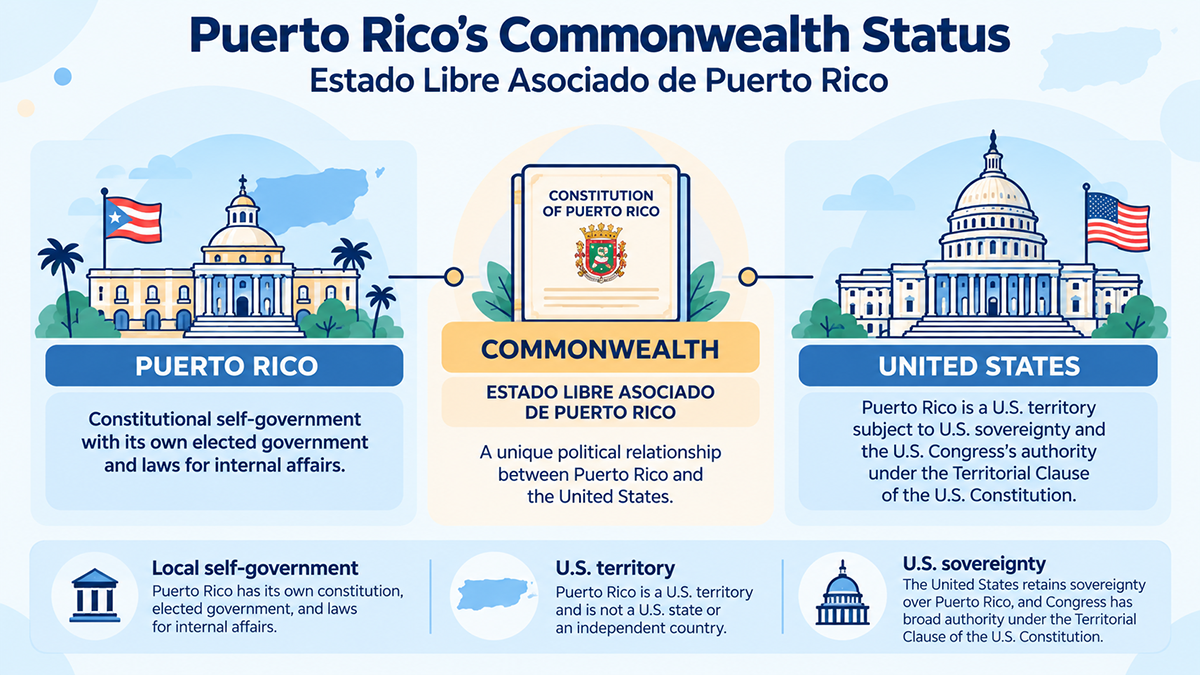
Puerto Rico's current political status is a U.S. territory with a locally elected government and its own constitution. Since 1952, Puerto Rico has officially used the name Commonwealth of Puerto Rico in English and Estado Libre Asociado de Puerto Rico in Spanish.
Commonwealth gives Puerto Rico substantial authority over its internal affairs, but it does not make Puerto Rico a U.S. state or a sovereign country. Congress retains broad authority over Puerto Rico under the U.S. Constitution's Territory Clause.
Commonwealth at a Glance
| Official English Name | Commonwealth of Puerto Rico |
|---|---|
| Spanish Name | Estado Libre Asociado de Puerto Rico |
| Established | 1952 |
| Political Status | U.S. territory |
| Local Government | Constitutional self-government |
| Sovereignty | United States |
| U.S. State? | No |
| Independent Country? | No |
What Does "Estado Libre Asociado" Mean?
Estado Libre Asociado is the official Spanish name of Puerto Rico's current form of government. It is commonly translated into English as the Commonwealth of Puerto Rico, although a literal translation of the Spanish words can sound closer to "Free Associated State."
That difference in terminology has sometimes caused confusion. Puerto Rico's current Commonwealth status is not the same as sovereignty in free association. Puerto Rico remains a U.S. territory under U.S. sovereignty rather than a sovereign country that has entered into a compact with the United States.
The creation of the Commonwealth in 1952 gave Puerto Rico substantial authority over its internal affairs through its own constitution and locally elected government. It did not, however, make Puerto Rico a U.S. state or an independent nation.
How Did Puerto Rico Become a Commonwealth?
Puerto Rico's Commonwealth government developed through a constitutional process authorized by Congress and approved by the people of Puerto Rico.
Congress enacted Public Law 600, authorizing the people of Puerto Rico to organize a constitutional government and draft their own constitution.
Puerto Rico elected delegates to a constitutional convention, which drafted a constitution. Puerto Rican voters approved the proposed constitution in a referendum on March 3, 1952.
After review and approval at the federal level, Puerto Rico's Constitution took effect on July 25, 1952, establishing the Commonwealth of Puerto Rico—Estado Libre Asociado de Puerto Rico.
How Puerto Rico's Government Works
What Powers Does Puerto Rico Have?
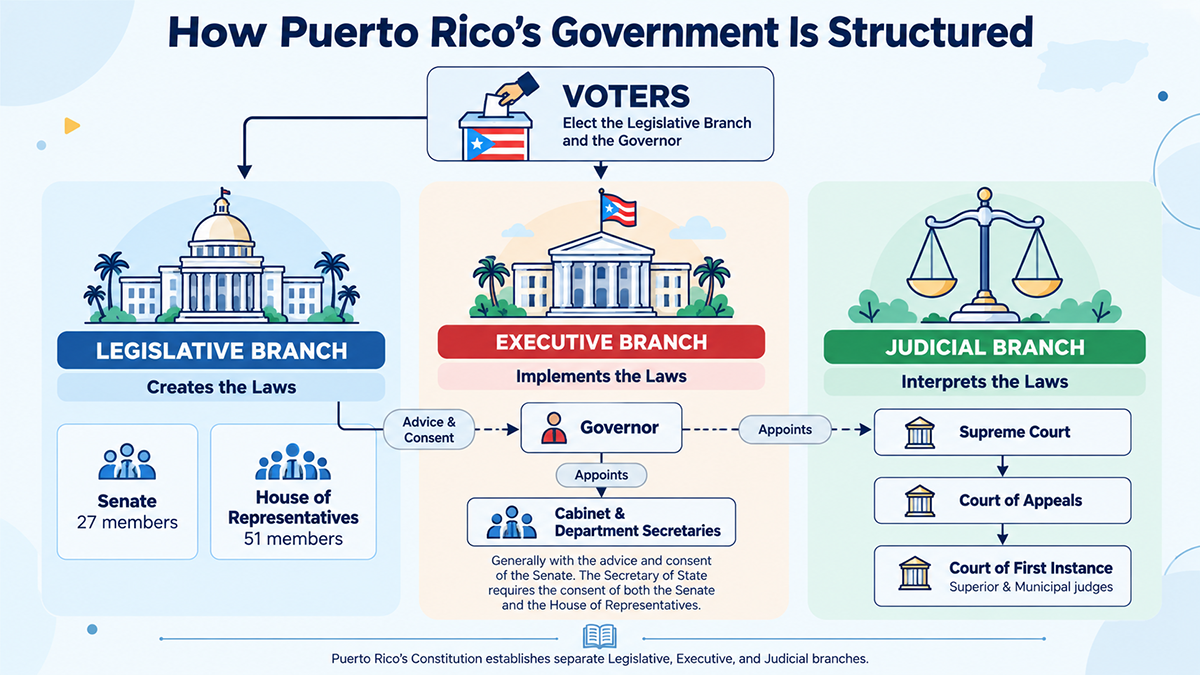
Puerto Rico has substantial authority to govern its own internal affairs. Under the Constitution of Puerto Rico, the island has its own elected government, legislature, court system, government agencies, and municipal governments.
In many areas of everyday life, Puerto Rico exercises powers similar to those exercised by state governments. The Legislative Assembly can enact laws for Puerto Rico, the Governor and executive agencies administer those laws and public programs, and Puerto Rico's courts interpret and apply Puerto Rico law.
Puerto Rico Can Make Its Own Laws
Puerto Rico has a bicameral Legislative Assembly consisting of the Senate and House of Representatives. It can enact laws covering a wide range of local matters, including education, health, public safety, transportation, economic development, environmental protection, professional licensing, and other areas of public policy.
Puerto Rico Has Its Own Executive Government
The Governor of Puerto Rico heads the executive branch and is elected by Puerto Rico voters. The government includes departments and agencies responsible for administering local laws and providing public services.
These agencies oversee areas such as education, health, transportation, natural resources, economic development, consumer affairs, public safety, and other responsibilities of the Puerto Rico government.
Puerto Rico Has Its Own Court System
Puerto Rico maintains its own judicial system for matters governed by Puerto Rico law. The Supreme Court of Puerto Rico is the highest court within that system, followed by the Court of Appeals and the Court of First Instance.
Puerto Rico's courts handle civil and criminal cases, interpret Puerto Rico's Constitution and laws, and review actions of the Puerto Rico government. Puerto Rico also has a separate federal court system for matters involving federal law.
Puerto Rico Has Its Own Tax System
Puerto Rico administers its own tax system and collects taxes used to fund the territorial government and public services. These include Puerto Rico income taxes, sales and use taxes, property-related taxes and other taxes and fees established under Puerto Rico law.
Puerto Rico's tax system operates alongside the U.S. federal tax system. Which federal taxes apply depends on the type and source of income and the taxpayer's circumstances.
Puerto Rico Administers Public Services
The Puerto Rico government has responsibility for many of the services residents encounter in everyday life, including public education, healthcare programs, police and emergency services, roads and transportation, environmental and natural-resource management, professional licensing, and economic development.
Puerto Rico Has Local Governments
Puerto Rico is divided into 78 municipalities. Each municipality has an elected mayor and municipal legislature and has authority over certain local matters established by Puerto Rico law.
Municipal governments can administer local services, manage municipal property and finances, adopt ordinances within their authority, and address community needs.
Local Authority vs. Sovereignty
Puerto Rico's powers over local affairs should not be confused with national sovereignty. Puerto Rico can govern many aspects of life on the island, but it cannot independently exercise powers reserved to the United States, such as conducting foreign policy, establishing a separate national immigration system, entering international treaties as a sovereign country, or determining Puerto Rico's political relationship with the United States.
This division of authority is central to understanding Commonwealth: Puerto Rico has substantial local self-government, while the United States retains sovereignty and Congress retains constitutional authority over the territory.
What Authority Does the Federal Government Retain?
Although Puerto Rico manages many of its own internal affairs, it remains a territory of the United States. Under the Territory Clause of the U.S. Constitution, Congress has broad authority to make laws and regulations concerning U.S. territories.
Federal laws apply in Puerto Rico according to federal constitutional and statutory rules. The federal government also retains authority in areas such as immigration, foreign affairs, national defense, interstate and international commerce, federal taxation, and other matters governed by federal law.
Puerto Rico cannot independently conduct foreign policy, enter international treaties as a sovereign nation, or establish its own immigration system. Congress also determines how many federal programs and federal laws apply to Puerto Rico and can legislate specifically for the territory.
The relationship therefore combines substantial local self-government with continued federal authority. Puerto Rico's elected government administers local affairs under its constitution, while the United States retains sovereignty and Congress retains its constitutional authority over the territory.
Commonwealth Is Not the Same as Free Association
The terms can sound similar, particularly because Estado Libre Asociado is sometimes translated literally as "Free Associated State." Legally, however, Puerto Rico's current Commonwealth status and sovereignty in free association are fundamentally different arrangements.
Commonwealth
Puerto Rico remains a U.S. territory.
The United States retains sovereignty, Puerto Rico operates under its locally adopted constitution, and Congress retains authority under the Territory Clause of the U.S. Constitution.
Free Association
Puerto Rico would be a sovereign nation.
Puerto Rico and the United States would establish their future relationship through a negotiated compact addressing matters that could include trade, economic assistance, migration, defense, and other areas agreed upon by both governments.
Commonwealth and Puerto Rico's Status Debate
Puerto Rico's relationship with the United States has been the subject of political debate for decades. Supporters of different status options have proposed maintaining or changing the island's relationship with the United States, and Puerto Rico has held several plebiscites to measure voter preferences.
The principal alternatives discussed in recent status debates include statehood, independence, and sovereignty in free association. Proposals concerning the continuation or modification of Commonwealth have also played an important role in Puerto Rico's political history.
Status plebiscites express the preferences of Puerto Rico's voters, but a plebiscite by itself does not change Puerto Rico's political status. Changing the legal relationship between Puerto Rico and the United States requires federal action.
Explore Puerto Rico's Political Status
Commonwealth ≠ Free Association
Despite the Spanish name Estado Libre Asociado, Puerto Rico's current Commonwealth status is not the same as sovereignty in free association. Under the current status Puerto Rico remains a U.S. territory; free association is a relationship between sovereign nations.
The Evolution of Puerto Rico's Goverment
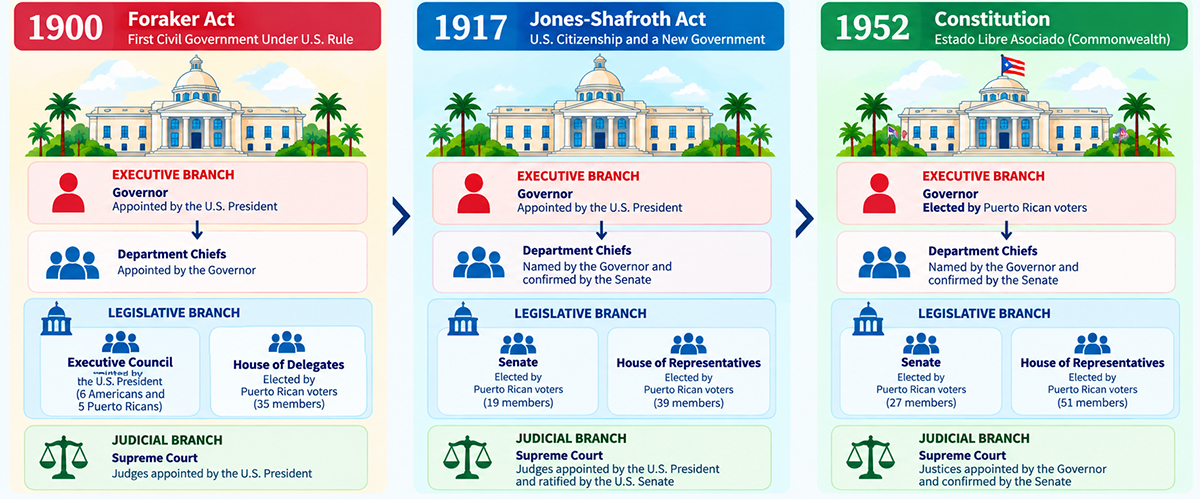
From U.S. territorial rule to the present, Puerto Rico's government has undergone significant changes in how its leaders are selected and how much authority Puerto Ricans have over their affairs.
Explore Puerto Rico's Political Evolution
Foraker Act (1900)
From military rule to civilian government.
Jones-Shafroth Act (1917)
U.S. citizenship and greater elected representation.
Frequently Asked Questions
What does Estado Libre Asociado mean?
Estado Libre Asociado is the official Spanish name for Puerto Rico's Commonwealth government. Although the words can be translated literally as "Free Associated State," Puerto Rico's current status is not the same as sovereignty in free association.
Is Puerto Rico a U.S. state?
No. Puerto Rico is a U.S. territory with its own constitution and locally elected government.
Is Puerto Rico an independent country?
No. Puerto Rico is under U.S. sovereignty and is not an independent nation.
Does Puerto Rico have its own government?
Yes. Puerto Rico has its own constitution, governor, legislature, courts, government agencies, and municipal governments. It exercises substantial authority over local affairs.
Is Commonwealth the same as free association?
No. Under Commonwealth, Puerto Rico remains a U.S. territory. Under sovereignty in free association, Puerto Rico would be a sovereign nation with a negotiated political relationship with the United States.
Can Puerto Rico change its political status on its own?
Puerto Ricans can express their preferred political status through elections and plebiscites, but changing Puerto Rico's legal relationship with the United States requires federal legislation.
Did You Know?
Each of Puerto Rico's 78 municipalities celebrates its own patron saint with annual Fiestas Patronales.
Get Our Newsletter
Discover new places, local flavors, upcoming events, cultural stories, and some of our favorite finds from around the island.Read the Latest ¡La Isla! Newsletter
Follow Along


