
The Foraker Act of 1900: Puerto Rico's First Civil Government Under U.S. Rule
After Puerto Rico was ceded by Spain to the United States in 1898, the island was governed by the U.S. military for approximately two years. Congress then passed the Foraker Act, also known as the Organic Act of 1900, establishing Puerto Rico's first civilian government under U.S. rule. The law took effect on May 1, 1900.
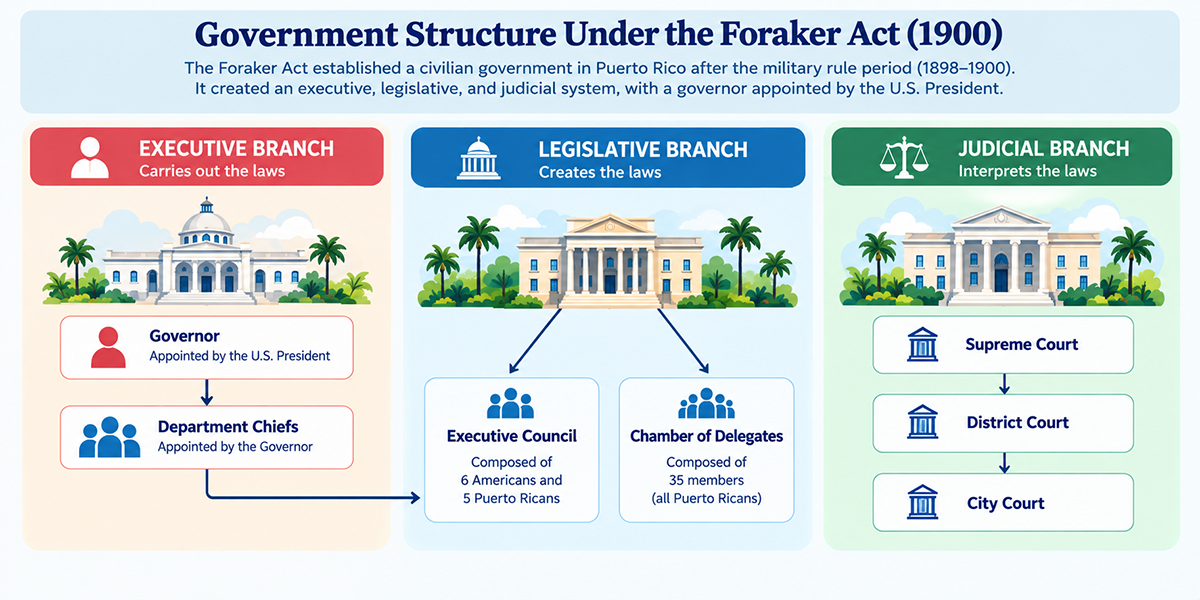
The new government included executive, legislative, and judicial branches, but political authority was divided very differently from Puerto Rico's government today. The President of the United States appointed the governor and the members of the Executive Council, while Puerto Rican voters elected the 35 members of the House of Delegates. The Executive Council also served as the upper chamber of the legislature, giving presidential appointees a significant role in making Puerto Rico's laws.
What Did the Foraker Act Establish?
The law created several important features of Puerto Rico's new civil government:
- A civilian governor appointed by the President of the United States.
- An Executive Council that served both executive and legislative functions.
- A 35-member House of Delegates elected by qualified Puerto Rican voters.
- A judicial system, including a Supreme Court.
- A Resident Commissioner to represent Puerto Rico in Washington, although without a vote in Congress.
- Application of U.S. federal laws to Puerto Rico, with exceptions for laws considered locally inapplicable. Research Guides
Why Was the Foraker Act Important?
The Foraker Act marked the transition from U.S. military rule to civilian government and established an early framework for the political relationship between Puerto Rico and the United States. However, Puerto Ricans did not yet have control over many of the government's most powerful positions. The governor, Executive Council, and Puerto Rico Supreme Court justices were appointed rather than elected locally, and Congress retained authority over Puerto Rico and could annul laws passed by its legislature.
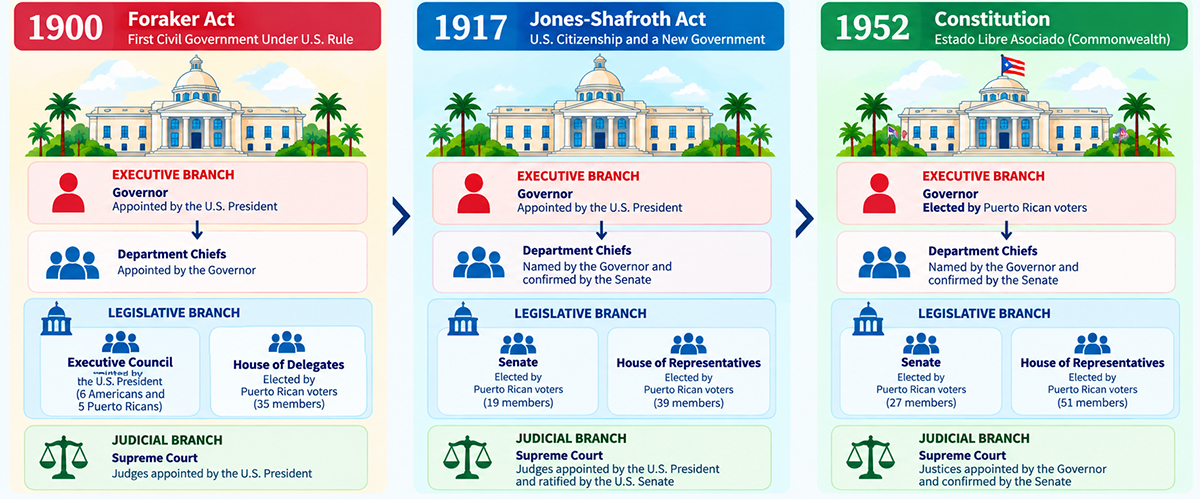
The system created by the Foraker Act remained in place until the Jones-Shafroth Act of 1917 reorganized Puerto Rico's government and granted U.S. citizenship to Puerto Ricans. Puerto Rico's governmental structure continued to evolve afterward, eventually leading to an elected governor and the adoption of the Constitution of Puerto Rico in 1952.
The Evolution of Puerto Rico's Goverment
From U.S. territorial rule to the present, Puerto Rico's government has undergone significant changes in how its leaders are selected and how much authority Puerto Ricans have over their affairs.
Explore Puerto Rico's Political Evolution
Jones-Shafroth Act (1917)
U.S. citizenship and greater elected representation.
Constitution of 1952
The foundation of Puerto Rico's modern government.
Did You Know?
Nearly everyone has health insurance.
Get Our Newsletter
Discover new places, local flavors, upcoming events, cultural stories, and some of our favorite finds from around the island.Read the Latest ¡La Isla! Newsletter
Follow Along


