
Arecibo Observatory
A Legacy of Scientific Discovery
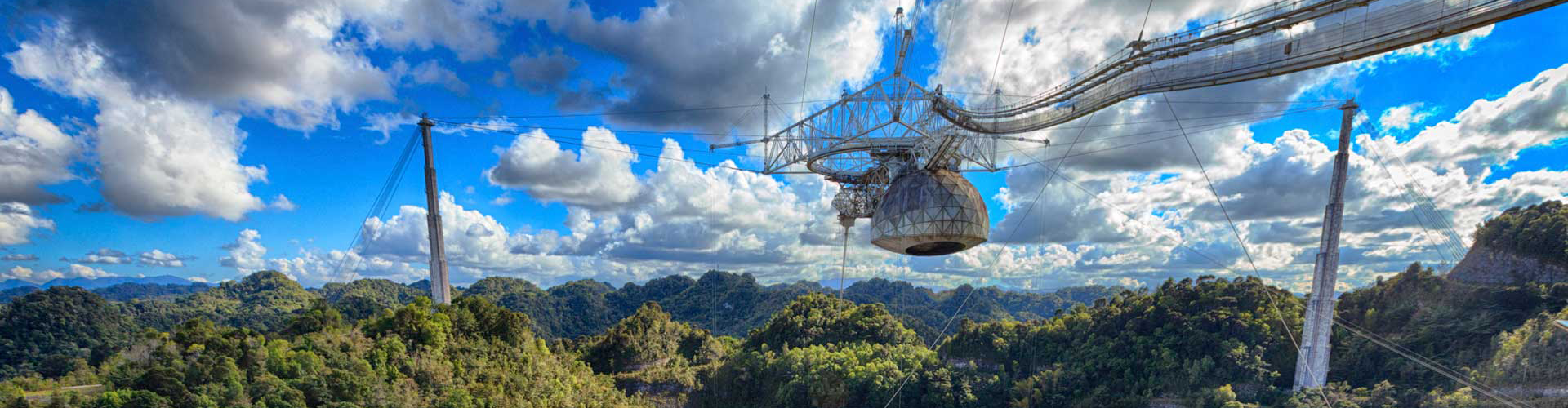
For nearly six decades, the Arecibo Observatory in Puerto Rico was one of the world's most important centers for radio astronomy and planetary science. Nestled among the limestone hills of Arecibo, its enormous 305-meter (1,000-foot) radio telescope helped scientists investigate distant stars, discover planets beyond our solar system, study Earth's atmosphere, and test fundamental theories about the universe.
Completed in 1963, the observatory became an international symbol of scientific discovery and an important part of Puerto Rico's scientific heritage. Although its iconic telescope collapsed on December 1, 2020, the site's legacy continues through scientific research, education, and the Arecibo C3 STEM Center.
Arecibo Observatory at a Glance
| Location | Esperanza, Arecibo, Puerto Rico |
|---|---|
| Opened | November 1, 1963 |
| Main telescope | 305 meters (1,000 feet) in diameter |
| Primary research | Radio astronomy, planetary radar, and atmospheric science |
| Original director | William E. Gordon |
| Major discoveries | Binary pulsars, planets outside our solar system, and planetary radar observations |
| Telescope collapse | December 1, 2020 |
| Site today | NSF Arecibo Observatory Historic District and Arecibo C3 STEM Center |
History of the Arecibo Observatory
The Arecibo Observatory originated during the early years of the space age, when scientists sought better ways to investigate Earth's upper atmosphere and the universe using radio waves. Physicist William E. Gordon of Cornell University played a leading role in developing the project, which initially focused on studying the ionosphere, a region of Earth's atmosphere containing electrically charged particles.
Construction began in 1960 in a natural limestone depression in the mountains south of the city of Arecibo. The surrounding karst landscape provided a suitable location for an enormous stationary reflector. The telescope was completed in 1963 and quickly developed into a major international research facility.
Over the following decades, improvements to its receivers, radar systems, and suspended equipment platform expanded its scientific capabilities. The telescope remained the world's largest single-aperture radio telescope until China's Five-hundred-meter Aperture Spherical Telescope (FAST) surpassed it in 2016.
How Did the Arecibo Telescope Work?
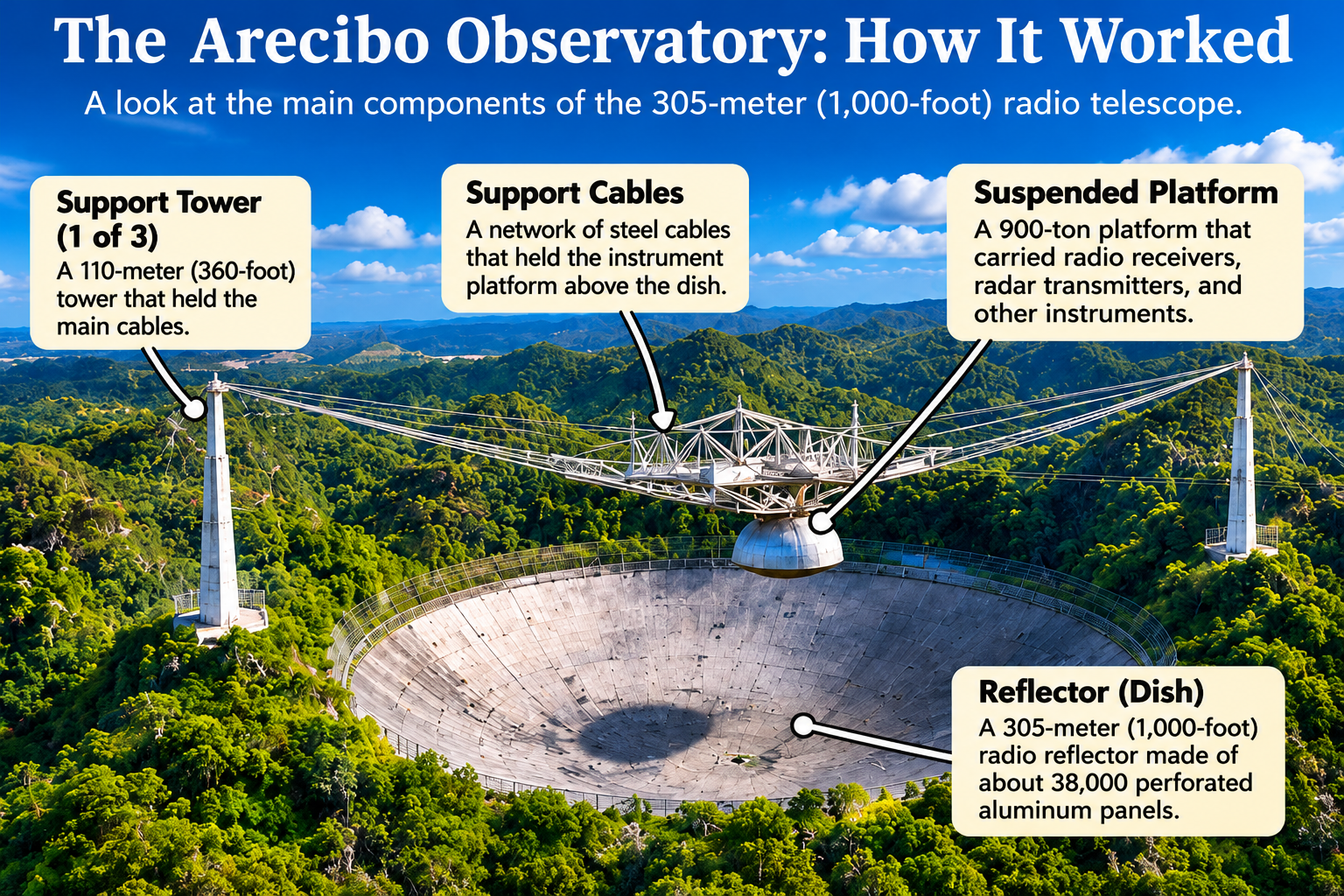
Unlike an optical telescope that collects visible light, Arecibo used radio waves to study objects in space and processes in Earth's atmosphere. Its enormous spherical reflector collected faint radio signals and directed them toward specialized receivers suspended high above the dish.
The telescope's 305-meter reflector was built into the landscape and could not rotate like a conventional telescope. Instead, movable equipment above the reflector allowed scientists to observe different regions of the sky within the telescope's viewing range.
Arecibo also operated a powerful planetary radar system. By transmitting radio signals toward nearby celestial objects and analyzing their returning echoes, researchers could study planetary surfaces and investigate the shapes, motions, and other properties of asteroids.
Major Scientific Discoveries
Testing Einstein's Theory of Relativity
In 1974, astronomers Russell Hulse and Joseph Taylor discovered the first binary pulsar using the Arecibo telescope. Their observations revealed a rapidly rotating neutron star orbiting another compact star.
Continued measurements of this system provided important indirect evidence of gravitational waves, supporting a major prediction of Albert Einstein's general theory of relativity. Hulse and Taylor received the 1993 Nobel Prize in Physics for their discovery.
Discovering Planets Beyond Our Solar System
In 1992, astronomers announced the discovery of planets orbiting the pulsar PSR B1257+12 using observations made with Arecibo. These were the first confirmed planets discovered outside our solar system, demonstrating that planetary systems could exist in unexpected environments.
Exploring Planets and Asteroids
Arecibo's radar capabilities helped scientists study the surfaces and rotation of planets, including Mercury and Venus. The observatory also played an important role in characterizing near-Earth asteroids, helping researchers better understand their size, shape, rotation, and trajectories.
Studying Earth's Atmosphere
Beyond astronomy, Arecibo supported research into Earth's ionosphere and upper atmosphere. Scientists used its instruments to investigate how charged particles interact with radio waves and how the atmosphere responds to solar activity.
The Arecibo Message: A Signal Into Space
On November 16, 1974, the observatory transmitted a short radio message toward the globular star cluster Messier 13 (M13). Designed as a demonstration of the telescope's capabilities, the message contained 1,679 binary digits representing information about mathematics, chemistry, DNA, humanity, and the solar system.
The transmission became known as the Arecibo Message. It was primarily a symbolic demonstration rather than a realistic attempt to begin an immediate conversation with extraterrestrial civilizations. Its lasting significance lies in the questions it raised about communicating across enormous distances and between potentially very different forms of intelligence.
What Caused the Arecibo Observatory to Collapse?
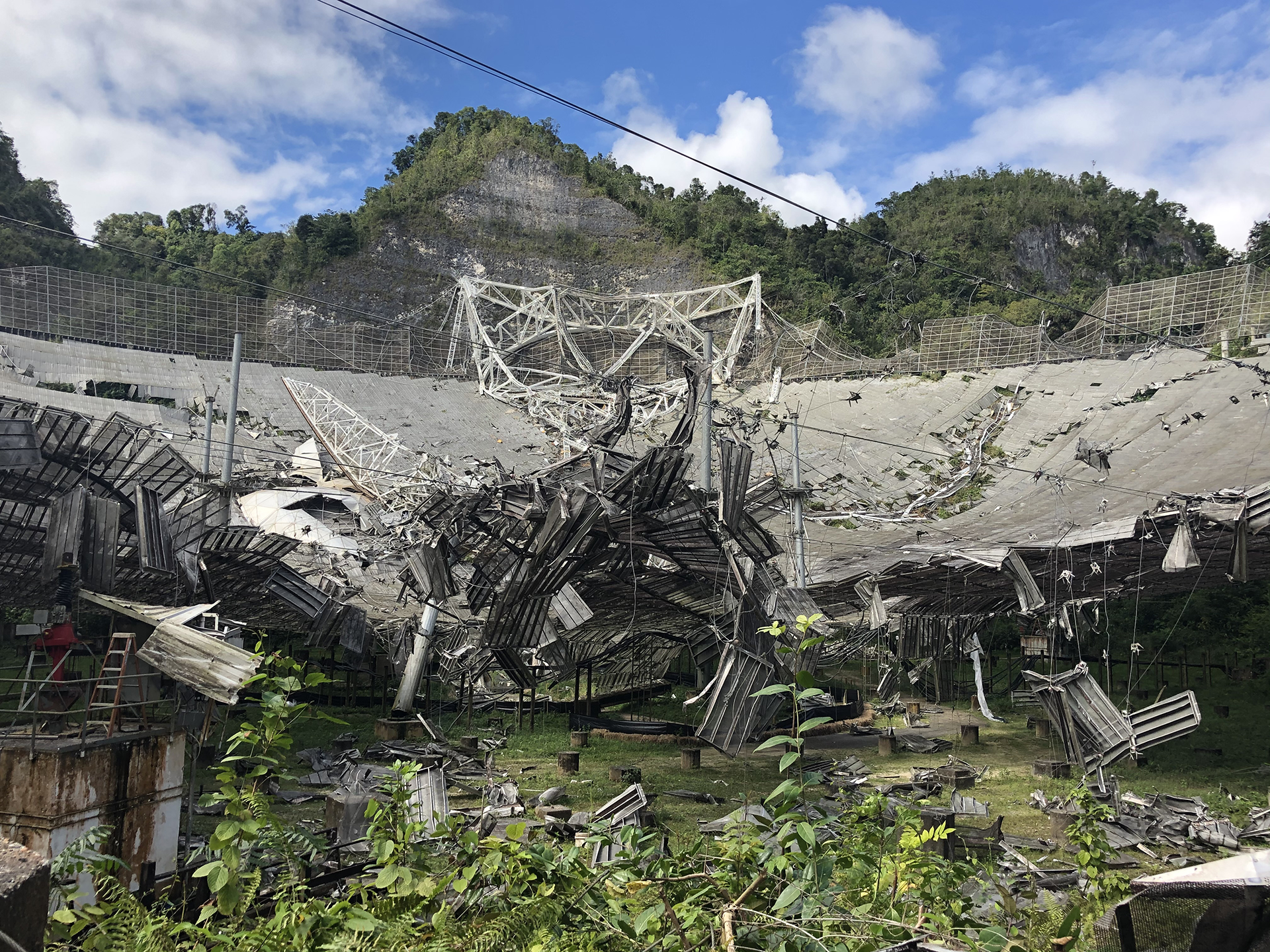
The telescope's collapse on December 1, 2020, followed a series of cable failures that weakened the structure supporting its suspended instrument platform.
Hurricane Maria in September 2017 subjected the telescope's supporting cables to extraordinary stresses. Inspections later revealed signs of deterioration and movement within some cable connections. On August 10, 2020, an auxiliary cable pulled out of its socket, damaging the reflector below. A second cable failed on November 6, increasing concerns about the stability of the structure.
On November 19, 2020, the National Science Foundation announced that engineers had determined the telescope could not be safely repaired and would need to be decommissioned. Before that process could be completed, additional structural failures caused the suspended platform to fall into the reflector on December 1.
What the Investigation Found
According to a 2024 investigation by the National Academies of Sciences, Engineering, and Medicine, the root cause of the Arecibo telescope's collapse was accelerated, long-term zinc creep within the sockets anchoring its supporting cables.
Zinc creep occurs when zinc gradually deforms under sustained stress. Over time, this deterioration compromised the cable connections and contributed to the structural failures that ultimately caused the suspended platform to collapse on December 1, 2020.
The investigation also identified warning signs that were not adequately addressed. The findings highlighted the importance of responding to structural deterioration, improving inspection procedures, and recognizing potential failures before they become catastrophic.
Why Wasn't the Telescope Repaired Before It Collapsed?
It as the result of a sequence of events:
| 2017 |
Hurricane Maria damages the facility
Inspections revealed deterioration in cable connections. However, some needed repairs were not classified as urgent, and the repair process remained incomplete. |
| Aug. 10, 2020 |
A supporting cable pulls out
One cable failed unexpectedly, damaging the dish. Engineers began planning emergency stabilization. |
| Nov. 6, 2020 |
A second cable fails
This occurred just three days before planned stabilization work. The remaining cables were placed under greater stress. |
| Nov. 19, 2020 |
NSF decides repairs are too dangerous
Engineers concluded they could not safely stabilize the structure without risking workers' lives. The National Science Foundation announced plans for controlled decommissioning. |
| Dec. 1, 2020 |
The telescope collapses
Before decommissioning could take place, another cable failed and the approximately 900-ton suspended platform crashed into the dish. |
Could the Collapse Have Been Prevented?
Possibly, yes. That is one of the most important conclusions from the 2024 investigation.
The report found that visible cable deterioration after Hurricane Maria should have prompted stronger corrective action. It also found that existing engineering assessments did not adequately account for the progressive loss of strength in the cable sockets.
But it did not conclude that a single straightforward repair would definitely have prevented the collapse.
What makes this particularly significant for Puerto Rico
Arecibo wasn't just a radio telescope. It was one of Puerto Rico's most internationally recognized scientific institutions, associated with major discoveries in radio astronomy, planetary science, and the study of near-Earth asteroids.
The loss also affected generations of Puerto Rican scientists, engineers, students, and visitors who saw it as a symbol of the island's contributions to global science.
What Remains of the Arecibo Observatory Today?
Although the 305-meter radio telescope is no longer operational, the historic observatory site remains an important part of Puerto Rico's scientific heritage.
The Arecibo C3 STEM Center is developing the site as a destination for science education, computational skills, research, and community engagement. Visitors can learn about the observatory's discoveries through historical interpretation, exhibits, and views of the preserved telescope remains.
Can You Visit the Arecibo Observatory?
Yes. The Arecibo C3 STEM Center offers limited public visits and educational programs. General admission experiences may include a preview of the Signals exhibition, historical interpretation, and views of the telescope's remains.
Visitors must reserve tickets in advance, and availability varies by program and date. Some areas have limited accessibility. Check the official Arecibo C3 visitor information for current hours, tickets, and visitor requirements before traveling.
A Scientific Legacy That Continues
For generations of scientists, students, and Puerto Ricans, the Arecibo Observatory represented the power of curiosity and discovery. Its contributions transformed our understanding of the universe, while its unmistakable silhouette became one of Puerto Rico's most recognizable scientific landmarks.
Although the great telescope is gone, the knowledge it helped create and the scientists it inspired remain an enduring part of Puerto Rico's contribution to global science.
Will the Arecibo Telescope Be Rebuilt?
That was a separate decision, involving money, scientific priorities, and federal funding.
- Rebuilding was not a simple repair. The suspended platform, cables, and reflector had suffered catastrophic damage. Restoring the telescope would have required a major reconstruction project.
- NSF had competing priorities. Even before the collapse, the agency had been reviewing Arecibo's long-term operating costs and funding arrangements.
- NSF chose a different future for the site. In 2022, it announced plans to prioritize STEM education and research rather than reconstruct the 305-meter telescope. In 2023, it committed more than $5 million over five years to a new educational initiative.
The decision was not that Arecibo had stopped being scientifically valuable. It reflected NSF's choice not to fund reconstruction of the original instrument within its available resources and priorities.
Frequently Asked Questions
Why was the Arecibo Observatory built in Puerto Rico?
Puerto Rico offered a suitable location for the enormous radio telescope, including a natural limestone depression that could accommodate its 305-meter reflector. The observatory was originally developed to study Earth's ionosphere and later became a major center for radio astronomy and planetary science.
When was the Arecibo Observatory built?
Construction began in 1960, and the Arecibo Observatory officially opened on November 1, 1963. It operated for nearly six decades before its main radio telescope collapsed in December 2020.
What important discoveries were made at the Arecibo Observatory?
Arecibo contributed to major scientific discoveries, including the first binary pulsar in 1974 and the first confirmed planets outside our solar system in 1992. Its observations also advanced research into gravitational waves, planetary radar, near-Earth asteroids, and Earth's upper atmosphere.
What was the Arecibo Message?
The Arecibo Message was a radio transmission sent toward the globular star cluster Messier 13 on November 16, 1974. It contained 1,679 binary digits representing information about mathematics, chemistry, DNA, humanity, and our solar system. The transmission demonstrated the telescope's capabilities and became a symbol of humanity's interest in communicating with extraterrestrial civilizations.
What caused the Arecibo Observatory to collapse?
The telescope collapsed on December 1, 2020, after a series of failures in the cables supporting its suspended instrument platform. A 2024 investigation identified accelerated zinc creep within the cable sockets as the root cause. Damage associated with Hurricane Maria and subsequent cable failures contributed to the sequence of events.
Will the Arecibo Telescope be rebuilt?
There are no announced plans to rebuild the original 305-meter telescope. Instead, the National Science Foundation has supported a transition toward science education and STEM programs at the historic site, including the Arecibo C3 STEM Center.
Can you visit the Arecibo Observatory today?
Yes. The Arecibo C3 STEM Center offers educational visits, exhibits, and opportunities to learn about the observatory's scientific legacy. Advance reservations are required for available visits, and access may be limited. Check the official Arecibo C3 website for current information.
Sources and Further Reading
The following resources provide additional information about the Arecibo Observatory, its scientific discoveries, the 2020 telescope collapse, and the site's continuing educational mission.
-
National Science Foundation (NSF)
Official information about the Arecibo Observatory, its history, scientific contributions, and transition toward STEM education.
National Science Foundation – Arecibo Observatory -
National Academies of Sciences, Engineering, and Medicine
The 2024 investigation into the telescope's collapse, including the structural failures and findings concerning accelerated zinc creep in the cable sockets.
Failure Analysis of the Arecibo Observatory 305-Meter Telescope -
NASA
Historical information about the observatory's contributions to astronomy, planetary radar, and scientific research.
NASA Science -
The Nobel Prize
Information about the 1993 Nobel Prize in Physics awarded to Russell Hulse and Joseph Taylor for discovering the first binary pulsar using the Arecibo telescope.
The Nobel Prize in Physics 1993 -
Arecibo C3 STEM Center
Current visitor information, educational exhibits, admission requirements, and programs at the former observatory site.
Arecibo C3 – Plan Your Visit
Did You Know?
Jones Act is a federal law requiring that goods shipped between U.S. ports are transported on ships built, owned, and operated by U.S. citizens or permanent residents.
Get Our Newsletter
Discover new places, local flavors, upcoming events, cultural stories, and some of our favorite finds from around the island.Read the Latest ¡La Isla! Newsletter
Follow Along


