
Hatillo, Puerto Rico
(ah-TEE-yo)
Hatillo is located on Puerto Rico's northern coast between Camuy and Arecibo. Known as "La Capital de la Industria Lechera" (Puerto Rico's Dairy Capital), the municipality produces a significant portion of the island's fresh milk and has long been one of Puerto Rico's agricultural centers. It is also known as "El Pueblo sin Sopa" (the town without soup).
Overview
Why Visit Hatillo?
Known as Puerto Rico's Dairy Capital, Hatillo offers visitors a different side of the island—one rooted in agriculture, local traditions, and beautiful Atlantic scenery. While many travelers pass through on their way west, those who stop discover uncrowded beaches, dramatic limestone coastlines, delicious local restaurants, and one of Puerto Rico's most colorful cultural celebrations, the famous Festival de las Máscaras.
Hatillo is an excellent destination for travelers looking to experience authentic Puerto Rican culture away from the busiest tourist areas. Whether you're enjoying fresh seafood overlooking the ocean, exploring the rugged north coast, or visiting during festival season, Hatillo combines small-town hospitality with unique attractions found nowhere else on the island.
Top Things to Do in Hatillo
Festival de las Máscaras
Held every December, Hatillo's Festival de las Máscaras is one of Puerto Rico's most distinctive cultural celebrations. Hundreds of participants dressed as colorful masked riders parade through town, preserving a tradition that dates back generations and commemorates the biblical story of King Herod.
Playa Sardinera
One of Hatillo's most popular beaches, Playa Sardinera is known for its long stretch of sand, scenic Atlantic views, and relaxing atmosphere. It's a favorite for walking, fishing, and enjoying ocean breezes.
Peñón Brusi
This rocky coastal area offers dramatic limestone formations, ocean vistas, and several seafood restaurants where visitors can enjoy fresh local cuisine overlooking the Atlantic Ocean.
Paseo Lineal de Hatillo
This scenic waterfront promenade provides a pleasant place for walking, jogging, cycling, and enjoying sunsets along the northern coast.
Plaza José R. Millán
The town's central plaza is surrounded by historic buildings, local businesses, and the beautiful Nuestra Señora del Carmen Parish. Throughout the year it serves as the gathering place for festivals and community events.
Iglesia Nuestra Señora del Carmen
Founded during the early years of Hatillo's history, this historic Catholic church remains one of the municipality's most recognizable landmarks and continues to serve the local community.
Monumento a las Máscaras de Hatillo
The Monumento a las Máscaras honors the municipality's famous masked celebration. It is a useful stop for travelers who are unable to visit during the December festival but want to understand how important the tradition is to Hatillo's identity.
The monument also provides a good photo opportunity and introduces visitors to the exaggerated forms, bold colors, and playful character associated with Hatillo's festival masks.
Monumento al Ganadero y Productor de Leche
This monument honors the cattle ranchers and dairy producers who helped shape Hatillo's economy and landscape. It reflects the pride residents take in the municipality's role as one of Puerto Rico's principal milk-producing areas.
For travelers, it is more meaningful after driving through Hatillo's rural barrios and seeing the surrounding pastures and farms.
Vaca Negra
Vaca Negra is one of Hatillo's most interesting stops for food-loving travelers. The company produces aged cheeses and other dairy products using milk connected with Puerto Rico's local dairy industry.
Visitors can sample cheeses, purchase products to take home, and learn more about the cheesemaking process. Depending on the current schedule, workshops or special experiences may also be available.
This attraction is especially appropriate in Hatillo because dairy farming is such an important part of the municipality's identity. It gives visitors a chance to taste a product directly connected with the surrounding landscape.
Nearby Río Camuy Cave Park
Located just minutes from Hatillo, the Río Camuy Cave Park is one of the world's largest cave systems open to visitors, making Hatillo an excellent base for exploring one of Puerto Rico's greatest natural attractions.
Plan your Visit
Located along Puerto Rico's northern coast, Hatillo is easy to reach from San Juan and makes an excellent stop while exploring the island's North Region.
Getting There
By Air
Hatillo is approximately 1 hour from Luis Muñoz Marín International Airport (SJU) in San Juan via PR-22. Rafael Hernández Airport (BQN) in Aguadilla is about 45 minutes away, making both airports convenient entry points.
By Car
The municipality is located directly along PR-22 (José de Diego Expressway), one of Puerto Rico's primary highways, making it easily accessible from San Juan, Arecibo, Aguadilla, and other northern municipalities.
Getting Around
Rental Car
A rental car is highly recommended. Many of Hatillo's beaches, restaurants, farms, and natural attractions are spread throughout the municipality and are easiest to reach by car.
Taxis & Rideshare
Taxis and rideshare may be available, but service can be limited compared with San Juan.
Walking
Downtown Hatillo is pedestrian-friendly, allowing visitors to comfortably explore the central plaza, local shops, restaurants, and historic church on foot.
Nature & Resources
Geography
Hatillo sits along Puerto Rico's Atlantic coast within the island's northern limestone karst region, north Lares and Utuado; east of Camuy; and west of Arecibo. The municipality covers approximately 42 square miles. This unique landscape features rolling hills, fertile farmland, caves, sinkholes, underground rivers, and rugged coastal cliffs that have shaped both the municipality's scenery and economy.
The municipality is best known for its extensive dairy farms, making agriculture one of the defining characteristics of the region. The coastline offers beaches, rocky headlands, and spectacular ocean views, while nearby natural attractions such as Río Camuy Cave Park showcase one of the Caribbean's most impressive cave systems.
Rivers and Water Resources
Several streams and river systems cross the municipality as water moves from the interior hills toward the Atlantic. These waterways have supported agriculture, settlements, and livestock farming throughout Hatillo's history.
Heavy tropical rain can cause water levels to rise quickly. Visitors should never attempt to cross a flooded road or enter a river during severe weather.
Neighborhoods & Barrios
Hatillo is made up of 10 barrios (PDF) (wards/districts):
- Aibonito
- Bayaney
- Buena Vista
- Campo Alegre
- Capáez
- Carrizales
- Corcovado
- Hatillo
- Naranjito
- Pueblo
Climate
Hatillo enjoys a warm tropical climate year-round, with average daytime temperatures ranging from the upper 70s during winter to the upper 80s during summer. The refreshing Atlantic trade winds help moderate temperatures throughout much of the year.
Rainfall is fairly evenly distributed, although the wettest months generally occur from May through November. Hurricane season runs from June through November, while December through April typically offers the driest weather and is considered the most popular time to visit.
10 Day Forecast from weather.com
Where to Stay
Hotels & Inns
- Parador El Buen Café
These hotels offer convenient access to downtown Hatillo, nearby attractions, restaurants, and Puerto Rico's scenic northern coast.
Local Flavors & Festivities
Where to Eat
- Menta Cuisine
- Sabor Isleño Hatillo
- Brisas del Campo
- Marilyn's Bar & Grill
- Delicias
- El Platanal Hatillo
- Rancho del Norte Hatillo
- Black Pepper Bistro & Bar
- Camila's Café
- Miti Miti Coffee Shop
Festivals and Events
Displaying 5 results.
-
Carnaval de Hatillo
- December
Famous for the Festival de las Máscaras, commemorating the Day of the Holy Innocents with costumed riders, elaborate masks, parades, music, and unique local traditions.
-
Festival de las Mascaras
- December
Colorful masks and costumes decorate Hatillo Festival of Masks. The festivities include dances, food, parades.(787) 898-3835
-
Festival del Guiro
- December
Traditionally held during the Christmas season. This celebration highlights the güiro, a percussion instrument closely associated with traditional Puerto Rican music, especially during the island's long Christmas season.(787) 898-3840
-
Festival Nacional de las Máscaras
- December
Traditional festival showcasing Puerto Rico's famous handcrafted masks, cultural exhibitions, artisan markets, live music, and the island's unique masquerade traditions.
-
Fiestas Patronales de Nuestra Sra. del Carmen
- July
Every year, Hatillo celebrates a patron saint festival. The festivities include dances, food, parades and religious processions.(787) 898-3840
History
Before Spanish colonization, the area now known as Hatillo was inhabited by the Taíno people, who relied on the fertile land, nearby rivers, and Atlantic coast for farming, fishing, and trade.
During the Spanish colonial period, settlers established farms and ranches throughout the region. Hatillo officially became a municipality on June 30, 1823, after separating from Camuy. Throughout the 19th century, agriculture became the foundation of the local economy, eventually evolving into one of Puerto Rico's largest dairy-producing regions.
Today, Hatillo is recognized as Puerto Rico's Dairy Capital while continuing to preserve its agricultural heritage, vibrant traditions, and welcoming small-town character.
Moments in History
Taíno communities inhabit the area.
Agustín Ruiz Miranda founds Hatillo on June 30.
Agriculture becomes the municipality's primary economic activity.
Cattle raising, subsistence farming, and sugarcane contribute to the local economy.
Hatillo is temporarily annexed to the neighboring municipality of Camuy.
Hatillo regains its status as an independent municipality.
Hatillo remains Puerto Rico's leading dairy-producing municipality.
Notable People
Hatillo has been the birthplace of distinguished Puerto Ricans whose work has influenced politics, literature, visual arts, religion, entertainment, music, and international fashion.
Famous Hatillanos
Francisco M. Susoni Abreu
1876–1954
Medicine • Politics
A physician, legislator, and political leader, Susoni served in Puerto Rico's first elected Senate, later became vice president of the Senate, and also presided over the House of Representatives. He was the first gubernatorial candidate of the Puerto Rican Independence Party.
Oscar Colón Delgado
1889–1968
Visual Arts • Education
A self-taught painter and educator known for his depictions of Puerto Rican landscapes and rural life. He founded art schools in Arecibo, Caguas, Utuado, and Hatillo, helping make art education more accessible beyond San Juan.
José P. H. Hernández
1892–1922
Poetry • Music
A modernist poet, musician, and pharmacist whose writing explored love, nature, beauty, sorrow, and mortality. His best-known collections include Coplas de la vereda, El último combate, and the posthumously published Cantos de la Sierra.
Juanita García Peraza
1897–1970
Religion • Community Leadership
Founder of the Congregación Mita, a Puerto Rican religious movement with Protestant roots. Known to followers as Mita, she became an influential spiritual leader whose ministry expanded beyond Puerto Rico into the mainland United States and Latin America.
Miguelito Alcaide
1934–1988
Music • Composition
A guitarist, singer, composer, and celebrated requinto player. Alcaide performed and recorded with several of Puerto Rico's best-known vocal and guitar ensembles and was widely admired for his technical skill and expressive style.
Velda González de Modestti
1933–2016
Entertainment • Politics
An actress, dancer, cultural advocate, and longtime senator. She became famous for her television character Azucena and later served six consecutive terms in the Puerto Rico Senate, eventually becoming vice president of that body.
Joan Smalls
1988–
Fashion • Entertainment
An internationally recognized supermodel and actress who grew up in Hatillo. Smalls has appeared in major fashion campaigns and runway shows around the world and became the first Latina model selected as a global face of Estée Lauder.
City Symbols
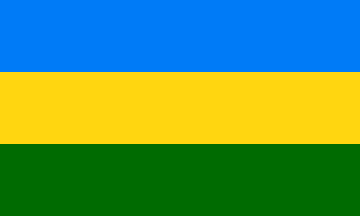
Flag
Hatillo's flag is divided into three equal horizontal bands: blue, yellow, and green.
- Blue represents the Atlantic Ocean, which borders the municipality along its northern coast.
- Yellow symbolizes Hatillo's material and artistic wealth.
- Green represents the vegetation, farmland, and broad rural landscape that have long defined the municipality.
Together, the colors present Hatillo as both a coastal town and an agricultural community—a place where the ocean, farmland, and local traditions remain closely connected.
Coat of Arms
Hatillo's coat of arms combines agricultural, coastal, religious, and civic symbols. The shield is divided into sections and is topped by a mural crown, the traditional heraldic emblem of a municipality.
- The corazón tree and its fruit refer to the municipality's historic name, Hatillo del Corazón.
- Two golden cows represent the cattle herds that shaped Hatillo's development and continue to symbolize its dairy industry.
- Silver and blue waves represent Hatillo's beaches and Atlantic coastline.
- The central shield of the Carmelite Order honors Nuestra Señora del Carmen, the patroness of the municipality.
- The mural crown identifies Hatillo as an organized Puerto Rican municipality.
Beneath the shield appears the phrase "Hatillo del Corazón," preserving one of the town's oldest and best-known names.
Anthem
Hatillo's municipal anthem is "De un mar azul en el Atlántico…". Its title evokes the municipality's coastal location and the blue Atlantic waters that border the town.
De un mar azul en el Atlantico...
Patron Saint
Nuestra Señora del Carmen
Hatillo's patroness is Nuestra Señora del Carmen. The municipality's parish, patron-saint celebrations, and the Carmelite emblem in the coat of arms all reflect this religious tradition.
Hatillo was founded on June 30, 1823 by Agustín Ruiz Miranda.Economy
Hatillo has one of Puerto Rico's strongest agricultural economies and is widely recognized as the island's Dairy Capital. Local dairy farms produce approximately one-third of Puerto Rico's fresh milk, making agriculture an essential part of both the municipality's economy and identity.
Beyond dairy production, Hatillo's economy includes retail businesses, healthcare, education, light manufacturing, professional services, and tourism. Its strategic location along PR-22 also supports commercial development and regional commerce.
Education
Hatillo is served by public and private elementary and secondary schools. Public schools operate as part of the Puerto Rico Department of Education.
Students seeking university degrees, specialized technical programs, or professional training often attend institutions in nearby Arecibo or other municipalities. Arecibo is one of northern Puerto Rico's principal educational centers and is home to university and technical campuses.
Hatillo's cultural institutions, agricultural traditions, historical ruins, and festivals also provide informal educational opportunities. Visitors can learn about rural life, folk art, dairy production, religious customs, and the municipality's Canary Island heritage.
Demographics *
Population
38,486
Land Area: 41.78 sq mi
Density: 947 per sq mi
Median Age: 43
Sex: 52% female
Economics **
$11,675
Median household income: $18,998
Puerto Rico: $21,058
Persons below poverty line: 45.2%
Housing, families and educational attainment *
Number of households
17,816
Housing units density:
415.6 (2013)
Persons per household: 2.84
High school grad or higher: 74.5%
Marital status: 45% married
* U.S. Census Bureau 2020 data, unless otherwise noted - Source: Quick Facts Puerto Rico.
** U.S. Census Bureau 2016-2020
Map References
Coordinates: 18.4864° N, 66.8256° W
ZIP Code: 659
Driving Distance from San Juan: 61.5 miles
Driving Time: 1 hour, 27 minutes
Frequently Asked Questions
Is Hatillo worth visiting?
Yes. Hatillo is worth visiting for its dairy-country scenery, Atlantic coast, local food, traditional town center, and Festival de las Máscaras. It is especially appealing to travelers exploring northern Puerto Rico by car.
What is Hatillo best known for?
Hatillo is best known as one of Puerto Rico's leading dairy-producing municipalities and for the Festival de las Máscaras, celebrated each year on December 28.
When is the Festival de las Máscaras de Hatillo?
The festival is traditionally held on December 28, the Day of the Holy Innocents. Routes, schedules, and official activities may change each year.
Is the Hatillo Mask Festival suitable for children?
Families attend the festival, but it can be extremely loud and crowded. Hearing protection is recommended for young children and anyone sensitive to horns or amplified music.
Can you swim at Hatillo's beaches?
Swimming conditions vary. Hatillo faces the Atlantic Ocean, where waves and currents can be strong. Visitors should observe conditions, follow posted warnings, and remain on shore when the water is rough.
How far is Hatillo from San Juan? Hatillo is approximately one hour west of the San Juan metropolitan area in favorable traffic. The trip may take longer because of congestion, construction, weather, or the exact departure point.
Do you need a car in Hatillo?
A car is strongly recommended. Hatillo's town center, beaches, farms, restaurants, and cultural attractions are spread across the municipality.
How much time should you spend in Hatillo?
A half-day is enough for the principal town and coastal stops. A full day allows time for a rural drive, museum or cheese-related visit, local meal, and nearby north-coast attractions.
What towns can you combine with Hatillo?
Hatillo combines easily with Arecibo, Camuy, Quebradillas, Lares, and Isabela. It is a convenient stop on a northern or northwestern Puerto Rico road trip.
Is Hatillo a beach destination?
Hatillo has attractive Atlantic beaches and coastal scenery, but it is not a traditional resort destination. Its broader appeal comes from combining the coast with countryside, agriculture, local culture, and food.
What food should you try in Hatillo?
Try locally produced cheese, Puerto Rican pastries, milk-based desserts, traditional criollo food, seafood, and coffee from a neighborhood bakery or café.
What is the best time of year to visit Hatillo?
December through March generally offers comfortable weather for sightseeing. Visit on December 28 for the Festival de las Máscaras, but expect crowds, noise, and traffic restrictions.
Did You Know?
he only tropical rainforest in the U.S. National Forest System begins just minutes from the beach.
Get Our Newsletter
Discover new places, local flavors, upcoming events, cultural stories, and some of our favorite finds from around the island.Read the Latest ¡La Isla! Newsletter
Follow Along


