
Puerto Rico's Political Status: Understanding the Options
Puerto Rico's political status has been debated for more than a century. The island is part of the United States but is not a state, and its residents are U.S. citizens but do not have the same political representation at the federal level as residents of the 50 states.
Puerto Ricans have voted repeatedly on their preferred relationship with the United States, yet no plebiscite has itself changed the island's political status. Under the U.S. Constitution, Congress has broad authority over U.S. territories and would have to enact legislation to establish a new permanent status for Puerto Rico.
The debate is therefore about much more than whether Puerto Rico should become a state. It raises fundamental questions about sovereignty, citizenship, political representation, taxation, federal programs, national identity, economic relationships, and how much authority Puerto Rico should exercise over its own affairs.
What Is Puerto Rico's Status Today?
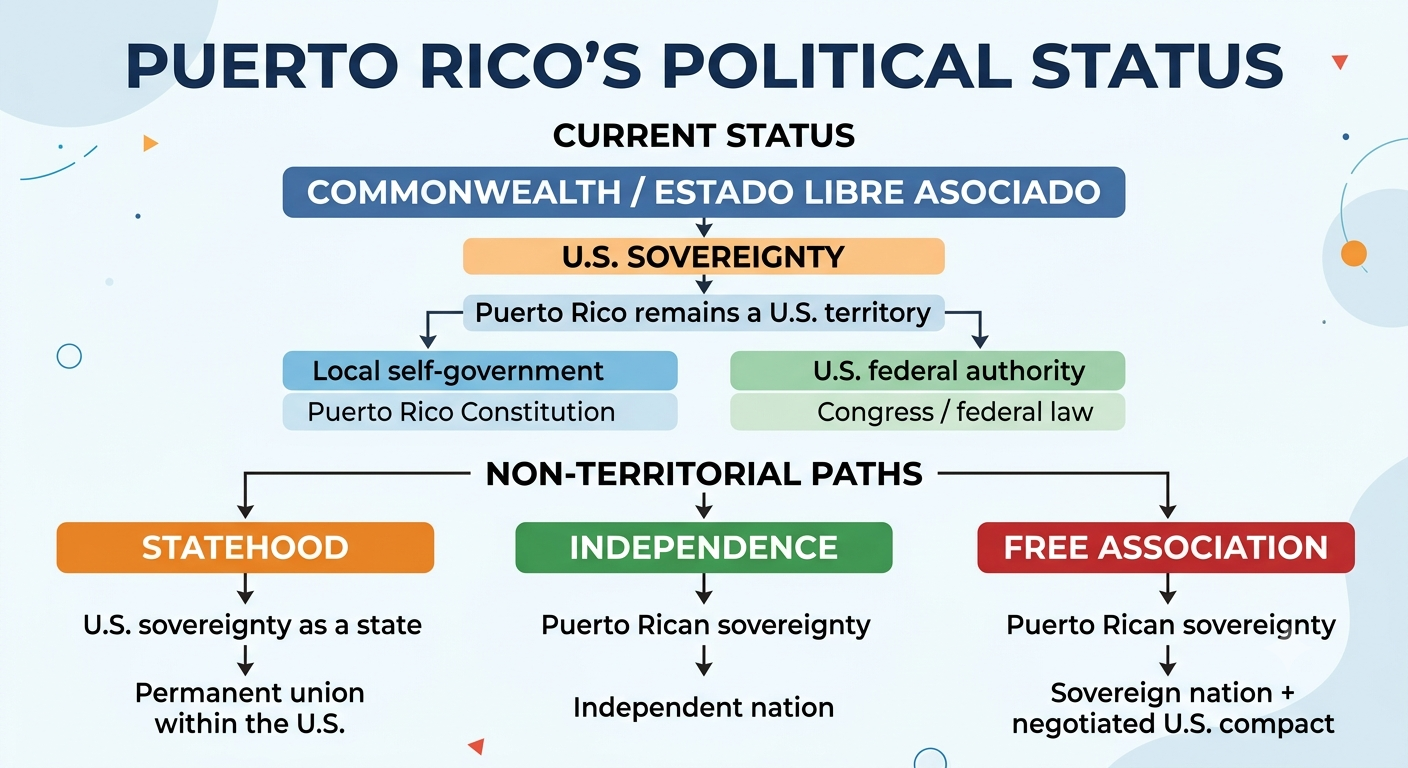
Puerto Rico is an unincorporated territory of the United States. Congress exercises authority over territories under Article IV, Section 3, Clause 2, the Territory Clause. Puerto Rico has its own constitution, elected governor and legislature, but Congress retains powers it would not possess over a state.
Residents are U.S. citizens. Puerto Rico elects a Resident Commissioner to the House of Representatives, but that representative cannot vote on final passage of legislation on the House floor, and Puerto Rico has no U.S. senators. Residents of Puerto Rico also do not vote for president in the general election.
Puerto Rico has local self-government, but it does not possess national sovereignty.
Congress can enact federal laws applicable to Puerto Rico and can treat territories differently from states in some federal programs, subject to constitutional constraints.
What Are the Status Options?
Commonwealth (Estado Libre Asociado)
Puerto Rico continues its relationship with the United States under the Commonwealth framework. Puerto Rico would remain under U.S. sovereignty while maintaining its own constitution and local government.
Statehood
Puerto Rico becomes a state of the United States, with the same constitutional status as the existing states, including voting representation in Congress and participation in presidential elections.
Independence
Puerto Rico becomes a sovereign nation. U.S. sovereignty over Puerto Rico would end, and Puerto Rico would assume responsibility for its own government, citizenship, foreign relations, immigration, trade, and other powers of an independent country
Sovereignty in Free Association
Puerto Rico becomes a sovereign nation and enter into a negotiated compact of free association with the United States. The specific relationship—including matters such as economic assistance, defense, migration, and other areas of cooperation—would depend on the agreement negotiated between the two countries.
What Would Statehood Mean?
Statehood would fundamentally change Puerto Rico's constitutional relationship with the United States. Instead of being a territory subject to Congress's territorial authority, Puerto Rico would become a state of the Union.
Representation in Congress
Puerto Rico would elect two U.S. senators.
It would also receive voting representation in the House of Representatives. The precise number of House seats would depend on population and the apportionment process in effect when admission occurred.
This would replace the current Resident Commissioner arrangement.
Presidential Elections
Residents of Puerto Rico would vote for president and vice president as residents of a state, with Puerto Rico receiving Electoral College votes based on its congressional representation.
U.S. Citizenship
People born in Puerto Rico are already U.S. citizens under federal statute.
Statehood would put future birthright citizenship in Puerto Rico on the same constitutional footing as birth within the states rather than depending on Puerto Rico's territorial status.
Federal Income Taxes
Bona fide Puerto Rico residents currently generally exclude Puerto Rico-source income from U.S. federal income taxation under special federal rules.
Under statehood, residents would generally become subject to federal income-tax rules in the same manner as residents of other states, while Puerto Rico would continue to have authority to impose its own state-level taxes.
Transition legislation could determine how and when that change occurred.
Federal Programs
Puerto Rico currently participates in many federal programs, but territorial treatment can differ from that of states.
Statehood would generally place Puerto Rico within the federal framework applicable to states, although the details of individual programs and transition provisions would depend on federal law.
Puerto Rico's Constitution
Puerto Rico would not necessarily need an entirely new constitution.
States have their own constitutions, and Puerto Rico already operates under a constitution adopted in 1952.
Congress would have to determine whether changes were necessary as part of admission. Interestingly, the new 2026 H.R. 9246 contains specific provisions concerning Puerto Rico's constitution under its proposed statehood transition.
Language and Culture
There is no constitutional requirement that a state make English its sole official language as a condition of remaining a state. Statehood would not itself eliminate Spanish, Puerto Rican cultural identity, municipal traditions, holidays, music, cuisine, or local institutions.
Congress could debate language issues during an admission process, however, as it has in some historical state admissions.
Puerto Rico's Public Debt
Statehood would not automatically erase Puerto Rico's public debt.
Existing debts and obligations would need to continue to be addressed under applicable law and whatever transition legislation Congress enacted.
PROMESA
PROMESA is particularly interesting because it was enacted specifically in response to Puerto Rico's fiscal crisis and created the Financial Oversight and Management Board.
What Would It Take for Puerto Rico to Become an Independent Country?
Fundamentally, Congress would enact legislation ending U.S. sovereignty over Puerto Rico and recognizing Puerto Rico as a sovereign nation. Transition legislation would have to address an enormous range of issues.
Puerto Rico would then have authority normally exercised by an independent country, including its own foreign relations and international agreements.
It could establish:
- its own citizenship
- its own immigration policy
- its own foreign policy
- its own international trade relationships
- its own national defense arrangements
- its own tax system
- its own international representation
Puerto Rico could seek membership in organizations such as the United Nations and establish diplomatic relations with other countries.
But independence would also require negotiating the separation of systems that have been interconnected with the United States for more than a century.
That transition is where the article gets really interesting.
What happens to U.S. citizenship?
Existing U.S. citizens would not simply become stateless. But citizenship for people born in Puerto Rico after sovereignty is established would become a different question.
The 2022 Puerto Rico Status Act illustrates one possible congressional approach. It distinguished between people who already possessed U.S. citizenship and future citizenship transmission/birth rules. Under independence, Puerto Rican citizenship would be determined by the new Puerto Rican nation, while U.S. citizenship would remain determined by U.S. law.
The treatment of existing U.S. citizenship and the ability to transmit U.S. citizenship to future generations would be among the most consequential issues Congress would have to address in independence legislation.
What Happens to the U.S. Dollar?
Independence does not inherently require Puerto Rico to stop using the U.S. dollar.
Several independent countries use the dollar without being U.S. territories or states. Puerto Rico could potentially continue using it unilaterally or negotiate a monetary arrangement.
But using the dollar and controlling monetary policy are different things.
An independent Puerto Rico could instead eventually establish its own currency or pursue another monetary arrangement.
Would Puerto Rico need a new currency?
Not necessarily. Political sovereignty and currency are separate questions. An independent Puerto Rico could potentially continue using the U.S. dollar, although it would not automatically have the same relationship with U.S. monetary institutions that it has as a U.S. territory.
What Happens to Social Security and Medicare?
Benefits already earned under Social Security involve federal statutory rights and contribution histories; the transition for future participation and benefits would depend on federal law and any agreements negotiated between the two countries.
Medicare, Medicaid, SNAP, veterans' programs, Pell Grants, federal highway funding, disaster assistance and many other programs each have their own statutes.
So independence wouldn't be one giant switch labeled "Federal Benefits: OFF."
Congress would need to determine transition arrangements program by program.
The 2022 Status Act is useful here because it proposed continued federal financial assistance followed by a lengthy transition rather than immediate termination, illustrating one possible approach—not a guarantee of what a future Congress would enact.
What Happens to Puerto Rico's Debt?
Changing political status would not automatically erase Puerto Rico's existing public debt.
Puerto Rico's debt restructuring has occurred under PROMESA, and any status-transition legislation would have to address the relationship between the new political status, existing governmental obligations, the Oversight Board, and federal law.
What About Defense?
Under full independence, Puerto Rico would become responsible for its own national defense arrangements.
That doesn't necessarily mean it would have to build a large military.
Puerto Rico could maintain its own defense forces, remain largely demilitarized, negotiate defense agreements with the United States, or enter other international arrangements.
What Is Free Association?
The United States currently has Compacts of Free Association with three sovereign Pacific countries: the Marshall Islands, Federated States of Micronesia, and Palau.
Those countries are sovereign nations, not U.S. territories.
A Puerto Rico free-association arrangement would likewise begin with Puerto Rican sovereignty, followed by negotiation of a compact covering agreed areas of cooperation. Existing U.S. compacts address matters including defense, migration and economic assistance, but a Puerto Rico compact would have to be separately negotiated.
Free association is not guaranteed permanent union with the United States.
Unlike statehood, a compact is an agreement between sovereign governments. Its provisions depend on negotiation and can include mechanisms for amendment or termination.
What Does "Commonwealth" Actually Mean?
Puerto Rico's use of the word Commonwealth is one of the greatest sources of confusion in the status debate.
In 1950, Congress enacted Public Law 600, authorizing Puerto Rico to draft its own constitution. Puerto Rico's constitution was approved by voters, modified and approved by Congress, and took effect in 1952..
The Spanish name adopted for the government was Estado Libre Asociado de Puerto Rico, while the English name became Commonwealth of Puerto Rico.
That gave Puerto Rico significantly greater local self-government than it had under earlier territorial governments, but it did not remove Puerto Rico from Congress's Territory Clause authority. CRS continues to describe Puerto Rico as a U.S. territory.
Congress continues to possess broad constitutional authority over Puerto Rico as a U.S. territory.
Commonwealth ≠ Free Association
Despite the Spanish term Estado Libre Asociado, Puerto Rico's present Commonwealth should not be confused with sovereignty in free association.
Under the present Commonwealth arrangement:
Sovereignty ultimately remains with the United States.
Under free association:
Puerto Rico becomes sovereign.
More Than 50 Years of Status Votes
1967 — The First Status Plebiscite
Voters were offered Commonwealth, statehood and independence.
Commonwealth received about 60.5%, statehood about 38.9%, and independence about 0.5%.
This was the clearest electoral victory for the Commonwealth option.
1993 — A Much Closer Vote
The three principal options appeared again.
Commonwealth received 48.6%, statehood 46.4%, and independence 4.5%.
Unlike 1967, no option received a majority.
1998 — "None of the Above"
The ballot structure changed substantially.
The choices included statehood, independence, free association and a territorial/Commonwealth formulation, but "None of the Above" received 50.2%, while statehood received approximately 46.5%.
This vote illustrates why the ballot wording matters so much: many voters rejected the status definitions presented to them rather than choosing one of them.
2012 — A Two-Part Question
This was fundamentally different.
First voters were asked whether Puerto Rico should continue its present territorial status.
Approximately 54% voted No.
A second question asked voters to choose among three nonterritorial alternatives.
Among votes cast for those alternatives:
Statehood — 61.16%
Sovereign Free Associated State — 33.34%
Independence — 5.49%
But many voters left the second question blank, and interpretation of the result became politically contested. That is important context rather than simply saying "61% voted for statehood."
2017 — Statehood Dominates Amid a Boycott
The ballot offered statehood, free association/independence, and the current territorial status.
Statehood received roughly 97% of votes cast, but participation was unusually low. The principal opposition parties boycotted the plebiscite; roughly 23% of registered voters participated. Government records show 502,616 statehood votes out of 517,216 voters.
So both numbers matter:
Statehood overwhelmingly won among those who participated, but turnout was unusually low.
2020 — A Direct Yes-or-No Question
For the first time, voters were presented with a straightforward question:
"Should Puerto Rico be admitted immediately into the Union as a State?"
The result was approximately:
Yes — 52.5%
No — 47.5%
Unlike 2012 and 2017, this did not ask voters to rank several competing status definitions.
2024 — Three Nonterritorial Options
The ballot presented:
Statehood
Sovereignty in Free Association with the United States
Independence
The existing Commonwealth/territorial status was not an option.
Certified results were:
Statehood — 620,782 — 58.61%
Free Association — 313,259 — 29.57%
Independence — 125,171 — 11.82%.
That's interesting historically because support recorded for the two sovereignty-based alternatives collectively was substantially larger than in many earlier plebiscites—but we shouldn't interpret that as a trend without accounting for changing ballot choices and participation.
What Have the Plebiscites Accomplished?
They demonstrate voter preferences at particular moments and under particular ballot structures.
They have not themselves changed Puerto Rico's political status.
Why Doesn't Puerto Rico Simply Decide?
Because a plebiscite and a change in legal status are two different things
Puerto Rico can conduct elections asking its residents which political relationship they prefer. Those votes can provide Congress with evidence of public preference and create political pressure for action.
But Puerto Rico cannot, through a local election alone, transform itself into a state of the United States.
The Constitution gives Congress the power to admit new states and broad authority over U.S. territories.
Statehood requires Congress
Puerto Rico cannot declare itself a state.
Congress would have to enact an admission law, and that legislation would have to become federal law.
Congress has followed different procedures when admitting states historically, so there is no single mandatory admission formula requiring a particular percentage in a Puerto Rican plebiscite.
Independence also requires a legal transition
Puerto Rico could express a preference for independence, but ending the existing U.S. territorial relationship would require a legal process addressing U.S. sovereignty and a transition.
Among the questions Congress and Puerto Rico would need to address are citizenship, federal property, courts, federal programs, taxation, immigration, existing obligations and the effective date of sovereignty.
Free Association requires even more than a vote
Free association involves two steps conceptually:
1. Puerto Rico becomes sovereign.
2. Puerto Rico and the United States establish the terms of their future relationship.
That second step requires negotiation.
Puerto Rico could favor free association, but Puerto Rico alone cannot dictate what obligations the United States would accept in a compact—and the United States cannot unilaterally define what sovereign Puerto Rico would accept either. That's why free association is fundamentally a nation-to-nation arrangement.
So who actually decides?
Puerto Ricans can express their preferred political status through the democratic process, but implementing a change in Puerto Rico's relationship with the United States requires federal legislation. Congress therefore plays the decisive constitutional role in changing the island's territorial status.
What Is Congress Doing Now?
The House passed the Puerto Rico Status Act (H.R. 8393) in December 2022, proposing a federally authorized process involving statehood, independence and sovereignty in free association, but it did not become law. Related legislation was introduced again in the following Congress.
On June 10, 2026, H.R. 9246, the Puerto Rico Democratic Self Determination Act, was introduced in the House and referred to the House Committee on Natural Resources. As of the latest official record, it remains an introduced bill; it has not become law.
Proposed—not scheduled under current law
The proposal calls for a federally structured plebiscite with four choices:
Independence
Commonwealth (Estado Libre Asociado)
Statehood
Sovereignty in Free Association with the United States.
It proposes a majority requirement
Under the introduced bill, a status option would have to receive more than 50% of valid votes.
It proposes an initial plebiscite for March 14, 2027.
If no option received a majority, it proposes a runoff on May 16, 2027 between the two options receiving the most votes.
Comparing Puerto Rico's Political Status Options
The four status options would create fundamentally different relationships between Puerto Rico and the United States. The biggest distinction is where sovereignty would reside and how Puerto Rico would participate in the U.S. political system.
| Issue | Commonwealth | Statehood | Independence | Free Association |
|---|---|---|---|---|
| Sovereignty | United States | United States | Puerto Rico | Puerto Rico |
| Political Relationship | U.S. territory | U.S. state | Independent nation | Sovereign nation with a negotiated U.S. compact |
| Puerto Rico Constitution | Yes | Yes, subject to requirements of statehood | Puerto Rico establishes its constitution as a sovereign nation | Puerto Rico establishes its constitution as a sovereign nation |
| U.S. Senators | None | Two | None | None |
| Voting Representation in U.S. House | No* | Yes | No | No |
| Vote for U.S. President While Living in Puerto Rico | No | Yes | No | No |
| U.S. Citizenship | Continues under current federal law | Citizenship on the same constitutional basis as other states | Existing and future citizenship rules would be addressed by federal transition law and Puerto Rican citizenship law | Existing and future citizenship and migration rules would depend on federal law and the negotiated relationship |
| Puerto Rican Citizenship | No separate sovereign nationality | No separate sovereign nationality | Determined by Puerto Rico | Determined by Puerto Rico |
| Foreign Policy | United States | United States | Puerto Rico | Puerto Rico |
| International Treaties | United States | United States | Puerto Rico | Puerto Rico |
| Immigration Policy | United States | United States | Puerto Rico | Puerto Rico, subject to any agreements negotiated with the United States |
| Federal Income Tax | Special territorial tax rules apply | Generally the same federal tax system as other states | Puerto Rico establishes its own national tax system; U.S. tax rules may still apply to U.S. citizens and businesses | Puerto Rico establishes its own tax system; U.S. treatment would depend on federal law and negotiated arrangements |
| Federal Programs | Participation varies by program and federal law | Generally treated under rules applicable to states | Future assistance or participation would require transition provisions or agreements | Could include assistance or programs negotiated with the United States |
| Defense | United States | United States | Puerto Rico determines its defense policy and may negotiate agreements | Subject to Puerto Rico's sovereignty and the terms of the negotiated compact |
| U.S. Territory Clause | Applies | No longer applies as territorial authority | Does not apply | Does not apply |
| Relationship with the United States | Territorial | Permanent constitutional union as a state | Nation-to-nation | Nation-to-nation under a negotiated compact |
* Puerto Rico currently elects a Resident Commissioner to the U.S. House of Representatives. The Resident Commissioner may participate in congressional committees but does not vote on final passage of legislation on the House floor.
Exact transition rules for citizenship, taxation, federal benefits, public debt, federal property, and other matters would depend on legislation enacted by Congress and, in the case of free association, the terms negotiated between Puerto Rico and the United States.
Questions Puerto Rico Would Have to Answer as an Independent Nation
What would the constitution of the sovereign republic provide?
What citizenship rules would Puerto Rico adopt?
Would Puerto Rico continue using the U.S. dollar?
What immigration system would it establish?
How would defense work?
What trade relationship would it negotiate with the United States?
How would existing federal benefits transition?
What would happen to federal lands and facilities?
How would banking and financial regulation change?
How would Puerto Rico handle international representation?
What treaties would need to be negotiated?
How would the new country structure taxation and customs?
Questions Puerto Rico Would Face as the 51st State
How would federal income taxation change?
How many House seats would Puerto Rico initially receive?
How would statehood affect federal programs?
What happens to Puerto Rico's existing tax incentives?
What happens to PROMESA?
Would Puerto Rico's constitution change?
What happens to agencies currently structured around territorial status?
Did You Know?
San Juan is the oldest European-founded city in U.S. territory.
Get Our Newsletter
Discover new places, local flavors, upcoming events, cultural stories, and some of our favorite finds from around the island.Read the Latest ¡La Isla! Newsletter
Follow Along


