
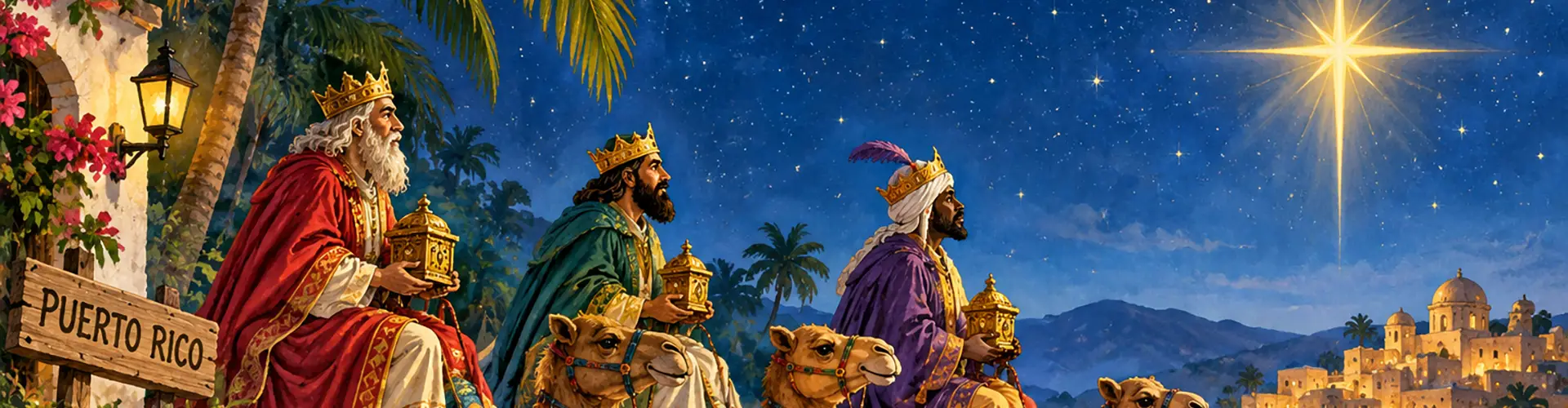
Three Kings Day in Puerto Rico
Three Kings Day, or Día de Reyes, is one of Puerto Rico's most beloved holiday traditions. Celebrated on January 6, the holiday commemorates the visit of the Three Wise Men—Los Tres Reyes Magos—to the infant Jesus. But in Puerto Rico, Día de Reyes has developed traditions all its own: children gather grass for the Kings' horses, gifts appear overnight, families celebrate with food and music, artisans carve colorful figures of the Magi, and communities across the island hold festivals and parades.
For generations, the Reyes Magos have occupied a special place in Puerto Rican Christmas. And January 6 doesn't necessarily end the celebration—the Octavitas help carry Puerto Rico's famously long Christmas season farther into January.
Who Are the Three Kings?
The Three Kings—known in Spanish as Los Tres Reyes Magos—are the wise men who, according to the Gospel of Matthew, traveled from the East to honor the newborn Jesus. Guided by a star, they arrived bearing three symbolic gifts: gold, frankincense, and myrrh.
The Bible does not actually say there were three Magi, nor does it give their names. The number three developed in Christian tradition because three gifts are mentioned. Over time, the Magi became known as Melchor, Gaspar, and Baltasar, and artistic traditions gave each king a distinct appearance and identity.
In Puerto Rico, the Three Kings became much more than figures in the Nativity story. They are deeply woven into Christmas traditions, religious observances, folk art, music, family celebrations, and childhood memories.
Melchor, Gaspar and Baltasar
Melchor (Melchior) is traditionally depicted as an older king, often with white or gray hair and a beard. He is associated with the gift of gold, symbolizing kingship.
Gaspar (Caspar) is commonly portrayed as a younger king and is associated with frankincense, traditionally interpreted as a symbol of divinity and worship.
Baltasar (Balthazar) is traditionally depicted as a Black king and is associated with myrrh, an aromatic resin historically used in perfumes, medicines, and burial preparations.
Why I Love Three Kings Day
One of my earliest childhood memories is of Three Kings Eve. I must have been around six years old. I remember going outside to gather grass for the Three Kings' camels, carefully placing it under my bed, and going to sleep knowing that Los Reyes would come during the night.
The next morning, I jumped out of bed and rushed to the floor to see what they had left for me. There, where I had placed the grass, was a doll.
Decades later, I can still picture that doll. Of all the Christmas gifts I've received over the years, it remains the one most deeply imprinted in my memory. I don't remember what it cost or even everything about it—I remember how it felt to find it there. The anticipation, the surprise, and the belief that the Three Kings had visited while I slept made it magical.
It's one of those small childhood moments that helps explain why Día de Reyes means so much to so many Puerto Ricans. The tradition isn't only about receiving a present. It's the ritual of gathering the grass, putting it under the bed, going to sleep full of anticipation, and waking up to discover that Los Reyes had come.
Origins of Three Kings Day
Three Kings Day is celebrated on January 6, the Christian feast of the Epiphany. The holiday commemorates the manifestation of Jesus to the Magi and has been observed by Christian communities for many centuries.
Veneration of the Magi became particularly prominent in medieval Europe. Their story appeared in religious art, church celebrations, processions, plays, and eventually popular holiday customs. Spain developed especially strong traditions surrounding Día de los Reyes Magos, including public processions and gift-giving.
How Three Kings Day Came to Puerto Rico
Puerto Rico's Reyes traditions developed from the island's centuries of Spanish colonial history and Catholic influence. Spanish religious observances were introduced beginning in the early colonial period, but over generations Puerto Ricans made Día de Reyes distinctly their own.
January 6 became an important day for family gatherings, religious observances, music, food, community celebrations, and—especially for children—gifts.
Puerto Rico also developed distinctive imagery surrounding the Kings. In Puerto Rican folk art, Los Reyes are frequently shown traveling on horseback, rather than on the camels commonly seen in European and Middle Eastern-inspired Nativity scenes. Wooden carvings of the Three Kings became an important part of the island's santos tradition.
By the nineteenth century, community celebrations of the Reyes were well established. The municipality of Juana Díaz began its famous Three Kings celebration in 1884, a tradition that continues today and has helped make the town particularly associated with Los Reyes Magos.
Camels or Horses?
The answer depends on the family and the tradition. Many Puerto Ricans remember leaving grass for the camels of the Three Kings, while Puerto Rican santos, carvings, paintings, and famous public representations such as the Reyes of Juana Díaz commonly portray the Kings on horseback. The horse imagery has become especially distinctive in Puerto Rican folk art, even though camels remain part of many families' childhood Día de Reyes stories.
How the Tradition Came to Puerto Rico
Under Spanish rule, Catholic observances became deeply embedded in Puerto Rican life. Epiphany was among those traditions, but over generations Puerto Ricans developed distinctive customs surrounding the Reyes Magos. What began as a religious observance also became a celebration of family, childhood, community and Puerto Rican cultural identity.
Three Kings Eve: Grass for the Horses
For many Puerto Rican children, the excitement of Three Kings Day begins the night before.
On January 5, Víspera de Reyes, children traditionally go outside and gather grass. The grass is placed in a box—often a shoebox—and left beneath the bed, near the Christmas tree, or in another special place before bedtime.
Why grass?
It's a treat for the horses carrying Los Tres Reyes Magos on their long journey from house to house.
Children then go to sleep knowing that sometime during the night, Melchor, Gaspar, and Baltasar will arrive.
By morning, the grass has disappeared and gifts have been left in its place.
For children, the ritual creates much of the same anticipation associated with leaving cookies for Santa Claus—but with a distinctly Puerto Rican character.
Santa Claus and Los Reyes: Two Christmas Traditions
For generations, Los Tres Reyes Magos were Puerto Rico's traditional Christmas gift-bringers, with children awaiting their arrival on January 6. Today, many Puerto Rican families also celebrate Christmas Day with gifts from Santa Claus.
That means some children may receive presents on both December 25 and January 6.
Does Christmas End on Three Kings Day?
Not necessarily.
Puerto Rico is famous for having an unusually long Christmas season, and January 6 isn't always the finish line.
Las Octavitas
Traditionally, the eight days following Three Kings Day were known as the Octavas, a period with religious roots that extended the celebration of Epiphany. Puerto Rican tradition also developed what became known as Las Octavitas, continuing the festive spirit beyond January 6.
Over time, the term has become closely associated with the continuation of Puerto Rico's Christmas celebrations—more music, gatherings, parties, and opportunities for parrandas.
This helps explain why saying that Puerto Rican Christmas simply runs from Thanksgiving through January 6 doesn't quite capture it. Depending on the family and community, celebrations can continue well into January.
Frequently Asked Questions About Three Kings Day in Puerto Rico
When is Three Kings Day celebrated in Puerto Rico?
Three Kings Day, or Día de Reyes, is celebrated on January 6. The celebration begins the night before, on January 5, when children traditionally prepare for the arrival of Los Tres Reyes Magos.
What is Three Kings Day in Puerto Rico?
Three Kings Day is the Puerto Rican celebration of Epiphany, commemorating the visit of the Magi to the infant Jesus. In Puerto Rico, the religious holiday has also become an important cultural and family tradition involving gifts, food, music, festivals, folk art, and community celebrations.
Who are the Three Kings?
Christian tradition identifies the Three Kings as Melchor, Gaspar, and Baltasar. They represent the Magi described in the Gospel of Matthew who followed a star to Bethlehem and brought gifts of gold, frankincense, and myrrh to Jesus.
Are the names Melchor, Gaspar, and Baltasar in the Bible?
No. The Gospel of Matthew mentions the Magi but does not state their number or give their names. The tradition of three Magi named Melchor, Gaspar, and Baltasar developed later in Christian history.
Why do Puerto Rican children leave grass for the Three Kings?
On January 5, children traditionally gather grass and place it in a box for the animals carrying the Three Kings. During the night, the grass disappears and Los Reyes leave gifts for the children.
Why are the Three Kings shown riding horses in Puerto Rico?
Although the Magi are often depicted with camels elsewhere, Puerto Rican folk art and tradition frequently portray Los Tres Reyes Magos riding horses. The image has become a distinctive part of Puerto Rican Three Kings iconography.
Do children in Puerto Rico receive gifts on Three Kings Day?
Yes. Gift-giving on January 6 is one of Puerto Rico's best-known Three Kings traditions. Today, many families celebrate both Christmas Day and Three Kings Day, so some children receive gifts on both December 25 and January 6.
Where is the most famous Three Kings celebration in Puerto Rico?
Juana Díaz is especially famous for its Three Kings tradition. The municipality's Fiesta de Reyes dates to 1884 and has become one of Puerto Rico's best-known celebrations of Los Tres Reyes Magos.
What foods are eaten on Three Kings Day in Puerto Rico?
Día de Reyes falls within Puerto Rico's broader Christmas season, so celebrations may include traditional holiday foods such as pernil, pasteles, arroz con gandules, arroz con dulce, tembleque, and coquito. Foods and family traditions vary from household to household.
Is Three Kings Day more important than Christmas in Puerto Rico?
Historically, Día de Reyes held an especially important place in Puerto Rican Christmas traditions. Today, many families celebrate both Christmas Day and Three Kings Day, and the importance given to each holiday varies by family.
What are Las Octavitas?
Las Octavitas are part of the tradition of extending Puerto Rico's Christmas season beyond Three Kings Day. The period has religious roots but is also associated today with continued holiday gatherings, music, parties, and celebrations during January.
When does Christmas end in Puerto Rico?
There is no single ending date for every family. Christmas celebrations continue through Three Kings Day for many Puerto Ricans, while others continue celebrating during Las Octavitas and into the period of the Fiestas de la Calle San Sebastián in mid-January.
Did You Know?
Puerto Rico is one of the few places in the world where you can explore a tropical rainforest, surf the Atlantic Ocean, hike mountains over 4,000 feet high, kayak through glowing bioluminescent waters, and relax on Caribbean beaches—all within a single day.
Get Our Newsletter
Discover new places, local flavors, upcoming events, cultural stories, and some of our favorite finds from around the island.Read the Latest ¡La Isla! Newsletter
Follow Along


