
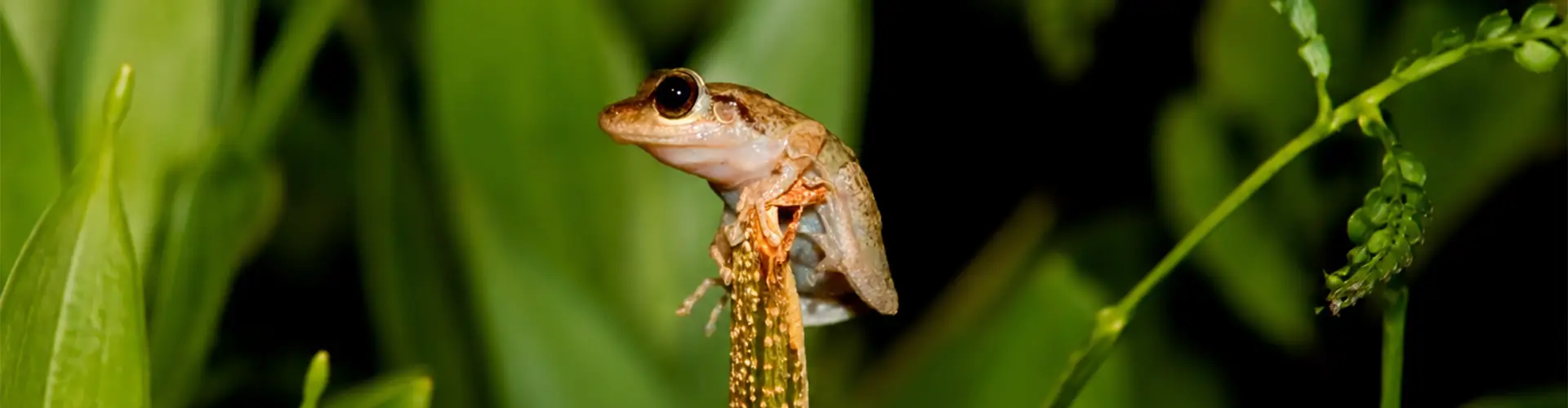
Puerto Rico's 17 Coquí Species
Meet the 17 native species of Puerto Rico's iconic tree frogs, including where they live, their scientific names, and conservation status.
Puerto Rico is home to one of the greatest diversities of Eleutherodactylus frogs in the world. Seventeen native species inhabit the island, each adapted to a unique environment—from the cloud forests of El Yunque to dry coastal forests and limestone caves. While the common coquí can be heard across much of Puerto Rico, several species are found nowhere else on Earth and occupy only small geographic ranges.
Eleutherodactylus Species - Scientific Names
| Common Name | Scientific Name | Endemic | Primary Habitat | Conservation Status |
|---|---|---|---|---|
| Common Coquí | Eleutherodactylus coqui | Yes | Forests, gardens, urban areas | Least Concern |
| Mountain Coquí | Eleutherodactylus portoricensis | Yes | Mountain rainforests | Near Threatened |
| Whistling Coquí | Eleutherodactylus brittoni | Yes | Moist forests | Least Concern |
| Coquí Llanero | Eleutherodactylus juanariveroi | Yes | Freshwater marshes | Critically Endangered |
| Golden Coquí | Eleutherodactylus jasperi | Yes | Montane forests | Extinct |
| Web-footed Coquí | Eleutherodactylus karlschmidti | Yes | Mountain streams | Extinct |
| Demon Coquí | Eleutherodactylus demonicus | Yes | Cloud forests | Data Deficient |
| Rock Coquí | Eleutherodactylus cooki | Yes | Rocky ravines | Endangered |
| Melodious Coquí | Eleutherodactylus wightmanae | Yes | Moist forests | Least Concern |
| Grassy Coquí | Eleutherodactylus gryllus | Yes | Grasslands & forests | Near Threatened |
| Forest Coquí | Eleutherodactylus hedricki | Yes | Montane forests | Endangered |
| Cave Coquí | Eleutherodactylus cooki | Yes | Caves & rocky habitats | Endangered |
| Red-eyed Coquí | Eleutherodactylus antillensis | Native | Dry and moist forests | Least Concern |
| Puerto Rican Grass Coquí | Eleutherodactylus richmondi | Yes | Moist mountain forests | Near Threatened |
| Wrinkled Coquí | Eleutherodactylus rugulosus | Yes | Forests | Least Concern |
| Dwarf Coquí | Eleutherodactylus unicolor | Yes | Cloud forests | Near Threatened |
| Hidden Coquí | Eleutherodactylus locustus | Yes | Leaf litter | Least Concern |
What Does Eleutherodactylus Mean?
The name comes from the Greek words eleutheros ("free") and daktylos ("finger" or "toe"), referring to the frogs' unwebbed toes. Unlike many frogs, coquís spend little time in water and are adapted for life on land and in trees.
Hear the sound of Puerto Rico
If you've ever spent an evening in Puerto Rico, you've likely heard the unmistakable "co-quí, co-quí" echoing through the warm tropical night. Produced by the male coquí to attract mates and establish territory, this distinctive two-note call is more than just a frog's song—it is the soundtrack of the island. For generations, the chorus of coquís has welcomed visitors, lulled residents to sleep, and become a cherished reminder of home for millions of Puerto Ricans around the world. Listen closely and experience one of Puerto Rico's most iconic natural sounds.
Frequently Asked Questions?
How many coquí species live in Puerto Rico?
Puerto Rico is home to 17 native coquí species, 13 of which are endemic, meaning they are found nowhere else in the world. Together, they represent one of the greatest diversities of Eleutherodactylus frogs on Earth.
What does "endemic" mean?
An endemic species is a plant or animal that is found naturally in only one geographic location and nowhere else in the world. If an endemic species disappears from its native habitat, it becomes extinct globally.
Puerto Rico is home to 13 endemic coquí species, making the island one of the world's most important centers of coquí diversity. These unique frogs evolved over millions of years and are found naturally only in Puerto Rico and its surrounding islands.
Which is the most common coquí?
The Common Coquí (Eleutherodactylus coqui) is the island's most widespread and recognizable species. Its distinctive "co-quí" call is heard nightly throughout much of Puerto Rico, from forests to residential neighborhoods.
Which is the rarest coquí?
The Coquí Llanero (Eleutherodactylus juanariveroi) is considered Puerto Rico's rarest living coquí. It is found only in a small freshwater wetland in the municipality of Humacao and is listed as Critically Endangered.
Which coquí species are extinct?
Two Puerto Rican coquí species are believed to be extinct: the Golden Coquí (Eleutherodactylus jasperi), last seen in the 1980s, and the Web-footed Coquí (Eleutherodactylus karlschmidti), which has not been observed in decades.
Which coquí species is found only in El Yunque?
Several coquí species inhabit El Yunque National Forest, including the Mountain Coquí (Eleutherodactylus portoricensis), the Melodious Coquí (Eleutherodactylus wightmanae), and the Common Coquí (Eleutherodactylus coqui). While some species have very limited distributions, none are found exclusively within El Yunque.
Why do different coquí species have different calls?
Each coquí species has its own unique call that helps individuals recognize members of the same species. These distinct vocalizations are used to attract mates, defend territories, and reduce confusion where several coquí species live in the same habitat.
Did You Know?
Because Puerto Rico is not a state, it has no senators or representatives in Congress.
Get Our Newsletter
Discover new places, local flavors, upcoming events, cultural stories, and some of our favorite finds from around the island.Read the Latest ¡La Isla! Newsletter
Follow Along


