
Puerto Rico's Topography
Puerto Rico may cover just 3,459 sq mi (8,959 sq km), but it contains one of the most geographically diverse landscapes in the Caribbean. Within a relatively short drive, visitors can travel from lush rainforests and rugged mountain peaks to dry forests, limestone caves, mangrove wetlands, and some of the Caribbean's most beautiful beaches. This remarkable variety of landscapes is the result of millions of years of geological activity, tropical weather, and the island's unique location between the Atlantic Ocean and the Caribbean Sea.
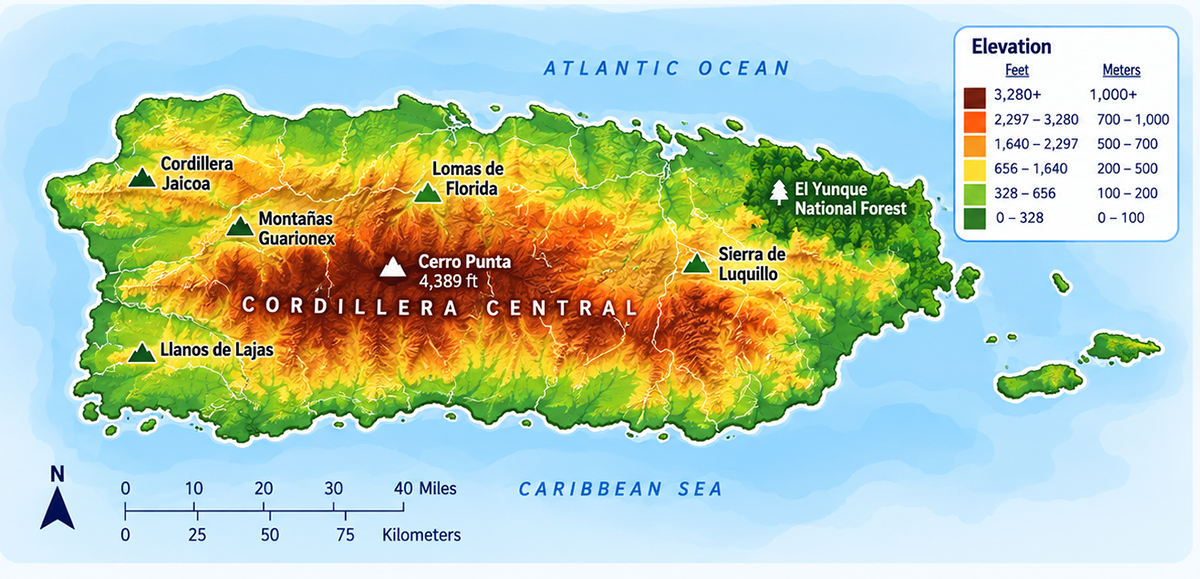
| Highest Mountains | |
| Cerro Punta | 4,389 ft |
| Rosa | 4,156 |
| Guilarte | 3,952 |
| Tres Picachos | 3,949 |
| Maravillas | 3,880 |
| Dona Juana | 3,536 |
| Toro | 3,524 |
| Yunque | 3,494 |
| Penuelas | 3,414 |
| Torrecilla | 3,093 |
Understanding Puerto Rico's Landscape
Rather than one continuous landscape, Puerto Rico is divided into several distinct geographic regions that each contribute to the island's beauty and biodiversity.
Puerto Rico's Five Major Landforms
Mountains - The Cordillera Central
Running east to west across the heart of Puerto Rico, the Cordillera Central is the island's backbone. These mountains divide the northern and southern coasts while influencing everything from rainfall and climate to agriculture and transportation.
The range includes Cerro de Punta, Puerto Rico's highest peak at 4,390 feet (1,338 m). The cooler temperatures and fertile soils of these mountains have made them ideal for coffee cultivation for more than two centuries, while scenic winding roads connect picturesque towns such as Jayuya, Adjuntas, Orocovis, and Maricao.
As someone who grew up on the island, one of my favorite drives has always been through the mountains. Every turn seems to reveal another breathtaking valley, hidden waterfall, or roadside café serving locally grown Puerto Rican coffee.
Mountain Ranges
The island's mountain ranges include the Cordillera Central, Sierra de Cayey, Sierra de Luquillo, and Sierra Bermeja. The highest peaks are listed in the table above.
Explore the Cordillera Central.
Coastal Plains
Surrounding the mountains are broad coastal plains where most of Puerto Rico's population lives today. These flatter regions became centers for agriculture during Spanish colonial times and later developed into the island's largest cities and transportation hubs.
The northern coastal plain receives significantly more rainfall than the south, while the southern coastal plain is warmer and considerably drier, creating two very different landscapes despite being only a short drive apart.
Explore Puerto Rico's coastal geography.
The Karst Region
Northern Puerto Rico contains one of the world's most important tropical karst landscapes. Millions of years of rainfall slowly dissolved the island's limestone, creating a fascinating terrain filled with caves, sinkholes, underground rivers, and the distinctive rounded hills known as mogotes.
The karst region stretches across municipalities including Arecibo, Camuy, Hatillo, Lares, Florida, and Quebradillas. It is home to spectacular natural attractions such as Río Camuy Cave Park, Cueva Ventana, and numerous protected forests that shelter hundreds of plant and animal species.
Beyond its scenic beauty, this limestone region serves as one of Puerto Rico's largest natural aquifers, supplying groundwater to many communities.
The northern karst belt extends from Aguadilla in the west toward Loíza in the east, with limestone hills, sinkholes, caves, and underground drainage systems.
Islands and Cays
Puerto Rico's geography extends well beyond its main island. Offshore islands and cays each possess their own unique ecosystems, beaches, and landscapes.
Notable islands include: Vieques, Culebra, Mona Island, Caja de Muertos and Desecheo Island.
Popular cays include: Icacos, Palomino, Cayo Luis Peña, Cayo Aurora (Gilligan's Island) and Cayo Caracoles.
Many of these smaller islands are protected nature reserves where visitors can enjoy crystal-clear waters, coral reefs, snorkeling, birdwatching, and secluded beaches.
River Valleys
Puerto Rico's rivers have carved broad valleys through the mountains over thousands of years, creating some of the island's most fertile agricultural lands. These valleys became natural corridors for roads, towns, and farming communities, supporting crops such as coffee, plantains, citrus, and vegetables. Many of Puerto Rico's inland municipalities developed along these river systems, which continue to provide drinking water, irrigation, and hydroelectric reservoirs today.
How Puerto Rico Was Formed
Puerto Rico sits near the boundary of the Caribbean and North American tectonic plates. Over millions of years, volcanic activity, tectonic uplift, and erosion gradually shaped the island into its present form.
While ancient volcanoes no longer exist, the mountains that dominate the island today were created as portions of the Earth's crust slowly rose above sea level. Wind, rainfall, and rivers then carved valleys, canyons, caves, and fertile plains that continue to evolve today.
Geological History and Tectonic Setting
Puerto Rico is composed of Jurassic to Eocene volcanic and plutonic rocks, which are overlain by younger Oligocene to recent carbonates and other sedimentary rocks. Most of the caverns and karst topography on the island occurs in the northern Oligocene to recent carbonates. The oldest rocks are approximately 190 million years old (Jurassic) and are located at Sierra Bermeja in the southwest part of the island.
Puerto Rico lies at the boundary between the Caribbean and North American plates. This means that it is currently being deformed by the tectonic stresses caused by the interaction of these plates.
Deep oceans waters fringe Puerto Rico. To the west, the Mona Passage, which separates the island from Hispaniola to the west, is about 80 miles (130 km) wide and more that 3,300 feet (1,000 meters) deep. Off the northern coast in the Atlantic Ocean at the boundary between the Caribbean and North American plates is the Puerto Rico Trench, the largest and deepest trench in the Atlantic. The trench is 800 kilometres (497 mi) long and has a maximum depth of 8,000 metres (26,247 ft) at Milwaukee Deep, which is the deepest point in the Atlantic Ocean. To the south the sea bottom descends to the 16,400 feet (5,000 meters) deep Venezuelan Basin of the Caribbean.
Terrain and Soil Classification
Terrain & Soil Classification of Puerto Rico
Puerto Rico's diverse landscape results in a variety of soil types, classified differently depending on the approach used.
Different classification schemes exist for the soils of Puerto Rico. One physiographic approach, based on a scientific classification by the U.S. Soil Conservation Service, can be summarized into five general soil types: humid coastal plains, semiarid coastal plains, humid uplands, semiarid uplands, and humid upland valleys. Another classification by soil scientists at the University of Puerto Rico groups the island's soils into coastal lowlands, alluvium, coastal plains, alluvium in terraces, upland dark, and upland reddish-purple.
Agricultural Potential of Puerto Rico's Soils
Although tropical soils are sometimes seen as infertile and poor for agriculture, Puerto Rico's soil diversity has sustained productive farming for centuries. Certain crops thrive in specific soil types due to drainage, moisture retention, and mineral composition.
Best Crops by Soil Type
- Alluvial (Floodplain) Soils – Ideal for: bananas, plantains, yams, taro, and root crops
- Coastal Plains & Lowlands – Used for: coconuts, citrus fruits, mangoes, and pineapples
- Humid Uplands & Valleys – Perfect for: coffee, cacao, and tobacco
- Semiarid Coastal & Upland Soils – Used for: sorghum, legumes, and livestock grazing
Impact of Deforestation & Soil Erosion
Puerto Rico's mountainous terrain and heavy seasonal rainfall make soil erosion a major environmental concern. Over time, deforestation, urbanization, and agricultural expansion have led to:
- Loss of fertile topsoil, affecting crop productivity.
- Increased sedimentation in rivers, impacting water quality.
- Landslides in steep areas, particularly in deforested regions.
To combat these issues, soil conservation efforts such as reforestation programs, contour farming, and terracing are being implemented to preserve the island's agricultural capacity and natural ecosystems.
Two Ways to Explore Puerto Rico
Puerto Rico can be explored from two different perspectives, each offering a unique way to discover the island.
Tourism Regions - ideal for planning vacations and road trips.
Topographical Regions - these regions organize Puerto Rico by its natural landscapes—mountain ranges, coastal plains, karst formations, forests, wetlands, and offshore islands.
Coastal Landscapes
Puerto Rico's coasts include mangrove forests, coral reefs, salt flats, estuaries, sea cliffs, and a remarkable variety of beaches. The northern and southern coastal plains differ in rainfall and landscape.
Explore Puerto Rico's coastal geography, beaches, and shorelines.
Frequently Asked Questions About Puerto Rico's Topography
What is the topography of Puerto Rico like?
Puerto Rico has a diverse landscape characterized by rugged mountains, fertile river valleys, coastal plains, limestone hills, and karst formations. Much of the island's interior is mountainous, while flatter coastal areas support many of its largest cities and communities.
What are the major mountain ranges in Puerto Rico?
Puerto Rico's principal mountain systems include the Cordillera Central, Sierra de Cayey, Sierra de Luquillo, and Sierra Bermeja. The Cordillera Central extends across much of the island's interior and includes Cerro de Punta, Puerto Rico's highest peak.
What is the highest point in Puerto Rico?
Cerro de Punta, located along the boundary between Jayuya and Ponce, is Puerto Rico's highest point, rising approximately 4,390 feet (1,338 meters) above sea level. It is part of the Cordillera Central mountain range.
What is Puerto Rico's karst region?
The karst region is a limestone landscape found primarily across northern Puerto Rico. Over millions of years, water dissolved the limestone, creating distinctive rounded hills called mogotes, caves, sinkholes, underground rivers, and natural aquifers. The region includes areas around Arecibo, Camuy, and other northern municipalities.
How was Puerto Rico's mountainous landscape formed?
Puerto Rico's mountainous terrain developed through ancient volcanic activity, tectonic uplift, and millions of years of erosion. Its location near the boundary of the Caribbean and North American tectonic plates contributed to the formation of its mountains, valleys, and complex geological features.
How does Puerto Rico's topography affect its climate?
Puerto Rico's mountains influence rainfall and temperature across the island. Moist trade winds rise over the mountains, producing wetter conditions on many northern and eastern slopes. As air descends toward the southern coast, conditions become comparatively warmer and drier, creating distinct regional climates.
Did You Know?
The world's largest filled-aperture telescope (i.e., a full dish) is the Arecibo radio telescope located in Arecibo, Puerto Rico, whose 305-meter dish is fixed in the ground.
Get Our Newsletter
Discover new places, local flavors, upcoming events, cultural stories, and some of our favorite finds from around the island.Read the Latest ¡La Isla! Newsletter
Follow Along


