
Puerto Rico's Monetary History
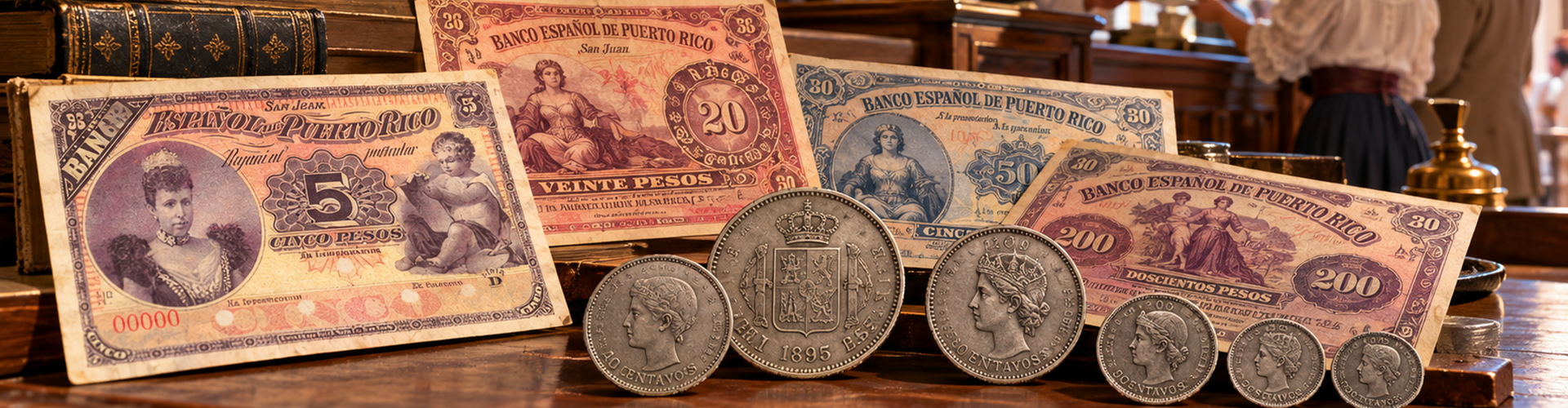
Puerto Rico's monetary history reflects centuries of political and economic change. Spanish coins circulated on the island during the colonial period, followed by Puerto Rico's own provincial currency in the late 19th century. After sovereignty changed from Spain to the United States in 1898, Puerto Rican currency was gradually replaced by the U.S. dollar.
From rare silver pesos bearing the image of King Alfonso XIII to early Puerto Rican banknotes, the coins and bills once used on the island offer a fascinating glimpse into Puerto Rico's history.
Puerto Rico's Currency Timeline
Spanish and other circulating coinage was used throughout Puerto Rico during the island's colonial period.
Puerto Rico received its own provincial silver coinage, denominated in pesos and centavos.
Spain ceded Puerto Rico to the United States following the Spanish-American War.
The U.S. dollar became Puerto Rico's official currency, replacing the Puerto Rican peso.
Puerto Rico uses the U.S. dollar (USD), the same currency used throughout the United States.
Puerto Rico's 1895 Provincial Coins
Beginning in the 17th century, the provincial currency (silver) minted in the Casa de Moneda de Madrid, in the denominations of 1 peso, 40 cents, 20 cents, 10 cents and 5 cents. These five denominations had a common design, with the figure of Alfonso XIII (1886 - 1931) boy by a side and the other the shield of Spain, with the real crown between the two columns of Hercules and the Puerto Rico inscription.
5 Centavos de Peso
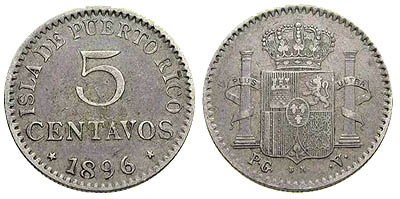
Units: 600.000 coins were minted in its first year of production, 1895 Puerto
Rico PG V
Material: Silver 835/1000
Weight: 1,25gr
Diameter: 16,5mm
10 Centavos de Peso
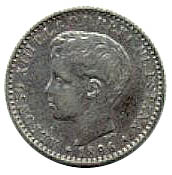
Units: 700,000 coins were minted in its first year of production, 1895 Puerto
Rico PG V
Material: Silver 835/1000
Weight: 2,5gr
Diameter: 18,5mm
20 Centavos de Peso
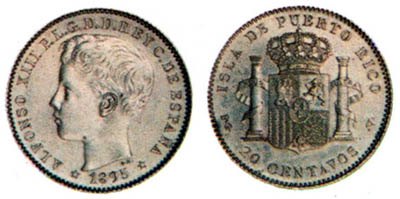
Units: 3.350.006 coins were minted in its first year of production, 1895 Puerto
Rico PG V
Material Silver 835/1000
Weight: 5gr
Diameter: 23,5mm
40 Centavos de Peso
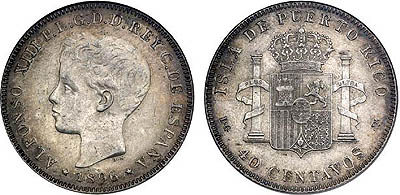
Units: 752.002 coins were minted in its first year of production, 1895 Puerto
Rico PG V
Material: Silver 835/1000
Weight: 10gr
Diameter: 31mm
Estimated Value $300-400
1 Peso
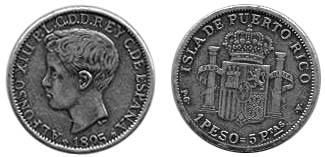
Units: 8.500.021 coins were minted in its first year of production, 1895 Puerto
Rico PG V
Material: Silver 900/1000
Weight: 25 gr
Diameter: 37,5mm
Did the Spanish Peso and Puerto Rican Peso Circulate Together?
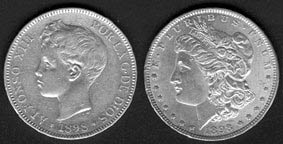
Spanish and American currencies of 1898
The one of Spain it was worth 5 pesetas and the American 1 dollar. From 1895-96 the Puerto Rican provincial peso was in circulation, but at the beginning of the 20th century an interchange took place, paying 60 cents of a dollar, which created a serious problem to investors, banks and the economy in general. The Puerto Rican currency had more value, in silver, that the one from the USA, but this one was endorsed in gold and the Puerto Rican only by its own weight in silver. In the end the Puerto Rican peso was fused to make the dollar of 1902.
Puerto Rico's Historic Banknotes
Banco Español de Puerto Rico
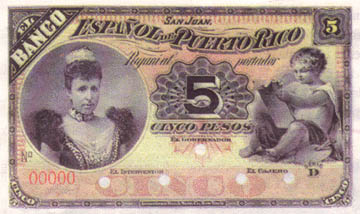
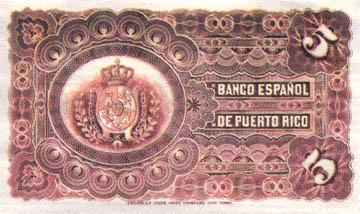
The Puerto Rican 5 pesos, series D, of the Spanish
Bank of Puerto Rico. The bank was founded on 1888, of private capital and it
had license from the Spanish government to issue notes during 25 years
(1888-1913). After the Spanish-American War the bank was renamed
Bank of Puerto Rico. The front shows the head of Queen Maria Cristina.
Bank of Porto Rico
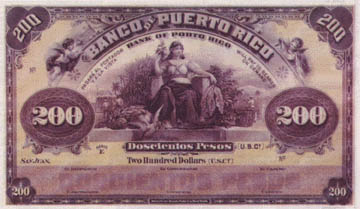
The Puerto Rican bilingual note of 200 pesos or dollars. This note
was issued by the Bank of Puerto Rico (Bank of Porto Rico)
just a short time after the cession of the Island.
The Treaty of Paris forced the United States to respect all licenses
or effective concessions, reason why the Bank of Puerto Rico, old
Spanish Bank of Puerto Rico, continued this operation
until its liquidation in 1913. In the beginning, the Bank of Puerto
Rico reprinted Spanish bills with red ink with the phrase
"American currency". The reprinted Spanish bills were those that
had the Paschal Lamb, instead of Queen Maria Cristina.
Why Puerto Rico Uses the U.S. Dollar Today
Puerto Rico uses the U.S. dollar (USD), just like the 50 states and other U.S. jurisdictions. Visitors from the mainland United States do not need to exchange currency when traveling to Puerto Rico.
What Puerto Ricans Call Their Money
- peso — commonly used for "dollar"
- peseta — 25 cents / a quarter
- vellon or ficha - commonly used for the nickel (5 cents)
- chavo — colloquial term associated with money or small change or 1 cent (chavito or perrita)
Coins Then & Now
| Historic Puerto Rican Currency | Currency Today |
|---|---|
| Peso | U.S. dollar |
| Centavos | Cents |
| Puerto Rican provincial coins | U.S. coins |
| Puerto Rican/Spanish-era banknotes | U.S. Federal Reserve notes |
Continue Exploring Puerto Rico
Glossary
mint: a place where coins, medals, or tokens are made
Sources
- De la Peseta al Euro: Camino Hacia la Unión
- Isla de Puerto Rico - 5 Centavos Peso, 1896
- Moneda y Numismatica en Puerto Rico
- Monedas de Alfonso XIII
- Puerto Rico 1890-1898
Did You Know?
The Cross of Burgundy still flies at El Morro and San Cristóbal as a reminder of Puerto Rico's Spanish military history.
Get Our Newsletter
Discover new places, local flavors, upcoming events, cultural stories, and some of our favorite finds from around the island.Read the Latest ¡La Isla! Newsletter
Follow Along


